
Introduction
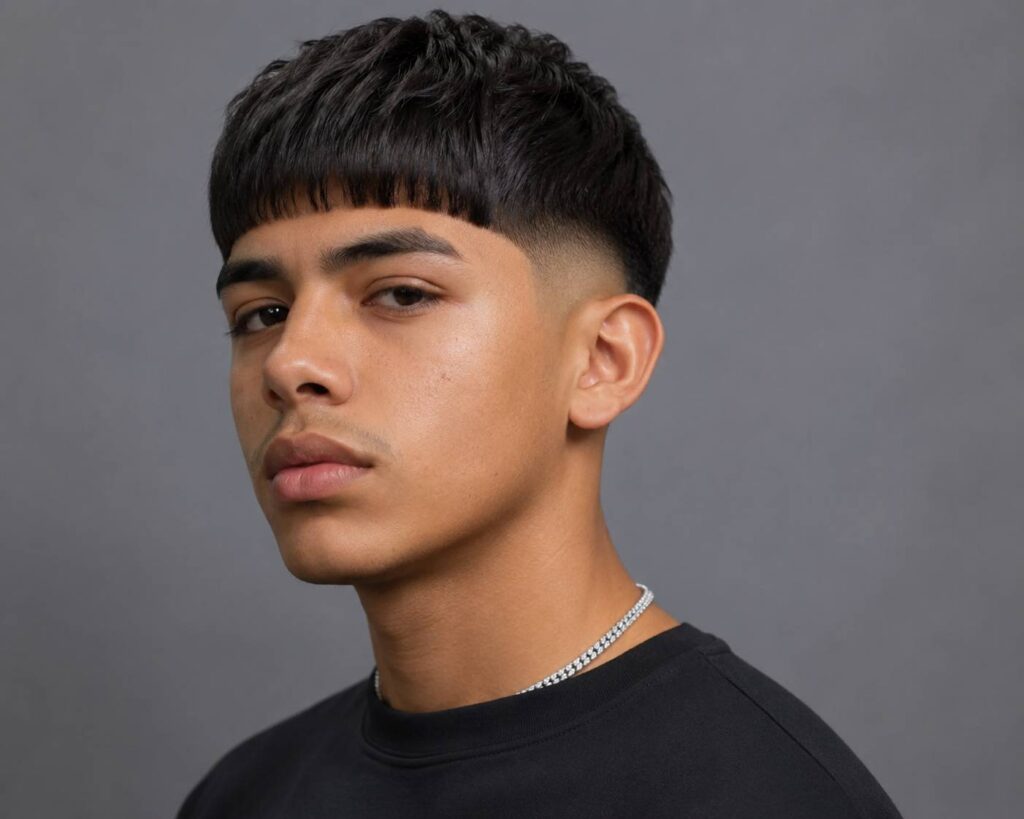
The Edgar haircut has become one of the most recognizable men’s hairstyles thanks to its clean fringe, sharp lines, and modern versatility. Once associated with a specific style trend, it has evolved into a family of haircuts that can be adapted for different face shapes, hair textures, and personal preferences. From subtle taper variations to bold skin fades, today’s Edgar haircut offers something for almost everyone.
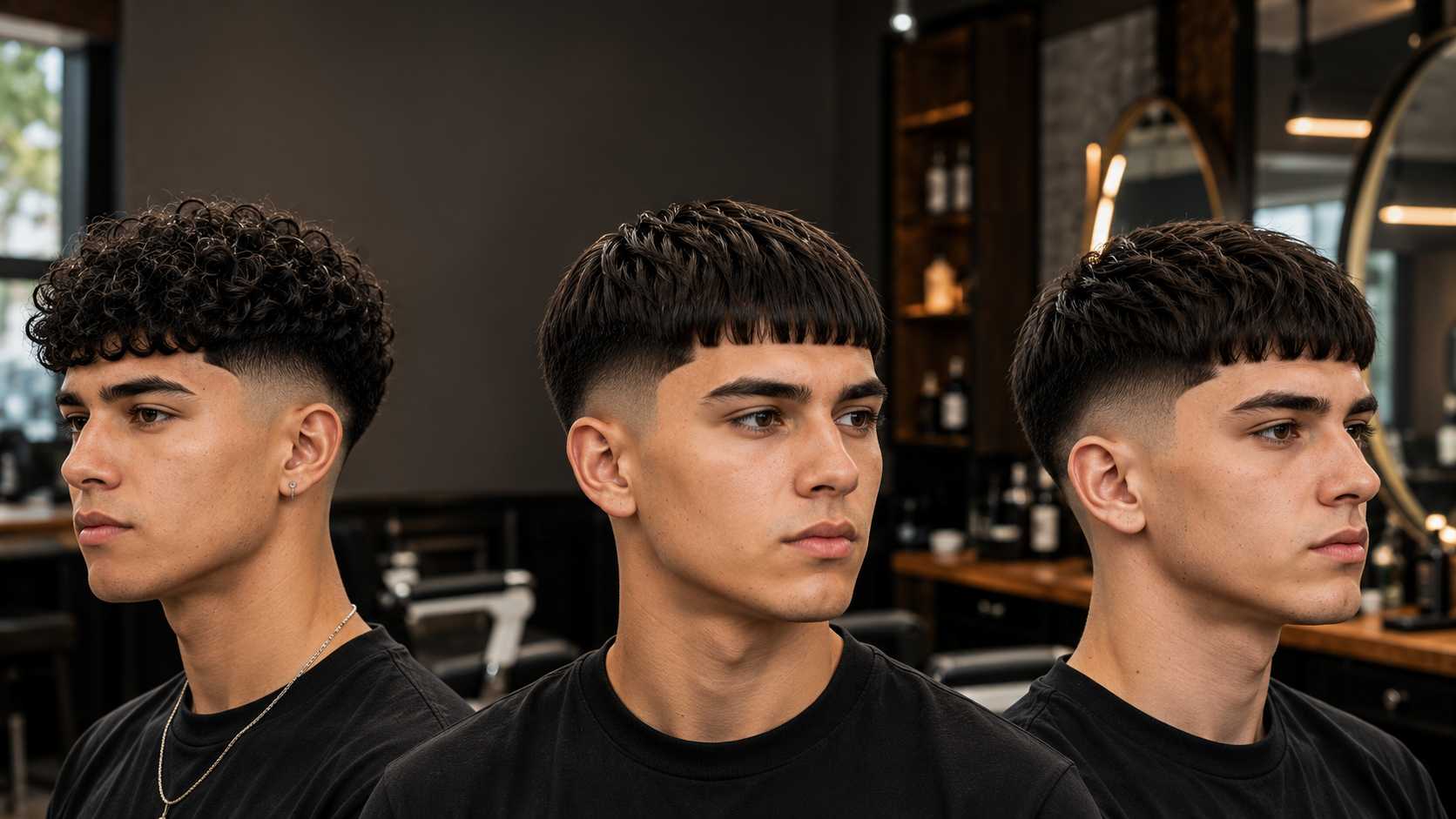
One reason for its lasting popularity is its flexibility. A classic Edgar creates a neat, structured appearance, while variations like the Low Taper Edgar, Curly Edgar, Fluffy Edgar, and Edgar Mullet allow you to personalize the look without losing its signature identity. Whether you’re after a professional style, a low-maintenance haircut, or a bold modern statement, there’s an Edgar variation designed to match your lifestyle.
In this comprehensive guide, you’ll learn what defines an Edgar haircut, explore its most popular variations, discover which styles work best for different face shapes and hair types, understand how to communicate your preferred look to your barber, and find practical tips for styling and maintenance. By the end, you’ll have the knowledge to confidently choose the Edgar haircut that suits you best.
Edgar Haircut at a Glance
| Feature | Details |
|---|---|
| Haircut Type | Modern men’s haircut |
| Hair Length | Short to medium |
| Signature Feature | Straight or slightly textured fringe with clean sides |
| Best For | Teenagers and adults seeking a structured, contemporary look |
| Hair Types | Straight, wavy, thick, and curly (with suitable variations) |
| Face Shapes | Oval, Square, Diamond, Round (with the right variation) |
| Styling Time | 5–10 minutes |
| Maintenance | Trim every 2–4 weeks |
| Difficulty | Easy to Moderate |
| Popular Variations | Classic, Low Taper, High Fade, Curly, Fluffy, Edgar Mullet |
What Is an Edgar Haircut?
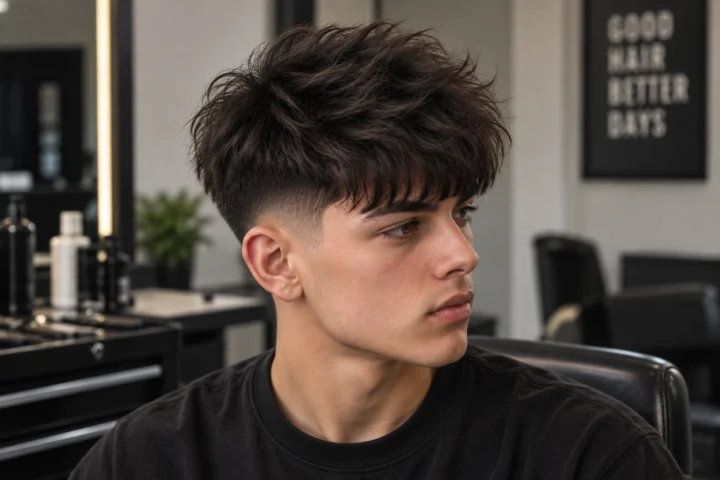
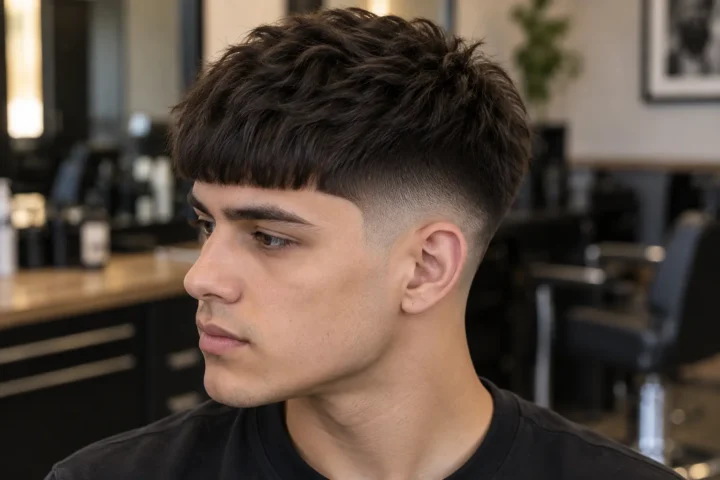
The Edgar haircut is a modern men’s hairstyle defined by a short, straight or slightly textured fringe paired with closely trimmed sides and back. Its clean outline creates a sharp, structured appearance while leaving enough room to customize the haircut with different fades, tapers, textures, and lengths.
Although many people think of the Edgar haircut as a single hairstyle, it’s better understood as a collection of related styles built around the same core design. The front fringe remains the defining feature, while the sides and top can be tailored to suit different hair types, face shapes, and personal preferences. This flexibility has contributed significantly to its popularity.
Unlike haircuts that rely on a single fixed template, the Edgar haircut adapts well to both subtle and bold looks. Someone who prefers a professional appearance may choose a Classic Edgar or Low Taper Edgar, while others may opt for a High Fade Edgar, Curly Edgar, or Fluffy Edgar for a more contemporary style.
The Three Signature Characteristics of an Edgar Haircut
1. Defined Fringe
The front fringe is the hallmark of the Edgar haircut. It is usually cut straight across or lightly textured, framing the forehead and giving the hairstyle its distinctive appearance.
2. Clean Sides and Back
Most Edgar haircuts incorporate a taper or fade on the sides and back. The height and intensity of the fade can vary, creating everything from understated everyday styles to bold, high-contrast looks.
3. Structured Top
The top of the hair can be kept neat and uniform or styled with additional texture and volume, depending on the chosen variation. This adaptability allows the haircut to complement different hair densities and styling preferences.
Why the Edgar Haircut Appeals to So Many Men
The Edgar haircut has remained popular because it balances style with practicality. It can be customized for different ages, professions, and hair types without losing its recognizable identity.
Some of its biggest advantages include:
| Benefit | Why It Matters |
|---|---|
| Highly Customizable | Multiple fade, taper, and texture options allow the haircut to suit different personal styles. |
| Modern Appearance | Clean lines and a defined fringe create a contemporary look. |
| Works with Various Hair Types | Straight, wavy, thick, and curly hair can all be adapted into Edgar variations. |
| Easy Daily Styling | Most versions require only a few minutes of styling with minimal product. |
| Suitable for Many Face Shapes | Choosing the right variation helps balance different facial features. |
| Strong Foundation for Other Styles | The Edgar haircut can evolve into taper, textured, mullet, or curly variations as hair grows. |
The History and Evolution of the Edgar Haircut
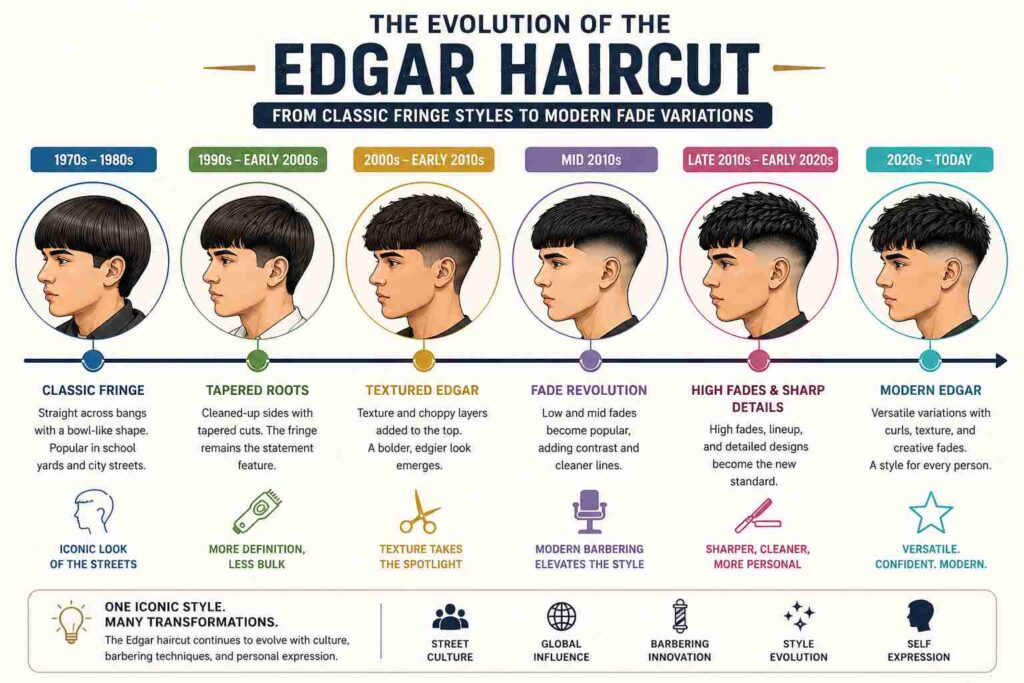
The Edgar haircut has grown from a niche style into one of the most recognizable men’s haircuts worldwide. While many people associate it with modern social media trends, its rise in popularity is the result of evolving barbering techniques, changing fashion preferences, and the influence of online culture.
Unlike classic hairstyles that have remained largely unchanged for decades, the Edgar haircut has continuously adapted. Today’s variations range from clean, professional looks to bold, textured styles, making it one of the most versatile haircuts available.
Modern barbering has evolved significantly over the history of haircuts, with hairstyle trends continually adapting to changes in fashion and grooming culture.
Where Did the Edgar Haircut Originate?
The exact origin of the Edgar haircut is difficult to pinpoint, but it is widely believed to have gained popularity within Latino communities in the United States, particularly among younger men who wanted a sharp, low-maintenance hairstyle with a distinctive identity.
The haircut combines a blunt fringe with closely trimmed sides, creating a bold contrast that immediately stands out. As barbers experimented with fades, tapers, and textured tops, the Edgar haircut evolved into multiple variations that appeal to different personal styles.
Rather than remaining tied to one cultural group, the hairstyle has expanded into mainstream barbering and is now requested by people from many different backgrounds.
Barber Insight
Many modern Edgar haircuts are customized to suit the client’s face shape, hair density, and styling routine. Two people asking for an “Edgar haircut” may leave with noticeably different results depending on their preferences.
How Social Media Helped Popularize the Edgar Haircut
Platforms such as TikTok, Instagram, and YouTube have played a major role in introducing the Edgar haircut to a wider audience. Hairstyle transformations, barber tutorials, and before-and-after videos have made it easier for people to discover new variations and communicate their preferred look to a barber.
Instead of searching for a generic short haircut, many users now search for specific versions, including:
- Classic Edgar Haircut
- Low Taper Edgar
- Curly Edgar
- Fluffy Edgar
- High Fade Edgar
- Edgar Mullet
This shift has transformed the Edgar haircut from a single hairstyle into a complete family of modern cuts.
Why the Edgar Haircut Continues to Evolve
Unlike hairstyles with rigid rules, the Edgar haircut is highly adaptable. Barbers can adjust almost every element of the cut, including:
- Fringe length
- Fade height
- Side profile
- Top texture
- Overall volume
- Hair length
This flexibility allows the haircut to stay relevant as fashion trends change.
For example, someone who prefers a subtle everyday look may choose a Low Taper Edgar, while someone wanting maximum contrast might opt for a High Fade Edgar. Those with naturally curly hair often benefit from a Curly Edgar, whereas thicker, straighter hair works well with a Classic Edgar or Textured Edgar.
History Timeline
| Period | Evolution of the Edgar Haircut |
|---|---|
| Early Popularity | Emerged as a distinctive short haircut with a blunt fringe. |
| Modern Barbering | Barbers introduced fades, tapers, and textured finishes. |
| Social Media Growth | Viral hairstyle videos increased worldwide recognition. |
| Current Trends | Multiple personalized Edgar variations suit different hair types and lifestyles. |
Why Is the Edgar Haircut So Popular?
Few modern hairstyles have remained as consistently popular as the Edgar haircut. Its success isn’t based on a single trend—it’s the combination of practicality, versatility, and a clean, contemporary appearance that continues to attract people of different ages and hair types.
Whether you’re looking for a sharp professional haircut, an easy-to-maintain everyday style, or a bold modern look, there’s an Edgar variation that can match your goals.
It Offers Exceptional Versatility
One of the biggest strengths of the Edgar haircut is that it isn’t limited to a single design.
You can customize:
- Fade type
- Hair length
- Fringe style
- Texture
- Volume
- Side profile
This allows the haircut to complement different personalities and lifestyles without losing its signature appearance.
It Works with Multiple Hair Types
Unlike some hairstyles that only suit straight hair, the Edgar haircut can be adapted for:
- Straight hair
- Thick hair
- Wavy hair
- Curly hair
- Dense textured hair
Each hair type benefits from different techniques, which is why dedicated variations have become increasingly popular.
Daily Styling Is Simple
Many Edgar variations require only a few minutes of styling each morning.
Most people only need:
- A quality matte clay or styling cream
- A comb or fingers for texture
- Occasional blow-drying for added volume
This makes the haircut suitable for students, professionals, and anyone who prefers a stylish look without an extensive grooming routine.
It Can Be Personalized for Different Face Shapes
Choosing the right Edgar variation can enhance facial proportions.
For example:
| Face Shape | Recommended Edgar Style | Why It Works |
|---|---|---|
| Oval | Classic Edgar | Naturally balanced proportions complement clean lines. |
| Round | High Fade Edgar | Creates more height and visual definition. |
| Square | Low Taper Edgar | Highlights a strong jawline while maintaining balance. |
| Diamond | Curly Edgar | Adds width and softens angular features. |
| Heart | Textured Edgar | Creates a more balanced appearance around the forehead. |
It’s Suitable for Different Age Groups
Although the Edgar haircut is especially popular among teenagers and young adults, many of its modern variations can be adapted for older men as well.
A softer taper or textured finish creates a polished appearance that works in professional settings, while bolder fade combinations appeal to those who prefer a more fashion-forward style.
Why People Choose an Edgar Haircut
| Benefit | Explanation |
|---|---|
| Modern Appearance | Sharp lines create a clean, contemporary style. |
| Easy Maintenance | Regular trims keep the haircut looking fresh with minimal effort. |
| Highly Customizable | Fade, taper, fringe, and texture can all be tailored to individual preferences. |
| Suitable for Multiple Hair Types | Works well with straight, wavy, thick, and curly hair when adapted correctly. |
| Versatile Styling | Can be worn neatly for professional environments or textured for a more casual look. |
| Wide Range of Variations | From Classic Edgar to Edgar Mullet, there is a version for almost every style preference. |
Barber Tip
Don’t ask your barber for just an “Edgar haircut.” Bring a reference photo or specify the exact variation—such as a Classic Edgar, Low Taper Edgar, or Curly Edgar. This makes it much easier for your barber to understand the look you’re aiming for and tailor it to your hair type and face shape.
Popular Edgar Haircut Styles
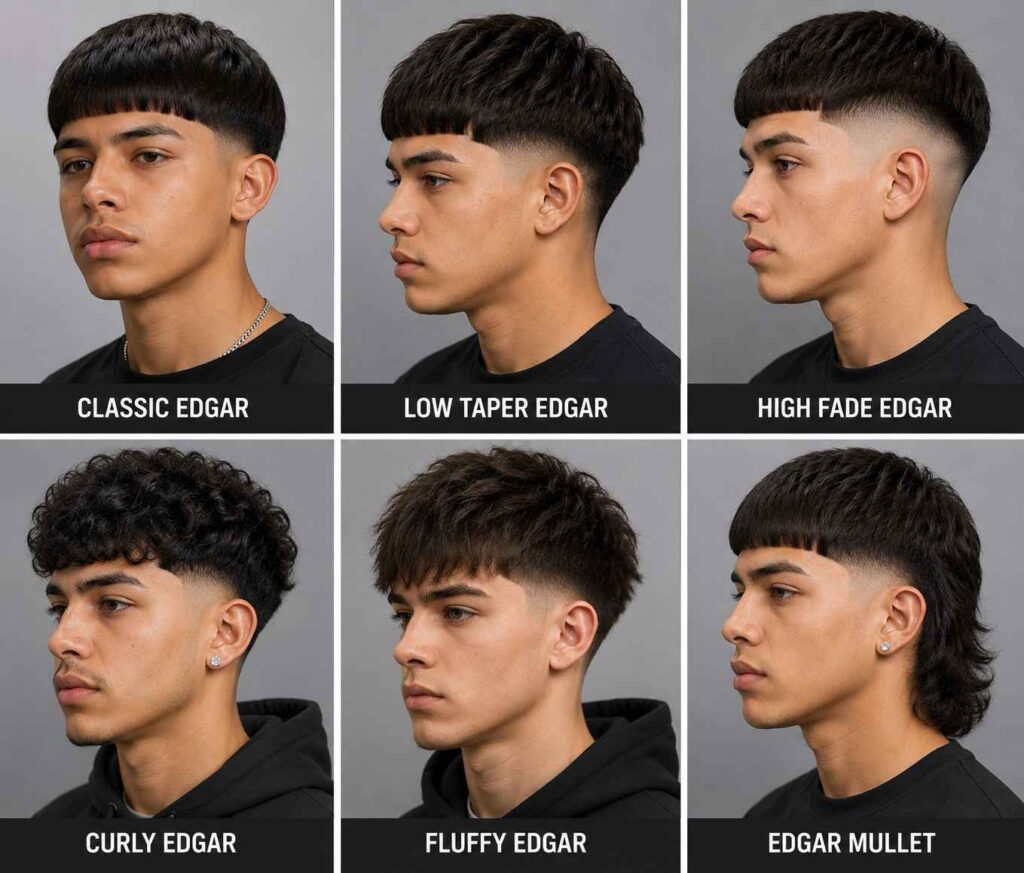
One of the biggest reasons for the Edgar haircut’s lasting popularity is its versatility. While the signature blunt fringe remains the defining feature, barbers can customize the fade, taper, texture, length, and overall shape to create styles that suit different personalities, hair types, and lifestyles.
Whether you’re looking for a clean professional haircut, a trendy textured style, or a bold modern fade, there’s an Edgar haircut variation designed for your needs.
Below are the most popular Edgar haircut styles and what makes each one unique.
Classic Edgar Haircut
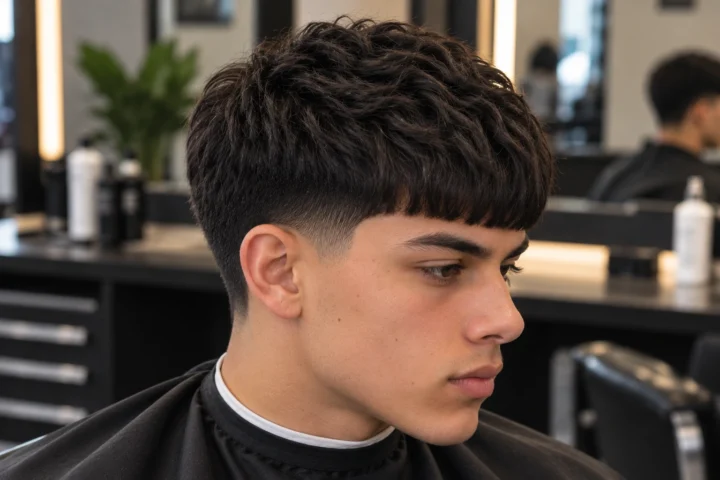
The Classic Edgar Haircut is the foundation of all Edgar variations. It features a clean, straight fringe, evenly blended sides, and a neatly trimmed top that creates a balanced, structured appearance.
Unlike trend-driven versions with dramatic fades or heavy texture, the Classic Edgar focuses on simplicity and precision. This makes it a great choice for students, professionals, and anyone who prefers a timeless hairstyle that remains easy to style and maintain.
It works particularly well with straight, thick, and slightly wavy hair because these hair types naturally hold the haircut’s defined shape.
Best For
- Straight hair
- Thick hair
- Oval face
- Square face
- Everyday professional styling
| Feature | Classic Edgar |
|---|---|
| Styling Difficulty | Easy |
| Maintenance | Moderate |
| Best Hair Type | Straight, Thick |
| Best Face Shape | Oval, Square |
| Styling Time | 5 Minutes |
Related Guide: Classic Edgar Haircut
Low Taper Edgar Haircut
The Low Taper Edgar softens the overall appearance by keeping the fade lower around the ears and neckline. Instead of creating dramatic contrast, it blends gradually into the top, producing a cleaner and more versatile finish.
Because the fade is subtle, this variation transitions easily between casual and professional environments. It also grows out more naturally than higher fades, making it a practical choice for people who don’t visit the barber every couple of weeks.
Best For
- Office professionals
- First-time Edgar haircut wearers
- Thick or straight hair
- Low-maintenance grooming routines
| Feature | Low Taper Edgar |
|---|---|
| Styling Difficulty | Easy |
| Maintenance | Low |
| Fade Type | Low Taper |
| Professional Appearance | Excellent |
| Styling Time | 3–5 Minutes |
Related Guide: Low Taper Edgar Haircut
High Fade Edgar Haircut
The High Fade Edgar creates the strongest visual contrast of all Edgar styles. The fade begins much higher on the sides, making the top appear fuller while emphasizing the sharp fringe.
This variation delivers a bold, modern look that highlights facial features and works particularly well for men with thicker hair.
Although it requires more frequent trims to maintain its crisp appearance, many people choose it because of its clean finish and contemporary style.
Best For
- Thick hair
- Round face shapes
- Fashion-forward styling
- High-contrast haircuts
| Feature | High Fade Edgar |
|---|---|
| Styling Difficulty | Moderate |
| Maintenance | High |
| Fade Height | High |
| Contrast | Very High |
| Styling Time | 5–8 Minutes |
Related Guide: High Fade Edgar Haircut
Curly Edgar Haircut
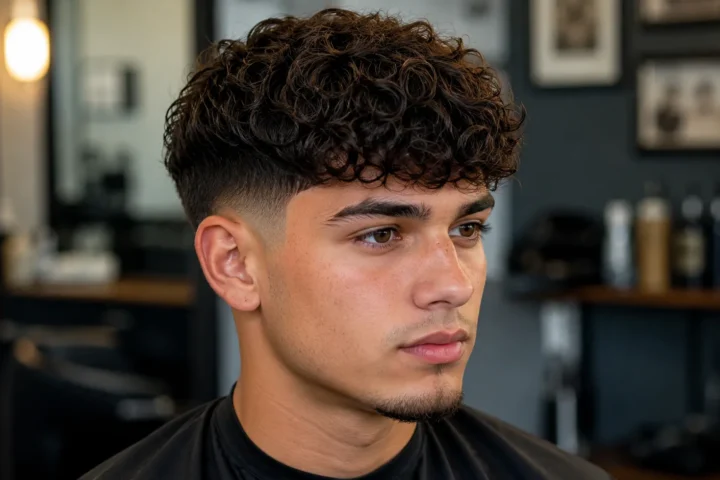
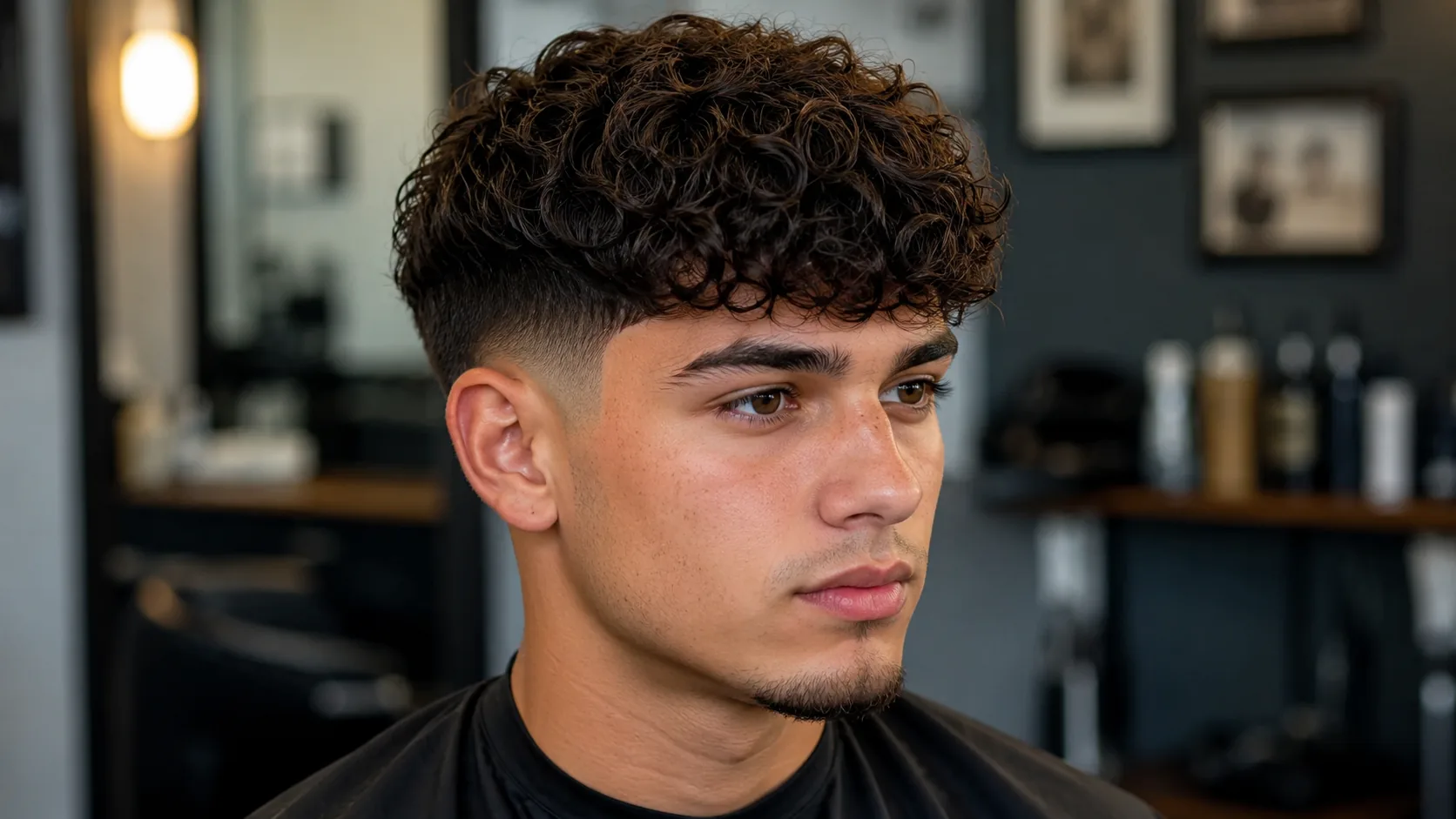
The Curly Edgar Haircut embraces natural curls while maintaining the haircut’s signature fringe and clean silhouette. Instead of forcing curly hair into a straight structure, this variation uses texture as one of its defining features.
The curls add volume, movement, and personality while the faded sides keep the overall haircut clean and manageable.
For men with naturally curly hair, this variation often requires less daily styling because the hair’s natural texture creates much of the finished look.
Best For
- Naturally curly hair
- Thick curls
- Medium-density hair
- Textured hairstyles
| Feature | Curly Edgar |
|---|---|
| Styling Difficulty | Easy |
| Maintenance | Moderate |
| Hair Type | Curly |
| Volume | High |
| Texture | Natural |
Related Guide: Curly Edgar Haircut
Fluffy Edgar Haircut
The Fluffy Edgar Haircut combines the structured front fringe of a traditional Edgar with added volume and soft texture across the top. The result is a more relaxed appearance that feels less rigid while maintaining the haircut’s recognizable identity.
This style has become especially popular among younger men because it creates movement without appearing overly formal.
Blow-drying and lightweight styling products often help achieve the desired fluffy effect.
Best For
- Fine to medium hair
- Wavy hair
- Teenagers and young adults
- Casual modern styling
| Feature | Fluffy Edgar |
|---|---|
| Styling Difficulty | Moderate |
| Maintenance | Moderate |
| Volume | High |
| Texture | Soft |
| Styling Time | 8–10 Minutes |
Related Guide: Fluffy Edgar Haircut
Edgar Mullet Haircut
The Edgar Mullet combines the sharp front fringe of an Edgar haircut with the extended length of a mullet at the back. This bold variation appeals to people who want a hairstyle that stands out while still incorporating the clean lines associated with modern barbering.
The contrast between the structured front and longer back creates a distinctive look that has gained popularity through social media and contemporary fashion.
Best For
- Trend-focused individuals
- Thick hair
- Creative personal styles
- Medium to long hair lengths
| Feature | Edgar Mullet |
|---|---|
| Styling Difficulty | Moderate |
| Maintenance | Moderate |
| Hair Length | Medium |
| Boldness | Very High |
| Styling Time | 8 Minutes |
Related Guide: Edgar Mullet Haircut
Which Edgar Haircut Should You Choose?
Choosing the right Edgar haircut depends on more than appearance. Your face shape, hair type, styling routine, and maintenance preferences all influence which variation will suit you best.
The table below provides a quick comparison of the most popular Edgar haircut styles.
| Edgar Style | Best Hair Type | Best Face Shape | Maintenance | Professional Friendly |
|---|---|---|---|---|
| Classic Edgar | Straight, Thick | Oval, Square | ⭐⭐⭐ | ✅ Yes |
| Low Taper Edgar | Straight, Wavy | Oval, Square, Diamond | ⭐⭐ | ✅ Excellent |
| High Fade Edgar | Thick, Straight | Round, Oval | ⭐⭐⭐⭐ | ✅ Yes |
| Curly Edgar | Curly | Oval, Diamond | ⭐⭐⭐ | ✅ Yes |
| Fluffy Edgar | Fine, Wavy | Oval, Heart | ⭐⭐⭐ | ✅ Yes |
| Edgar Mullet | Thick | Oval, Square | ⭐⭐⭐ | ⚠ Depends on workplace |
Barber Tip
If you’re trying an Edgar haircut for the first time, start with a Classic Edgar or Low Taper Edgar. Both styles are versatile, easier to maintain, and provide a solid foundation if you later decide to experiment with bolder variations like the High Fade Edgar or Edgar Mullet.
How to Choose the Right Edgar Haircut for You
Choosing the right Edgar haircut isn’t simply about following the latest trend. The best version is one that complements your face shape, hair type, daily styling routine, and personal lifestyle. A haircut that looks great on one person may not produce the same result on someone with different facial features or hair texture.
Instead of asking, “Which Edgar haircut is the most popular?”, a better question is, “Which Edgar haircut suits me best?”
The following factors will help you make the right choice before your next barber appointment.
Consider Your Face Shape First
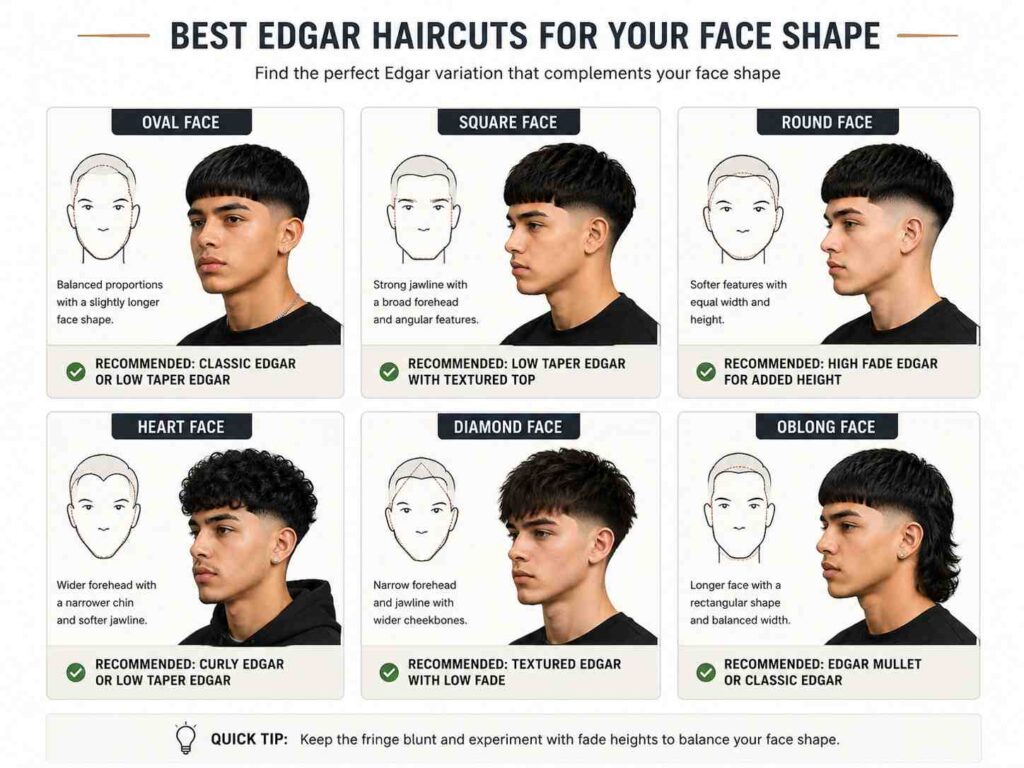
Your face shape has a significant impact on how an Edgar haircut will look. The goal isn’t to change your natural features but to create visual balance and highlight your strongest characteristics.
Some Edgar variations add height, while others soften sharp angles or reduce the appearance of width.
Face Shape Compatibility Table
| Face Shape | Recommended Edgar Style | Suitability | Why It Works |
|---|---|---|---|
| Oval | Classic Edgar, Low Taper Edgar | ⭐⭐⭐⭐⭐ | Naturally balanced face shape that suits almost every variation. |
| Round | High Fade Edgar, Textured Edgar | ⭐⭐⭐⭐☆ | Adds height and creates a longer facial appearance. |
| Square | Classic Edgar, Low Taper Edgar | ⭐⭐⭐⭐⭐ | Enhances strong jawlines without overwhelming facial proportions. |
| Heart | Fluffy Edgar, Textured Edgar | ⭐⭐⭐⭐☆ | Softens the forehead and adds balance to the lower face. |
| Diamond | Curly Edgar, Low Taper Edgar | ⭐⭐⭐⭐⭐ | Adds width around the forehead while maintaining overall symmetry. |
| Long/Oblong | Classic Edgar with Moderate Fringe | ⭐⭐⭐⭐☆ | A fuller fringe can help reduce the appearance of facial length. |
Match the Haircut to Your Hair Type
Hair texture influences how an Edgar haircut sits naturally and how much styling is required. Fortunately, one of the strengths of the Edgar haircut is that it can be adapted to a wide range of hair types.
Hair Type Compatibility Table
| Hair Type | Recommended Style | Suitability | Styling Notes |
|---|---|---|---|
| Straight Hair | Classic Edgar | ⭐⭐⭐⭐⭐ | Creates crisp lines and a structured appearance. |
| Thick Hair | Low Taper Edgar, High Fade Edgar | ⭐⭐⭐⭐⭐ | Holds shape well and provides excellent volume. |
| Wavy Hair | Textured Edgar, Fluffy Edgar | ⭐⭐⭐⭐☆ | Natural movement enhances texture. |
| Curly Hair | Curly Edgar | ⭐⭐⭐⭐⭐ | Embraces natural curls while maintaining the Edgar silhouette. |
| Fine Hair | Fluffy Edgar | ⭐⭐⭐⭐☆ | Use lightweight volumizing products for a fuller appearance. |
Think About Your Lifestyle
A great haircut should fit your routine—not the other way around.
Ask yourself:
- How often can I visit the barber?
- Do I enjoy styling my hair each morning?
- Does my workplace or school have grooming expectations?
- Do I prefer a clean, polished look or a more relaxed style?
If you want something simple and professional, a Classic Edgar or Low Taper Edgar is usually the better choice. If you enjoy experimenting with hairstyles and don’t mind more frequent maintenance, options like the High Fade Edgar or Edgar Mullet may be a better fit.
Lifestyle Recommendation Table
| Lifestyle | Recommended Edgar Style | Maintenance Level |
|---|---|---|
| Student | Classic Edgar | Moderate |
| Office Professional | Low Taper Edgar | Low |
| Athlete | High Fade Edgar | Moderate |
| Creative Professional | Fluffy Edgar | Moderate |
| Fashion Enthusiast | Edgar Mullet | High |
Consider Your Maintenance Commitment
Every Edgar haircut requires some level of upkeep, but not all styles demand the same amount of maintenance.
Before choosing a variation, think about how much time and effort you’re willing to invest in keeping it looking sharp.
Maintenance Comparison
| Edgar Style | Barber Visits | Daily Styling | Overall Maintenance |
|---|---|---|---|
| Classic Edgar | Every 3–4 Weeks | Low | ⭐⭐⭐☆☆ |
| Low Taper Edgar | Every 4 Weeks | Low | ⭐⭐☆☆☆ |
| High Fade Edgar | Every 2–3 Weeks | Moderate | ⭐⭐⭐⭐☆ |
| Curly Edgar | Every 3–4 Weeks | Moderate | ⭐⭐⭐☆☆ |
| Fluffy Edgar | Every 3 Weeks | Moderate | ⭐⭐⭐☆☆ |
| Edgar Mullet | Every 3–4 Weeks | Moderate | ⭐⭐⭐⭐☆ |
Quick Decision Guide
If you’re still unsure which Edgar haircut is right for you, use this simple guide:
| If You Want… | Choose… |
|---|---|
| A timeless everyday haircut | Classic Edgar |
| A subtle, office-friendly look | Low Taper Edgar |
| Maximum contrast and definition | High Fade Edgar |
| A style that embraces natural curls | Curly Edgar |
| Volume and movement | Fluffy Edgar |
| A bold, fashion-forward haircut | Edgar Mullet |
Barber Tip
Don’t choose a haircut based only on a celebrity or social media photo. The best Edgar haircut is the one that suits your face shape, hair texture, and lifestyle. A skilled barber can adapt the same style to fit your individual features while preserving the look you like.
Common Mistake
Many people request a specific Edgar variation without considering whether it complements their hair type or face shape. This often leads to disappointing results. Always discuss your hair’s natural texture, growth pattern, and maintenance expectations with your barber before deciding on the final style.
How to Ask Your Barber for an Edgar Haircut
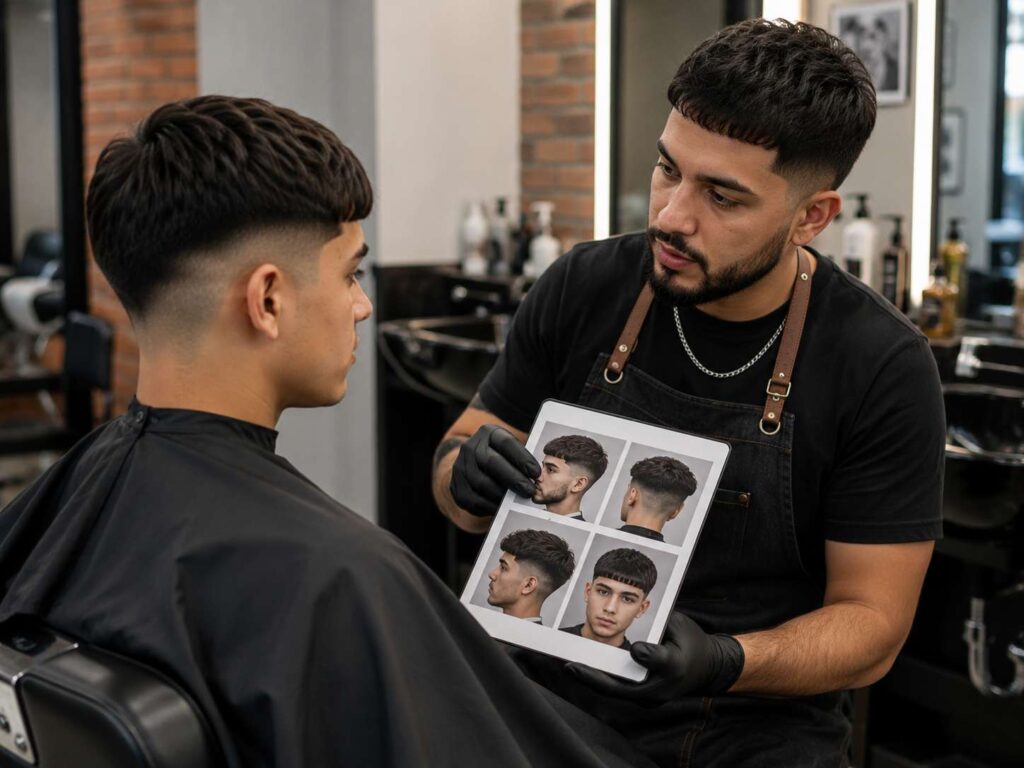
Walking into a barbershop and asking for an “Edgar haircut” may not always give you the result you expect. The Edgar haircut is no longer a single style—it includes numerous variations with different fades, fringe lengths, textures, and top lengths.
The more clearly you communicate your preferences, the more likely you’ll leave the barbershop with a haircut that suits your face shape, hair type, and lifestyle.
Instead of relying on the haircut’s name alone, explain the key details that define your preferred version.
Start by Choosing the Right Edgar Variation
Before booking your haircut, decide which Edgar style best matches your goals.
Ask yourself:
- Do I want a subtle or bold look?
- Should the fade be low, mid, or high?
- Do I prefer a clean or textured finish?
- Will I style my hair every morning?
- How often can I get a haircut?
Quick Selection Guide
| If You Want… | Ask for… |
|---|---|
| A timeless everyday style | Classic Edgar |
| A professional appearance | Low Taper Edgar |
| Maximum contrast | High Fade Edgar |
| Natural curls | Curly Edgar |
| Extra volume | Fluffy Edgar |
| A bold modern style | Edgar Mullet |
Explain the Four Main Parts of the Haircut
A barber doesn’t just cut “an Edgar.” They make decisions about several different elements of the haircut.
Discuss each of these areas before the haircut begins.
1. The Fringe
The fringe is the defining feature of every Edgar haircut.
Tell your barber whether you prefer:
- A straight fringe
- A lightly textured fringe
- A softer natural edge
- A shorter or longer fringe
2. The Fade or Taper
Choose how dramatic you want the transition on the sides.
| Fade Type | Appearance | Maintenance |
|---|---|---|
| Low Taper | Soft and subtle | Low |
| Mid Fade | Balanced contrast | Moderate |
| High Fade | Sharp and modern | High |
| Skin Fade | Maximum contrast | High |
3. The Top Length
The top section determines how much styling flexibility you’ll have.
You might prefer:
- Short and structured
- Medium with texture
- Longer for volume
- Natural curls
- Layered finish
4. The Texture
Texture changes the overall personality of the haircut.
Examples include:
- Smooth and clean
- Natural texture
- Messy finish
- Fluffy volume
- Defined curls
Show a Reference Photo
Even experienced barbers may interpret hairstyle names differently.
Bringing one or two clear reference photos helps eliminate confusion and ensures you’re both working toward the same result.
Choose photos that show:
- Front view
- Side profile
- Back view (if available)
- Similar hair texture to your own
Pro Tip: Save multiple photos of the same haircut from different angles. This gives your barber a better understanding of the overall style rather than relying on a single image.
Tell Your Barber About Your Hair
Your natural hair plays a major role in how an Edgar haircut will look.
Mention if your hair is:
- Thick
- Fine
- Straight
- Wavy
- Curly
- Coarse
- Difficult to style
This information helps your barber recommend adjustments that improve the final result.
Discuss Your Daily Routine
An Edgar haircut should fit your lifestyle.
Tell your barber:
- How much time you spend styling your hair
- Whether you use styling products
- How often you get haircuts
- Whether you prefer a low-maintenance style
A barber can adjust the fade, fringe, or top length to better suit your routine.
Edgar Haircut Communication Checklist
Before your haircut begins, make sure you’ve discussed the following:
| Haircut Detail | Why It Matters |
|---|---|
| Edgar variation | Establishes the overall style. |
| Fringe length | Defines the haircut’s signature appearance. |
| Fade or taper | Controls contrast and maintenance. |
| Top length | Affects styling flexibility. |
| Hair texture | Influences layering and finishing techniques. |
| Styling preference | Helps create a haircut that fits your routine. |
| Reference photos | Reduces misunderstandings. |
Questions Your Barber May Ask
A professional barber will often ask a few follow-up questions before starting.
Be prepared to answer questions like:
- How short do you want the sides?
- Do you prefer a taper or a fade?
- How much length do you want on top?
- Will you style your hair every day?
- Are you growing your hair out?
- How often do you usually get a haircut?
These questions help your barber personalize the haircut rather than simply copying a photo.
Common Mistakes When Asking for an Edgar Haircut
Many disappointing haircuts happen because of poor communication rather than poor cutting.
Avoid these common mistakes:
❌ Only saying “Give me an Edgar.”
There are many Edgar variations, and each one looks different.
❌ Choosing the Wrong Fade
A high fade creates a very different appearance than a low taper.
❌ Ignoring Hair Texture
Not every Edgar style works equally well with every hair type.
❌ Copying Someone With a Different Face Shape
A haircut that suits one person may need adjustments to flatter another face shape.
❌ Not Discussing Maintenance
Some Edgar styles require barber visits every two to three weeks, while others grow out more naturally.
Barber Tip
A great barber won’t simply copy a photo—they’ll adapt the haircut to suit your hair growth patterns, head shape, hair density, and lifestyle. Be open to their suggestions, especially if they recommend small modifications that improve the final result.
Common Mistake
Avoid using heavily filtered or AI-generated hairstyle photos as your only reference. Instead, choose clear, realistic images that accurately show the haircut’s fringe, fade, and texture. This gives your barber a much better idea of what you’re trying to achieve.
Find Your Ideal Edgar Haircut
Not every Edgar haircut is the right fit for every person. The best style depends on a combination of your face shape, hair type, maintenance preferences, and personal style.
Instead of choosing a haircut simply because it’s trending, use the guide below to identify the variation that best matches your features and lifestyle.
Think of this section as your starting point before exploring the individual Edgar haircut guides.
Choose Based on Your Face Shape
Your face shape plays a major role in determining which Edgar haircut will create the most balanced appearance.
| Face Shape | Best Edgar Haircut | Alternative Option | Why It Works |
|---|---|---|---|
| Oval | Classic Edgar | Low Taper Edgar | Balanced facial proportions suit nearly every variation. |
| Round | High Fade Edgar | Textured Edgar | Creates height and reduces facial width. |
| Square | Classic Edgar | Low Taper Edgar | Complements strong jawlines and angular features. |
| Heart | Fluffy Edgar | Textured Edgar | Softens a wider forehead while adding movement. |
| Diamond | Curly Edgar | Low Taper Edgar | Adds balance around the forehead and temples. |
| Long (Oblong) | Classic Edgar | Curly Edgar | A fuller fringe can help reduce the appearance of facial length. |
Editor’s Note: Face shape is only one factor. Hair texture and lifestyle are equally important when choosing the right variation.
Choose Based on Your Hair Type
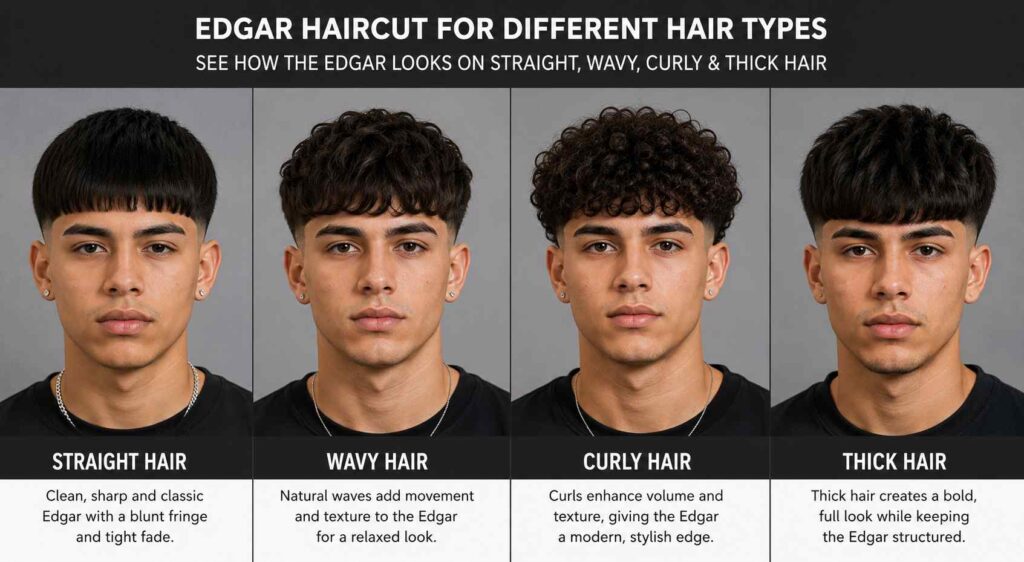
Different hair textures respond differently to the Edgar haircut. While almost every hair type can wear an Edgar, some variations are easier to maintain than others.
| Hair Type | Recommended Style | Difficulty | Daily Styling |
|---|---|---|---|
| Straight | Classic Edgar | Easy | Low |
| Thick | Low Taper Edgar | Easy | Low |
| Wavy | Textured Edgar | Moderate | Medium |
| Curly | Curly Edgar | Moderate | Low |
| Fine | Fluffy Edgar | Moderate | Medium |
Choose Based on Your Lifestyle
A haircut should complement your daily routine. Consider how much time you’re willing to spend styling your hair and how often you can visit the barber.
| Your Lifestyle | Recommended Style | Why |
|---|---|---|
| Student | Classic Edgar | Easy to maintain and suitable for everyday wear. |
| Office Professional | Low Taper Edgar | Clean, polished, and workplace friendly. |
| Active Lifestyle | High Fade Edgar | Stays neat during sports and outdoor activities. |
| Fashion Enthusiast | Edgar Mullet | Bold, expressive, and trend-forward. |
| Minimal Styling | Classic Edgar | Requires little daily effort. |
Choose Based on Maintenance
Some Edgar haircuts need more frequent touch-ups than others.
| Maintenance Preference | Best Option |
|---|---|
| Very Low | Low Taper Edgar |
| Low | Classic Edgar |
| Moderate | Curly Edgar |
| Moderate | Fluffy Edgar |
| High | High Fade Edgar |
| High | Edgar Mullet |
Edgar Haircut Decision Matrix
If you’re still undecided, this quick reference can help.
| If You Want… | Recommended Edgar Style |
|---|---|
| A timeless haircut | Classic Edgar |
| A clean professional appearance | Low Taper Edgar |
| A bold modern style | High Fade Edgar |
| A haircut that embraces curls | Curly Edgar |
| Extra volume and movement | Fluffy Edgar |
| Something unique and eye-catching | Edgar Mullet |
Quick Recommendation
New to Edgar haircuts?
Start with either the Classic Edgar or Low Taper Edgar.
These two styles:
- Suit the widest range of face shapes.
- Work with most hair types.
- Require relatively little styling.
- Grow out neatly between barber visits.
- Can easily be adapted into other Edgar variations later.
Barber Tip
If you’re uncertain, ask your barber which Edgar variation complements your natural hair growth pattern, not just your face shape. Hair density, cowlicks, and growth direction often influence the final result more than people realize.
Common Mistake
Choosing the same Edgar haircut as a friend or influencer without considering your own hair texture and facial features can lead to disappointing results. Use inspiration photos as a starting point, but personalize the haircut with your barber.
How to Style an Edgar Haircut
One of the biggest advantages of the Edgar haircut is that it doesn’t require an elaborate styling routine. Whether you’ve chosen a Classic Edgar, Low Taper Edgar, or Curly Edgar, the goal is to enhance the haircut’s natural shape rather than completely reshape your hair every morning.
The amount of styling required depends on your hair type, the variation you’ve chosen, and the finish you prefer. Some styles look best with a natural matte texture, while others benefit from added volume or definition.
The good news is that most Edgar haircuts can be styled in less than 10 minutes using just a few basic tools and products.
Essential Styling Tools
Before you begin, keep these basic grooming tools on hand.
| Tool | Purpose | Essential? |
|---|---|---|
| Blow Dryer | Adds volume and helps direct hair | ✅ Yes |
| Wide-Tooth Comb | Detangles damp hair without pulling | ✅ Yes |
| Styling Comb | Shapes the fringe and creates clean lines | ⭐ Recommended |
| Hair Brush | Smooths thicker or longer hair | ⭐ Recommended |
| Microfiber Towel | Removes excess moisture gently | ✅ Yes |
Basic Styling Routine
Most Edgar haircut variations follow the same general styling process.
Step 1: Start with Clean, Damp Hair
Wash your hair if needed and gently towel dry it until it’s slightly damp.
Avoid styling soaking wet hair, as products won’t distribute evenly.
Step 2: Blow Dry in the Desired Direction
Use a blow dryer on medium heat while directing the hair into its natural shape.
Depending on the style:
- Blow forward for a Classic Edgar.
- Lift the roots slightly for a Fluffy Edgar.
- Diffuse curls for a Curly Edgar.
- Add texture with your fingers for a Textured Edgar.
Step 3: Apply a Small Amount of Product
Start with a pea-sized amount of product.
It’s always easier to add more than remove excess product.
Rub it between your palms before applying evenly throughout the hair.
Step 4: Shape the Fringe
The fringe is the defining characteristic of the Edgar haircut.
Use your fingers or a comb to create:
- Straight finish
- Slight texture
- Soft natural movement
- Controlled volume
Choose the finish that best matches your chosen variation.
Step 5: Final Adjustments
Check the haircut from multiple angles.
Smooth flyways if necessary and avoid overworking the hair once it’s in place.
Best Styling Products for an Edgar Haircut
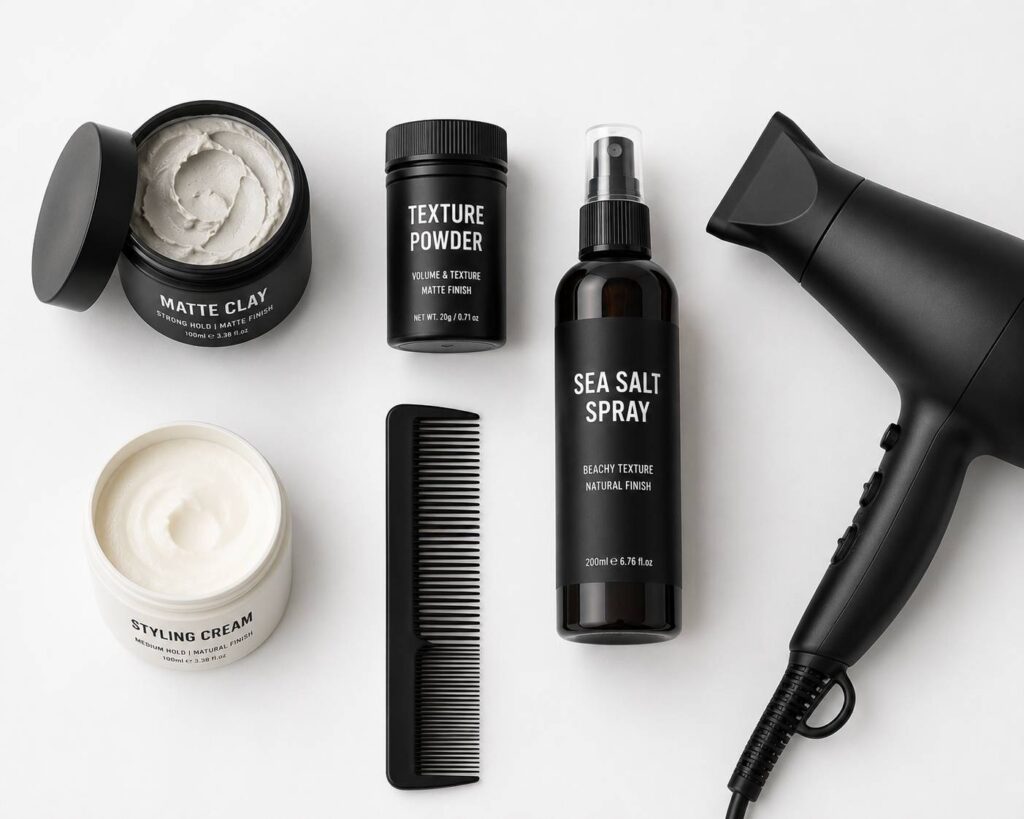
Different products produce different finishes. Choosing the right one depends on your desired look and hair type.
| Product Type | Best For | Finish | Hold |
|---|---|---|---|
| Matte Clay | Classic Edgar | Natural Matte | Strong |
| Texture Paste | Textured Edgar | Natural Texture | Medium |
| Sea Salt Spray | Fluffy Edgar | Volume & Movement | Light |
| Styling Cream | Low Taper Edgar | Soft Natural Finish | Light |
| Curl Cream | Curly Edgar | Curl Definition | Medium |
| Texture Powder | Fine Hair | Extra Volume | Light |
Editor’s Recommendation: If you’re buying just one product, start with a quality matte clay. It’s versatile enough for most Edgar haircut variations and provides a natural finish without excessive shine.
Styling Tips for Different Hair Types
Every hair type responds differently to styling products and techniques.
Straight Hair
- Matte clay works best.
- Blow dry forward for clean definition.
- Avoid heavy pomades that flatten the hair.
Thick Hair
- Use lightweight clay.
- Blow dry before applying product.
- Ask your barber to remove excess bulk if needed.
Wavy Hair
- Work with the natural movement instead of forcing it straight.
- Sea salt spray enhances texture without stiffness.
Curly Hair
- Apply curl cream to damp hair.
- Use a diffuser rather than high heat.
- Avoid brushing dry curls.
Fine Hair
- Texture powder adds volume without weighing hair down.
- Use minimal product.
- Blow dry with the head tilted forward to create lift.
Styling Time Comparison
Different Edgar variations require different amounts of effort.
| Edgar Style | Styling Time | Difficulty |
|---|---|---|
| Classic Edgar | 5 Minutes | Easy |
| Low Taper Edgar | 3–5 Minutes | Easy |
| High Fade Edgar | 5–8 Minutes | Moderate |
| Curly Edgar | 5–7 Minutes | Moderate |
| Fluffy Edgar | 8–10 Minutes | Moderate |
| Edgar Mullet | 8–10 Minutes | Moderate |
Common Styling Mistakes
Even a well-cut Edgar haircut can lose its shape if it’s styled incorrectly.
Avoid these common mistakes:
Using Too Much Product
Heavy product makes the hair look greasy and reduces natural movement.
Start with a small amount and build gradually.
Ignoring Your Natural Hair Texture
Trying to force naturally curly hair into a perfectly straight Edgar often creates unnecessary frizz and daily frustration.
Instead, embrace your hair’s natural characteristics.
Skipping Blow Drying
A few minutes with a blow dryer often makes the biggest difference in creating volume and direction.
Waiting Too Long Between Haircuts
Even the best styling products can’t compensate for an overgrown fade or uneven fringe.
Regular trims keep the haircut looking sharp.
Daily Styling Checklist
Before leaving home, ask yourself:
| Checklist | Done |
|---|---|
| Hair is clean or refreshed | ☐ |
| Product applied evenly | ☐ |
| Fringe is properly shaped | ☐ |
| Sides look neat | ☐ |
| Hair has natural movement | ☐ |
Barber Tip
Ask your barber to demonstrate how they style your haircut before you leave the shop. Watching their technique for just a few minutes can make it much easier to recreate the look at home.
Pro Tip
Less product usually creates a better Edgar haircut.
Most people use twice as much styling product as they actually need. Start with a small amount, style your hair, then add more only if necessary.
Common Mistake
Using the same styling routine for every Edgar variation.
A Classic Edgar, Curly Edgar, and Fluffy Edgar each require different products and techniques. Adjust your routine to match your specific haircut instead of following a one-size-fits-all approach.
Edgar Haircut Maintenance Guide
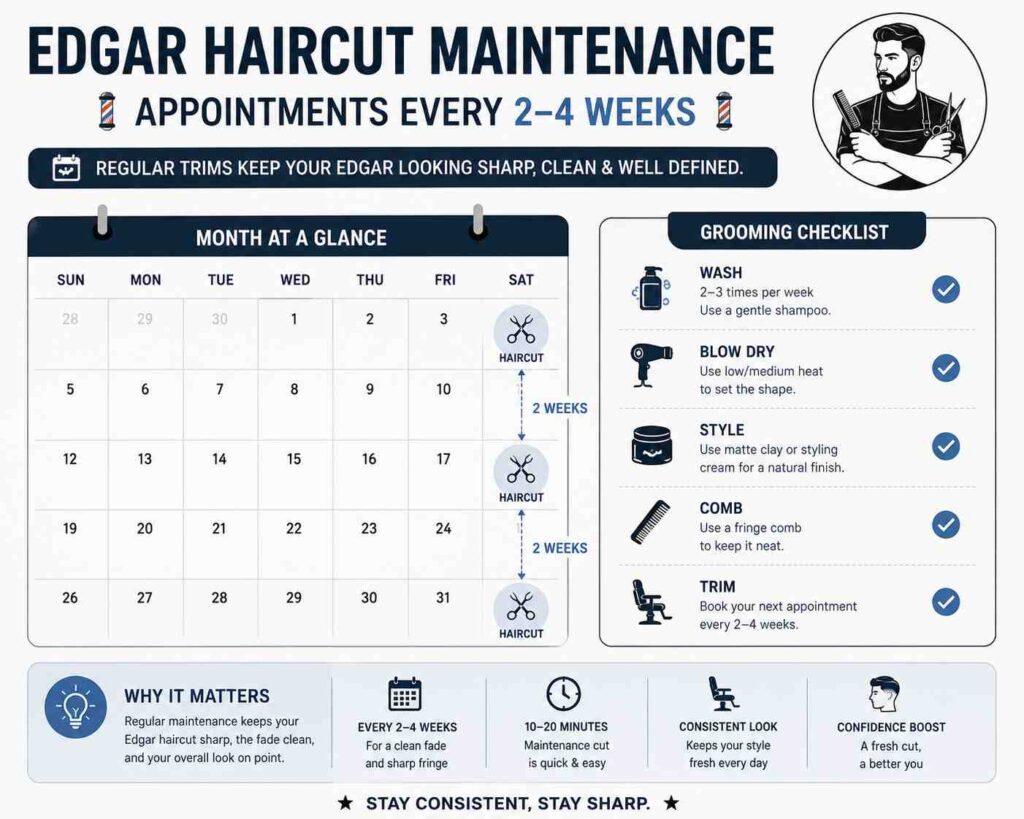
Getting an Edgar haircut is only the beginning. To keep its clean lines, sharp fringe, and well-defined fade, regular maintenance is essential. Unlike longer hairstyles that can grow out without a noticeable change, the Edgar haircut relies on precision. Even a few weeks of growth can soften its signature shape.
The good news is that maintaining an Edgar haircut doesn’t require an extensive routine. With regular barber visits, proper washing, and the right styling habits, you can keep your haircut looking fresh every day. Healthy hair begins with proper washing habits and healthy scalp care.
How Often Should You Get an Edgar Haircut?
The ideal trimming schedule depends on the specific Edgar variation you choose. Haircuts with higher fades and sharper outlines generally require more frequent maintenance than softer taper styles.
Recommended Barber Visit Schedule
| Edgar Style | Recommended Trim | Maintenance Level |
|---|---|---|
| Classic Edgar | Every 3–4 weeks | Moderate |
| Low Taper Edgar | Every 4 weeks | Low |
| Mid Fade Edgar | Every 3 weeks | Moderate |
| High Fade Edgar | Every 2–3 weeks | High |
| Skin Fade Edgar | Every 2 weeks | Very High |
| Curly Edgar | Every 3–4 weeks | Moderate |
| Fluffy Edgar | Every 3–4 weeks | Moderate |
| Edgar Mullet | Every 3–4 weeks | Moderate |
Tip: Waiting too long between trims can make the fade appear uneven and cause the fringe to lose its clean definition.
Daily Maintenance Routine
Keeping your Edgar haircut looking sharp doesn’t require hours in front of the mirror. A consistent five-minute routine is often enough.
Morning Routine
- Lightly dampen your hair if needed.
- Blow dry to restore shape and volume.
- Apply a small amount of styling product.
- Shape the fringe.
- Check the sides and neckline before leaving.
Evening Routine
- Remove styling products before sleeping.
- Avoid sleeping with heavy product in your hair.
- Brush or finger-comb your hair gently to prevent tangles.
Weekly Hair Care Routine
A weekly maintenance routine helps preserve the health of both your hair and scalp.
| Task | Frequency |
|---|---|
| Shampoo | 2–3 times per week (adjust for your hair type) |
| Conditioner | Every wash |
| Deep Conditioning Treatment | Once a week |
| Clean Styling Tools | Once a week |
| Check Fringe Length | Weekly |
Healthy hair is easier to style and helps your Edgar haircut maintain its intended shape.
Washing Your Hair Correctly
Overwashing can strip natural oils, while underwashing can lead to product buildup.
General Guidelines
| Hair Type | Shampoo Frequency |
|---|---|
| Straight Hair | 2–3 times weekly |
| Thick Hair | 2–3 times weekly |
| Wavy Hair | 2–3 times weekly |
| Curly Hair | 1–2 times weekly |
| Oily Hair | Every other day if needed |
Choose a shampoo and conditioner that match your hair type rather than using the same products for everyone.
Maintaining the Fringe
The fringe is the most recognizable feature of an Edgar haircut, so it deserves extra attention.
To keep it looking sharp:
- Trim it regularly.
- Style it in the same direction each day.
- Avoid letting it become too heavy.
- Use lightweight products to prevent separation.
A well-maintained fringe instantly makes the entire haircut look cleaner.
Keeping the Fade Looking Sharp
The fade is often the first part of an Edgar haircut to lose definition as your hair grows.
To maintain a clean appearance:
- Schedule regular barber appointments.
- Avoid attempting major fade corrections at home.
- Keep the neckline tidy between appointments if you’re comfortable doing so.
Professional maintenance produces the most consistent results, especially for high fades and skin fades.
Protecting Your Hair from Damage
Healthy hair holds its shape better and responds more effectively to styling.
To reduce damage:
- Limit excessive heat when blow drying.
- Use a heat protectant if styling frequently.
- Avoid harsh shampoos that dry out your hair.
- Stay hydrated and maintain a balanced diet.
Healthy hair supports a healthier-looking haircut. If you’re experiencing excessive hair thinning or sudden hair loss, consult a qualified healthcare professional rather than relying solely on styling products.
Signs It’s Time for a Trim
Many people wait too long before visiting the barber.
Watch for these signs:
- The fringe covers your eyebrows more than intended.
- The fade has become blurry or uneven.
- Styling takes longer than usual.
- The haircut has lost its clean outline.
- Hair around the ears looks overgrown.
If you notice several of these signs, it’s probably time to book your next appointment.
Edgar Haircut Maintenance Checklist
Use this checklist to stay on top of your grooming routine.
| Maintenance Task | Frequency | Completed |
|---|---|---|
| Shampoo | 2–3× per week | ☐ |
| Condition | Every wash | ☐ |
| Style hair | Daily | ☐ |
| Clean styling tools | Weekly | ☐ |
| Deep conditioning | Weekly | ☐ |
| Barber appointment | Every 2–4 weeks | ☐ |
Barber Tip
Book your next haircut before leaving the barbershop. Maintaining a consistent schedule helps your Edgar haircut keep its shape and reduces the need for major corrections later.
Expert Tip
Take a photo of your haircut within the first few days after your barber visit. At your next appointment, use that photo as a reference to show exactly how you like your Edgar haircut to look. This makes it easier for your barber to recreate the same result consistently.
Common Maintenance Mistakes
Avoid these habits if you want your Edgar haircut to look its best:
- Skipping trims for six weeks or longer.
- Using too much styling product.
- Blow drying on excessively high heat.
- Washing with harsh shampoos every day.
- Ignoring changes in your hair’s natural growth pattern.
Edgar Haircut Maintenance at a Glance
| Category | Recommendation |
|---|---|
| Daily Styling Time | 5–10 minutes |
| Barber Visits | Every 2–4 weeks |
| Shampoo | 2–3 times weekly (adjust for hair type) |
| Conditioner | Every wash |
| Styling Products | Lightweight, suited to your hair type |
| Heat Styling | Moderate, with heat protectant |
Pros and Cons of an Edgar Haircut
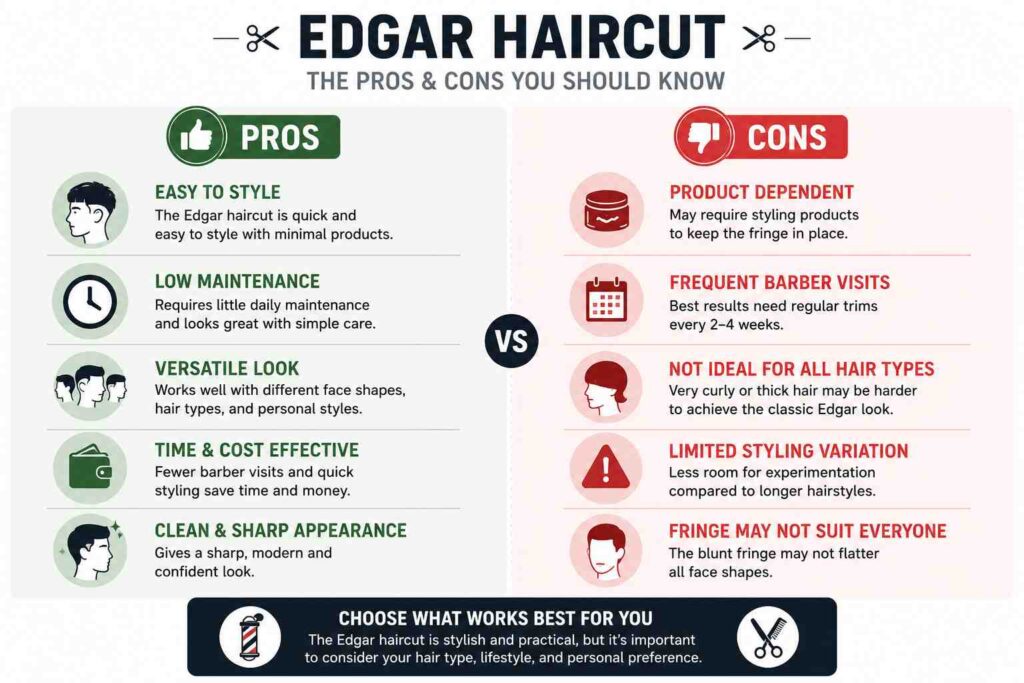
The Edgar haircut has become one of the most recognizable men’s hairstyles because it combines a sharp appearance with impressive versatility. However, like any haircut, it isn’t the perfect choice for everyone.
Before deciding on an Edgar haircut, it’s helpful to understand both its strengths and its potential drawbacks. Considering factors such as your hair type, maintenance routine, workplace expectations, and personal style will help you determine whether it’s the right fit.
Advantages of an Edgar Haircut
The Edgar haircut remains popular for several reasons. Its structured design, adaptability, and modern appearance make it suitable for many different people.
Sharp and Modern Appearance
One of the biggest attractions of the Edgar haircut is its clean, defined look.
The signature blunt fringe, combined with neatly faded or tapered sides, creates a polished hairstyle that stands out without being overly complicated.
Whether you choose a Classic Edgar or a textured variation, the haircut offers a contemporary style that remains fashionable throughout the year.
Works with Multiple Hair Types
Unlike some hairstyles that require naturally straight hair, the Edgar haircut can be adapted for:
- Straight hair
- Thick hair
- Wavy hair
- Curly hair
- Medium-density hair
A skilled barber can modify the length, fade, and texture to suit your natural hair.
Versatile Style Options
The Edgar haircut isn’t limited to one look.
Popular variations include:
- Classic Edgar
- Low Taper Edgar
- High Fade Edgar
- Mid Fade Edgar
- Burst Fade Edgar
- Curly Edgar
- Fluffy Edgar
- Textured Edgar
- Edgar Mullet
This versatility makes it easy to personalize the haircut while keeping its recognizable identity.
Easy Daily Styling
Most Edgar haircut variations require only a few minutes of styling each morning.
A simple routine often includes:
- Dampening the hair
- Blow drying (if needed)
- Applying a small amount of styling product
- Shaping the fringe
Many people can complete their routine in less than ten minutes.
Suitable for Different Age Groups
Although the Edgar haircut is especially popular among teenagers and young adults, it can also suit older men when tailored appropriately.
Subtle variations, such as the Low Taper Edgar or Classic Edgar, provide a cleaner and more understated appearance suitable for professional environments.
Disadvantages of an Edgar Haircut
While the Edgar haircut offers many benefits, it’s important to understand its limitations before making a decision.
Requires Regular Trims
One of the biggest drawbacks is maintenance.
Because the haircut relies on clean lines and sharp fades, regular barber visits are essential.
Most people need a trim every 2 to 4 weeks, depending on the variation.
Not Every Variation Fits Every Workplace
Some Edgar styles—particularly those with high fades, dramatic texture, or bold mullet-inspired designs—may not align with conservative workplace grooming expectations.
If your profession has a strict dress code, a Classic Edgar or Low Taper Edgar is generally a safer choice.
Styling May Be Necessary
Although styling usually takes only a few minutes, some variations lose their shape if left completely untouched.
Fluffy, textured, or curly Edgar styles often benefit from lightweight styling products and occasional blow drying.
Hair Texture Can Affect Results
Not every Edgar haircut looks identical on every hair type.
Natural curl patterns, hair density, and growth direction influence the final appearance.
A haircut that looks excellent on someone with thick, straight hair may need adjustments for finer or curlier hair.
Frequent Fade Maintenance
High fades and skin fades grow out quickly.
As new hair grows, the sharp contrast softens, making the haircut appear less defined.
People who prefer crisp fades should expect more frequent barber appointments.
Pros and Cons Comparison Table
| Advantages | Disadvantages |
|---|---|
| Modern appearance | Requires regular trims |
| Many style variations | High fades need frequent maintenance |
| Works with multiple hair types | Some styles require daily styling |
| Easy to personalize | Results vary by hair texture |
| Suitable for many face shapes | Bold variations may not suit every workplace |
| Quick styling routine | Professional upkeep is recommended |
Who Should Get an Edgar Haircut?
The Edgar haircut is an excellent choice for people who:
- Like modern hairstyles.
- Prefer clean, structured haircuts.
- Don’t mind regular barber visits.
- Want multiple styling options.
- Enjoy experimenting with different fade styles.
It can also be adapted for a wide range of ages and hair textures when customized by an experienced barber.
Who Might Prefer Another Hairstyle?
Another hairstyle may be a better option if you:
- Prefer growing your hair for several months without trimming.
- Rarely use styling products.
- Want a longer hairstyle with more movement.
- Work in an environment with very conservative grooming expectations.
- Don’t enjoy regular barber maintenance.
These considerations don’t necessarily rule out an Edgar haircut, but they may influence which variation is most suitable.
Quick Decision Summary
| Question | If Your Answer Is “Yes” |
|---|---|
| Do you like clean, structured haircuts? | Edgar Haircut is a strong choice. |
| Can you visit a barber every 2–4 weeks? | Most Edgar styles will be easy to maintain. |
| Are you willing to spend 5–10 minutes styling your hair? | You’ll have access to more Edgar variations. |
| Do you want a hairstyle with many customization options? | The Edgar haircut offers excellent versatility. |
Barber Tip
If you’re unsure whether an Edgar haircut is right for you, begin with a Classic Edgar or Low Taper Edgar. These styles are easier to maintain, suit a wide range of face shapes, and can be modified into more dramatic variations later if you decide to experiment.
Expert Insight
The success of an Edgar haircut depends less on following trends and more on choosing a variation that complements your natural hair texture, facial proportions, and lifestyle. A personalized approach almost always produces better long-term results than copying a haircut exactly from a photo.
Common Mistake
Don’t judge the Edgar haircut based solely on one variation you’ve seen online. The style includes everything from subtle tapers to bold high fades and textured finishes. Exploring different options can help you find a version that matches your preferences.
Edgar Haircut at a Glance
| Category | Rating |
|---|---|
| Styling Difficulty | ⭐⭐☆☆☆ (Easy–Moderate) |
| Maintenance | ⭐⭐⭐☆☆ |
| Versatility | ⭐⭐⭐⭐⭐ |
| Professional Appearance | ⭐⭐⭐⭐☆ (varies by style) |
| Beginner Friendly | ⭐⭐⭐⭐⭐ |
Edgar Haircut vs. Other Popular Haircuts
The Edgar haircut is often compared to other modern men’s hairstyles because they share features such as short sides, textured tops, or blunt fringes. However, each haircut has its own unique characteristics, maintenance requirements, and styling options.
If you’re deciding between the Edgar haircut and another style, the comparisons below will help you understand the key differences.
Edgar Haircut vs. Caesar Cut
At first glance, the Edgar haircut and Caesar cut look similar because both feature a short fringe. The main difference lies in the overall structure and contrast.
The Edgar haircut typically includes faded or tapered sides with a more defined, blunt fringe. The Caesar cut has a softer fringe and a more uniform length around the head, creating a classic and understated appearance.
Comparison Table
| Feature | Edgar Haircut | Caesar Cut |
|---|---|---|
| Fringe | Sharp, blunt | Short, textured |
| Sides | Fade or taper | Even length or subtle taper |
| Overall Look | Modern | Classic |
| Styling | Low to moderate | Low |
| Maintenance | Moderate | Low |
Best Choice:
- Choose an Edgar Haircut for a bold, modern appearance.
- Choose a Caesar Cut if you prefer a timeless, low-maintenance style.
Edgar Haircut vs. French Crop
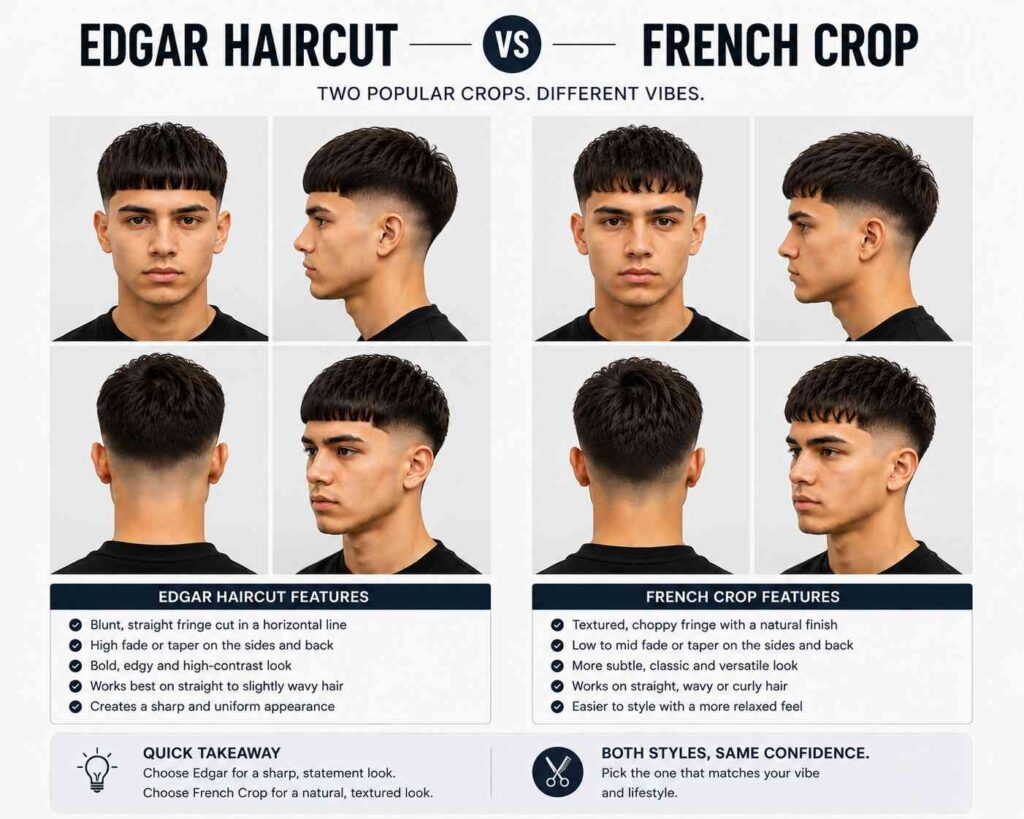
The French Crop and Edgar haircut both feature short hair with a forward-styled top, but they create different visual effects.
The French Crop focuses on textured layers and a natural fringe, while the Edgar haircut emphasizes straight lines and stronger definition.
Comparison Table
| Feature | Edgar Haircut | French Crop |
|---|---|---|
| Fringe | Straight and defined | Soft and textured |
| Texture | Optional | Essential |
| Fade | Usually present | Optional |
| Style | Structured | Relaxed |
| Popularity | Trend-driven | Timeless |
Best Choice:
- Edgar for sharper lines.
- French Crop for natural texture.
Edgar Haircut vs. Crew Cut
The Crew Cut is significantly shorter than most Edgar variations.
A Crew Cut features a gradually shorter top with no signature fringe, making it one of the easiest hairstyles to maintain.
The Edgar haircut offers far more personality, customization, and styling flexibility.
Comparison Table
| Feature | Edgar Haircut | Crew Cut |
|---|---|---|
| Top Length | Short to medium | Very short |
| Fringe | Yes | No |
| Styling | Moderate | Minimal |
| Barber Visits | Every 2–4 weeks | Every 3–5 weeks |
| Versatility | High | Moderate |
Edgar Haircut vs. Buzz Cut
Although both haircuts are clean and masculine, they are completely different styles.
The Buzz Cut uses the same clipper guard over most or all of the head, while the Edgar haircut relies on varying lengths, a defined fringe, and a fade or taper to create its distinctive shape.
Comparison Table
| Feature | Edgar Haircut | Buzz Cut |
|---|---|---|
| Hair Length | Short to medium | Very short |
| Fringe | Yes | No |
| Styling Products | Often used | Rarely needed |
| Maintenance | Moderate | Low |
| Overall Appearance | Structured | Minimalist |
Edgar Haircut vs. Taper Fade
A taper fade is not actually a hairstyle—it is a cutting technique used on the sides and back.
An Edgar haircut can include a taper fade, but the haircut itself is defined by its blunt fringe and overall shape.
Comparison Table
| Feature | Edgar Haircut | Taper Fade |
|---|---|---|
| Haircut Type | Complete hairstyle | Fading technique |
| Fringe | Yes | Depends on hairstyle |
| Top Style | Defined | Any style |
| Customization | High | Extremely High |
Key Takeaway: A Low Taper Edgar combines both concepts into a single haircut.
Edgar Haircut vs. Mullet
The Edgar Mullet has blurred the line between these two styles, but a traditional Edgar and a traditional Mullet remain distinct.
The Edgar haircut keeps the back relatively short and emphasizes a structured front.
The Mullet is characterized by short hair at the front and sides with noticeably longer hair at the back.
Comparison Table
| Feature | Edgar Haircut | Mullet |
|---|---|---|
| Back Length | Short | Long |
| Fringe | Blunt | Optional |
| Fade | Common | Optional |
| Style | Structured | Retro and expressive |
| Maintenance | Moderate | Moderate |
Edgar Haircut Comparison Chart
If you’re looking for a quick overview, this table summarizes how the Edgar haircut compares to several popular alternatives.
| Hairstyle | Styling Difficulty | Maintenance | Professional Friendly | Best For |
|---|---|---|---|---|
| Edgar Haircut | ⭐⭐☆☆☆ | ⭐⭐⭐☆☆ | ✅ Yes (depending on variation) | Modern, versatile styling |
| Caesar Cut | ⭐☆☆☆☆ | ⭐⭐☆☆☆ | ✅ Yes | Simple everyday look |
| French Crop | ⭐⭐☆☆☆ | ⭐⭐⭐☆☆ | ✅ Yes | Textured hairstyles |
| Crew Cut | ⭐☆☆☆☆ | ⭐⭐☆☆☆ | ✅ Yes | Very low maintenance |
| Buzz Cut | ⭐☆☆☆☆ | ⭐☆☆☆☆ | ✅ Yes | Minimal grooming |
| Mullet | ⭐⭐⭐☆☆ | ⭐⭐⭐☆☆ | ⚠ Varies | Bold personal style |
Which Haircut Is Right for You?
Choosing between these hairstyles comes down to your priorities.
| If You Want… | Recommended Haircut |
|---|---|
| Sharp definition | Edgar Haircut |
| A classic military-inspired style | Crew Cut |
| A textured everyday hairstyle | French Crop |
| The lowest maintenance | Buzz Cut |
| A subtle fringe | Caesar Cut |
| A bold statement hairstyle | Edgar Mullet |
Barber Tip
Don’t focus only on the haircut’s name. Bring reference photos and discuss details such as fringe length, fade height, and top texture with your barber. Small adjustments often make a bigger difference than choosing one haircut name over another.
Expert Insight
Many hairstyles overlap in certain features, but the defining characteristic of the Edgar haircut remains its structured fringe combined with clean, tapered or faded sides. Understanding these defining elements makes it easier to compare the Edgar with similar cuts and choose the version that best matches your preferences.
Common Mistake
People often assume the Edgar haircut and French Crop are identical because both have a short fringe. In reality, the Edgar emphasizes crisp lines and structure, while the French Crop relies on texture and a softer, more natural finish.
Frequently Asked Questions About Edgar Haircuts
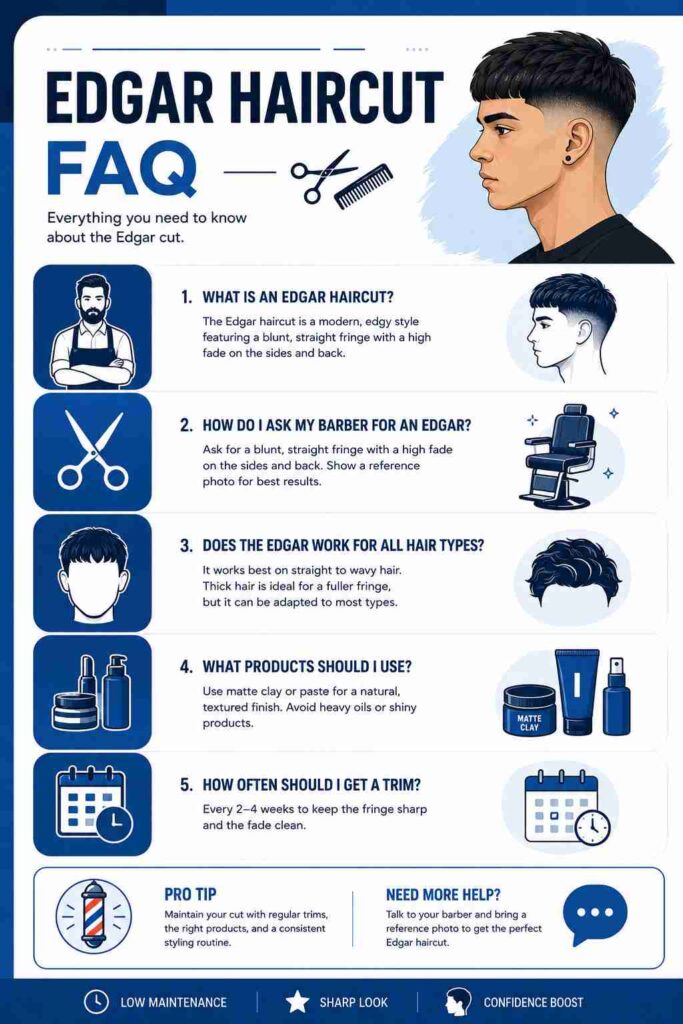
The Edgar haircut has gained widespread popularity over the past few years, leading to many questions about who it suits, how it’s maintained, and how it compares to other hairstyles. Below are answers to some of the most common questions people ask before getting an Edgar haircut.
What Is an Edgar Haircut?
An Edgar haircut is a men’s hairstyle defined by a straight or slightly textured fringe paired with short, faded, or tapered sides. While the exact length and fade vary between styles, the signature front fringe remains the defining feature.
Today, the Edgar haircut includes many variations, including the Classic Edgar, Low Taper Edgar, High Fade Edgar, Curly Edgar, Fluffy Edgar, and Edgar Mullet.
Why Is It Called an Edgar Haircut?
The exact origin of the name isn’t universally agreed upon. Over time, the hairstyle became widely recognized online and in barbershops under the name “Edgar haircut,” especially through social media and pop culture. While there are several theories about how the name originated, there is no single verified explanation.
Who Looks Good With an Edgar Haircut?
The Edgar haircut can suit many people when adapted to their individual features.
It generally works well for:
- Oval faces
- Square faces
- Diamond faces
- Straight hair
- Thick hair
- Wavy hair
- Curly hair (with appropriate modifications)
The key is choosing the right variation rather than assuming one version fits everyone.
Does the Edgar Haircut Work for Curly Hair?
Yes. The Curly Edgar is one of the most popular variations.
Instead of straightening natural curls, this style embraces texture while maintaining the haircut’s structured fringe and clean sides.
A barber experienced with curly hair can adjust the shape to complement your curl pattern and hair density.
Is the Edgar Haircut High Maintenance?
Maintenance depends on the variation you choose.
- Low Taper Edgar: Lower maintenance.
- Classic Edgar: Moderate maintenance.
- High Fade Edgar: Requires more frequent trims.
- Skin Fade Edgar: Highest maintenance.
Most people benefit from visiting the barber every two to four weeks.
How Long Does It Take to Style an Edgar Haircut?
Most Edgar haircut variations can be styled in 5 to 10 minutes.
A basic routine includes:
- Dampening the hair.
- Blow drying if needed.
- Applying a small amount of styling product.
- Shaping the fringe.
How Often Should I Get an Edgar Haircut?
To maintain sharp lines and a clean fade, schedule a haircut approximately every:
| Style | Trim Frequency |
|---|---|
| Classic Edgar | 3–4 weeks |
| Low Taper Edgar | 4 weeks |
| High Fade Edgar | 2–3 weeks |
| Skin Fade Edgar | 2 weeks |
| Curly Edgar | 3–4 weeks |
Regular trims help preserve the haircut’s structure and reduce styling time.
What Face Shape Is Best for an Edgar Haircut?
The Edgar haircut is most adaptable for:
- Oval faces
- Square faces
- Diamond faces
People with round or long face shapes can also wear an Edgar haircut, but choosing the right variation—such as a High Fade Edgar or a balanced fringe length—is important for creating visual harmony.
Can You Get an Edgar Haircut with Thin Hair?
Yes, although some variations work better than others.
People with fine or thin hair often benefit from:
- Fluffy Edgar
- Textured Edgar
- Low Taper Edgar
These styles can create the appearance of greater volume without requiring excessive styling.
What’s the Difference Between an Edgar Haircut and a French Crop?
While both hairstyles feature a forward-styled fringe, they differ in their overall appearance.
The Edgar haircut focuses on:
- Defined straight fringe
- Sharp lines
- Structured silhouette
The French Crop emphasizes:
- Textured top
- Softer fringe
- More natural finish
Is the Edgar Haircut Still Popular?
Yes. The Edgar haircut continues to be one of the most requested modern men’s hairstyles because it offers numerous variations to suit different face shapes, hair textures, and personal styles.
Its popularity has also been supported by social media, barbershop trends, and the growing demand for customized fades and textured hairstyles.
Can an Edgar Haircut Look Professional?
Absolutely. Professional appearance depends largely on the variation you choose.
A Classic Edgar or Low Taper Edgar can look polished and workplace-appropriate, while more dramatic versions—such as a High Fade Edgar or Edgar Mullet—may be better suited to casual or creative environments.
Do I Need Styling Products for an Edgar Haircut?
Styling products aren’t always essential, but they help maintain the haircut’s shape throughout the day.
Popular product categories include:
- Matte clay
- Texture paste
- Sea salt spray
- Styling cream
- Curl cream
- Texture powder
Choose products based on your hair type and the finish you want to achieve.
Can I Cut an Edgar Haircut at Home?
While basic maintenance, such as trimming around the neckline, is possible for some people, creating the signature fringe and a clean fade requires skill and proper tools.
For the best results, it’s recommended to have an Edgar haircut performed and maintained by an experienced barber.
Which Edgar Haircut Is Best for Beginners?
If it’s your first Edgar haircut, start with:
- Classic Edgar
- Low Taper Edgar
These styles are versatile, easier to maintain, and can be adjusted over time as you become more comfortable with the look.
Will an Edgar Haircut Suit My Hair Type?
In most cases, yes.
Modern Edgar haircuts can be adapted for:
| Hair Type | Suitable? |
|---|---|
| Straight | ✅ Excellent |
| Thick | ✅ Excellent |
| Wavy | ✅ Very Good |
| Curly | ✅ Very Good |
| Fine | ✅ Good (with the right variation) |
A consultation with your barber will help determine the most suitable version based on your hair’s texture, density, and growth pattern.
Conclusion
The Edgar haircut has grown from a bold fringe style into one of the most versatile modern men’s hairstyles. Whether you prefer a Classic Edgar, Low Taper Edgar, High Fade Edgar, Curly Edgar, or Fluffy Edgar, there’s a variation to match different face shapes, hair types, and personal styles.
Choosing the right Edgar haircut is about more than following trends. Consider your face shape, hair texture, lifestyle, and maintenance routine to find a style that suits you. Clear communication with your barber, the right styling products, and regular trims will help keep your haircut looking sharp and well-defined.
As EdgarHaircut.org continues to expand, you’ll find in-depth guides covering every Edgar haircut variation, styling technique, face shape recommendation, maintenance tip, and comparison article. Our goal is to help you make informed decisions and confidently choose the Edgar haircut that fits your look and lifestyle.
Ready to find your ideal style? Explore our detailed guides to compare Edgar haircut variations, discover the best option for your hair type and face shape, and learn how to style and maintain your haircut like a pro.