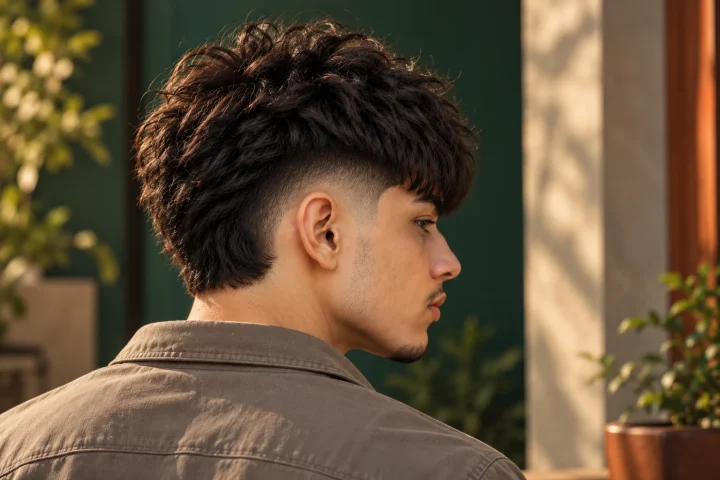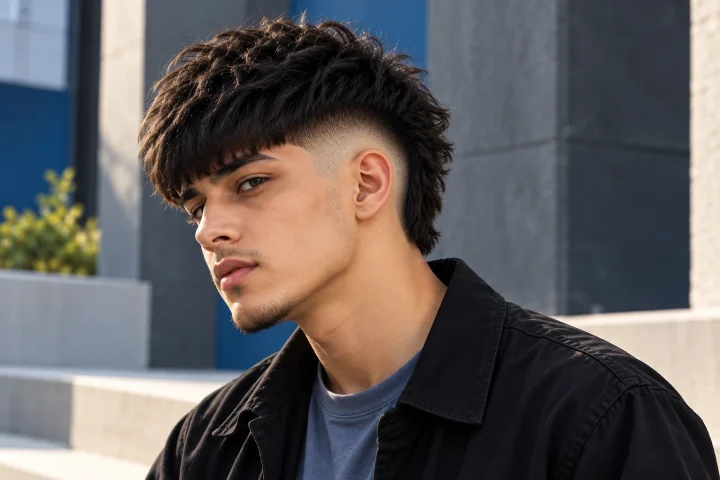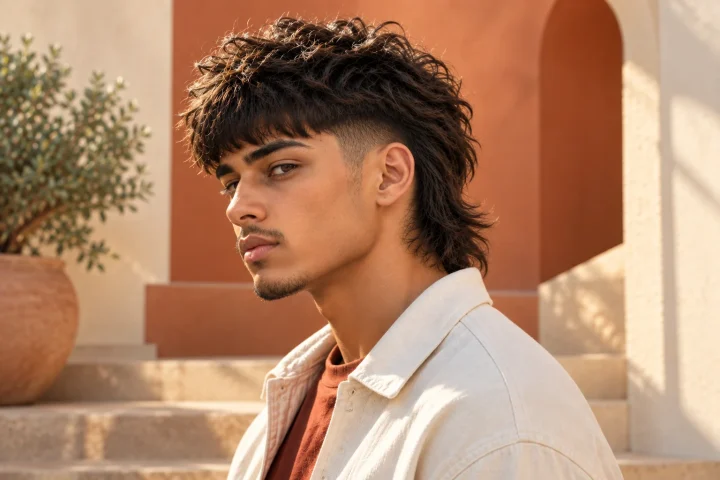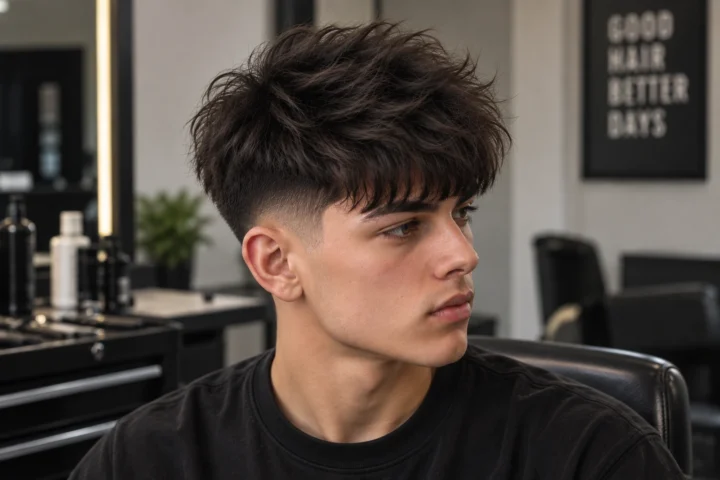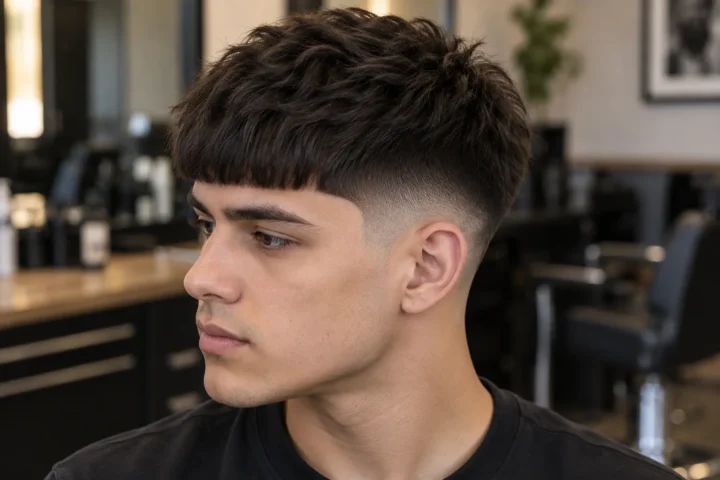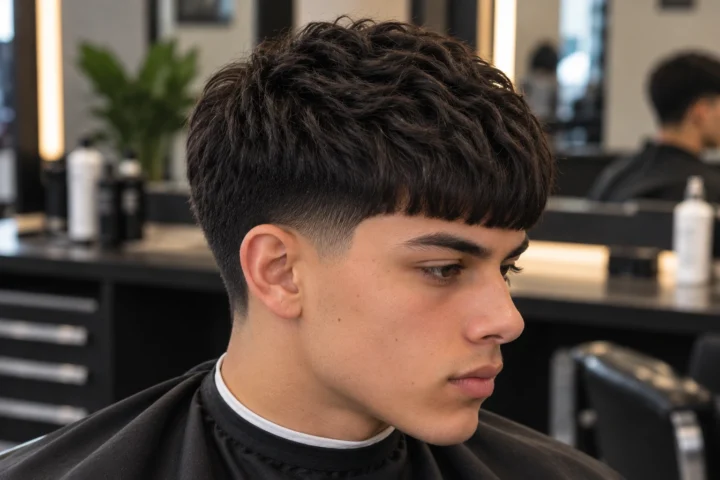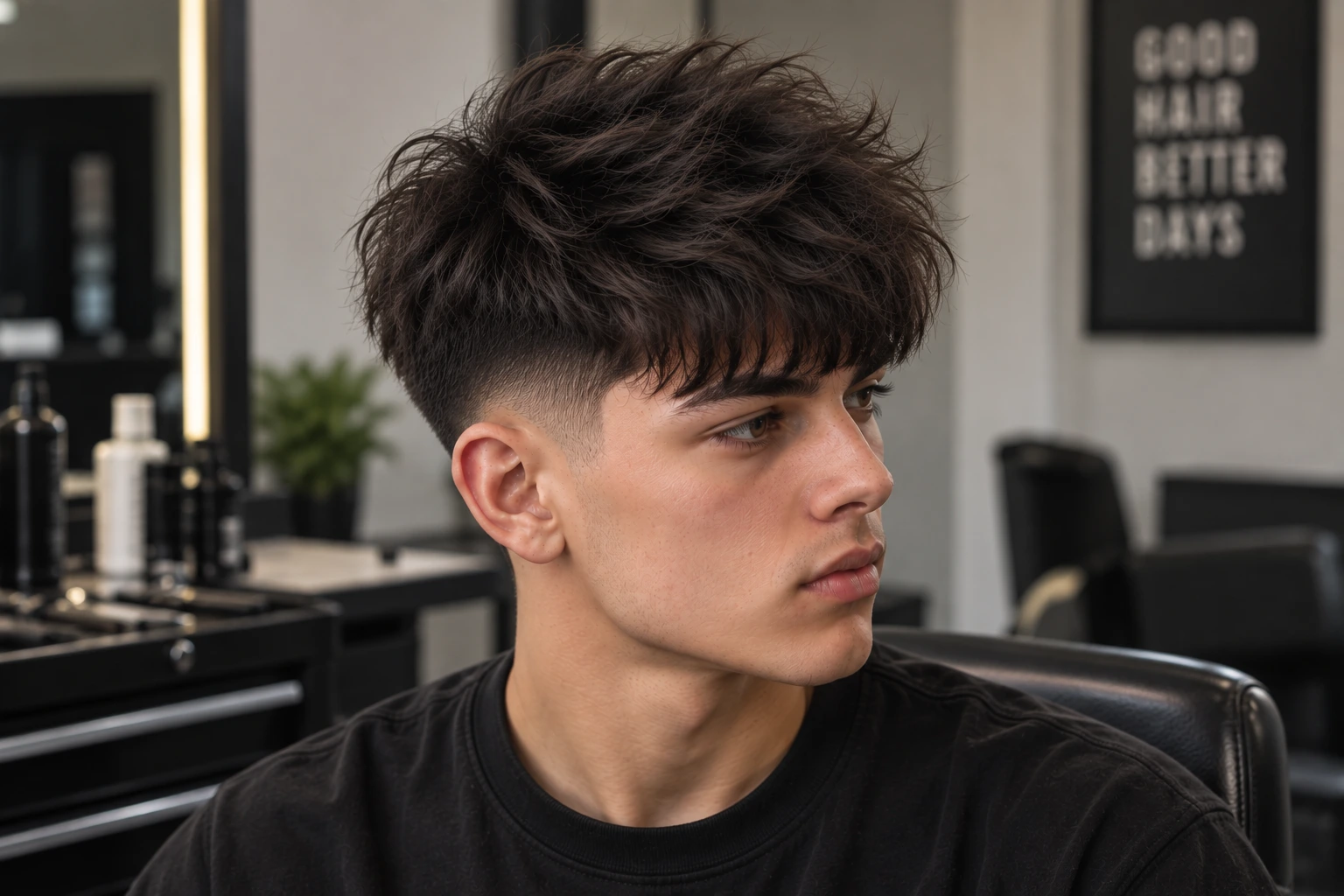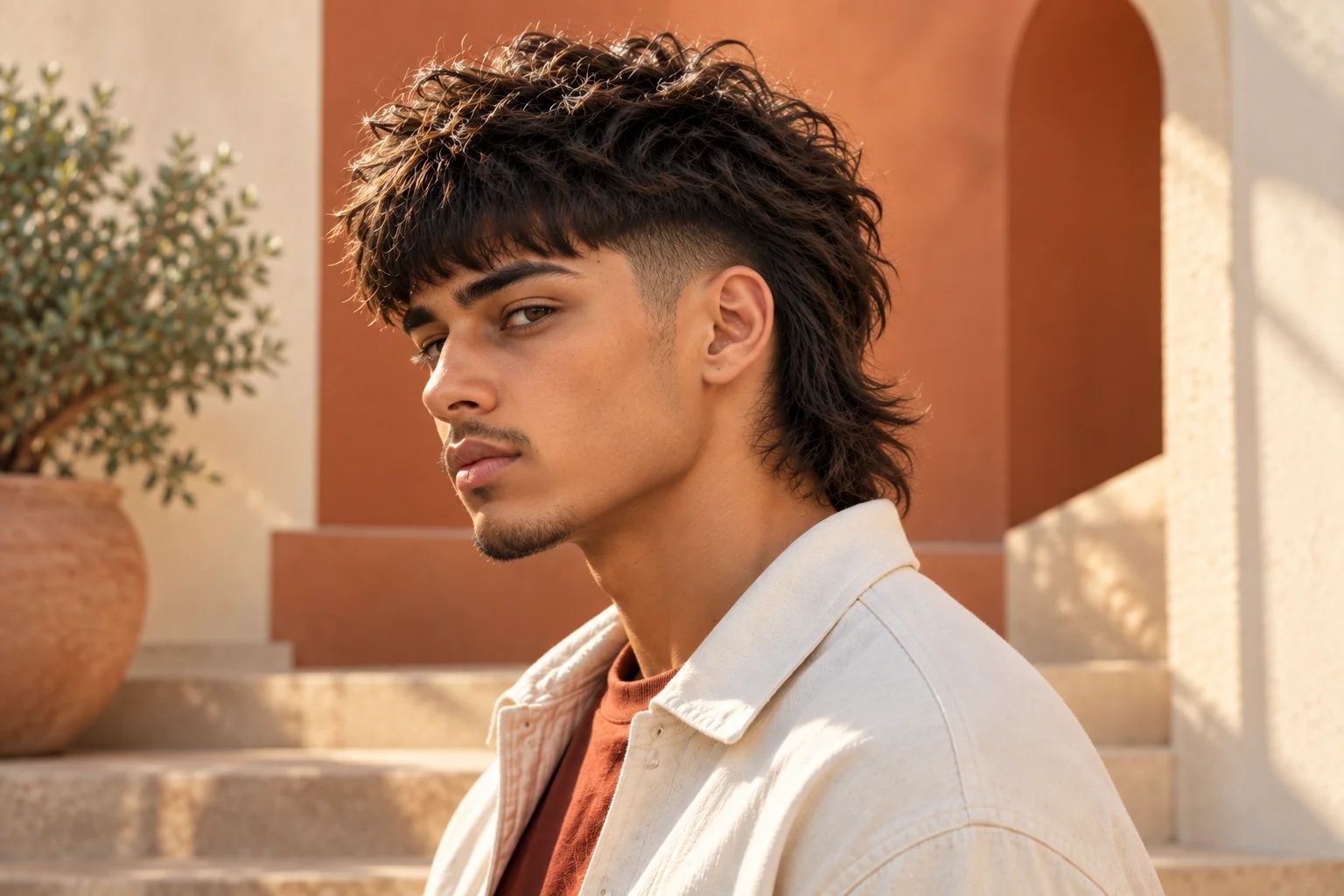

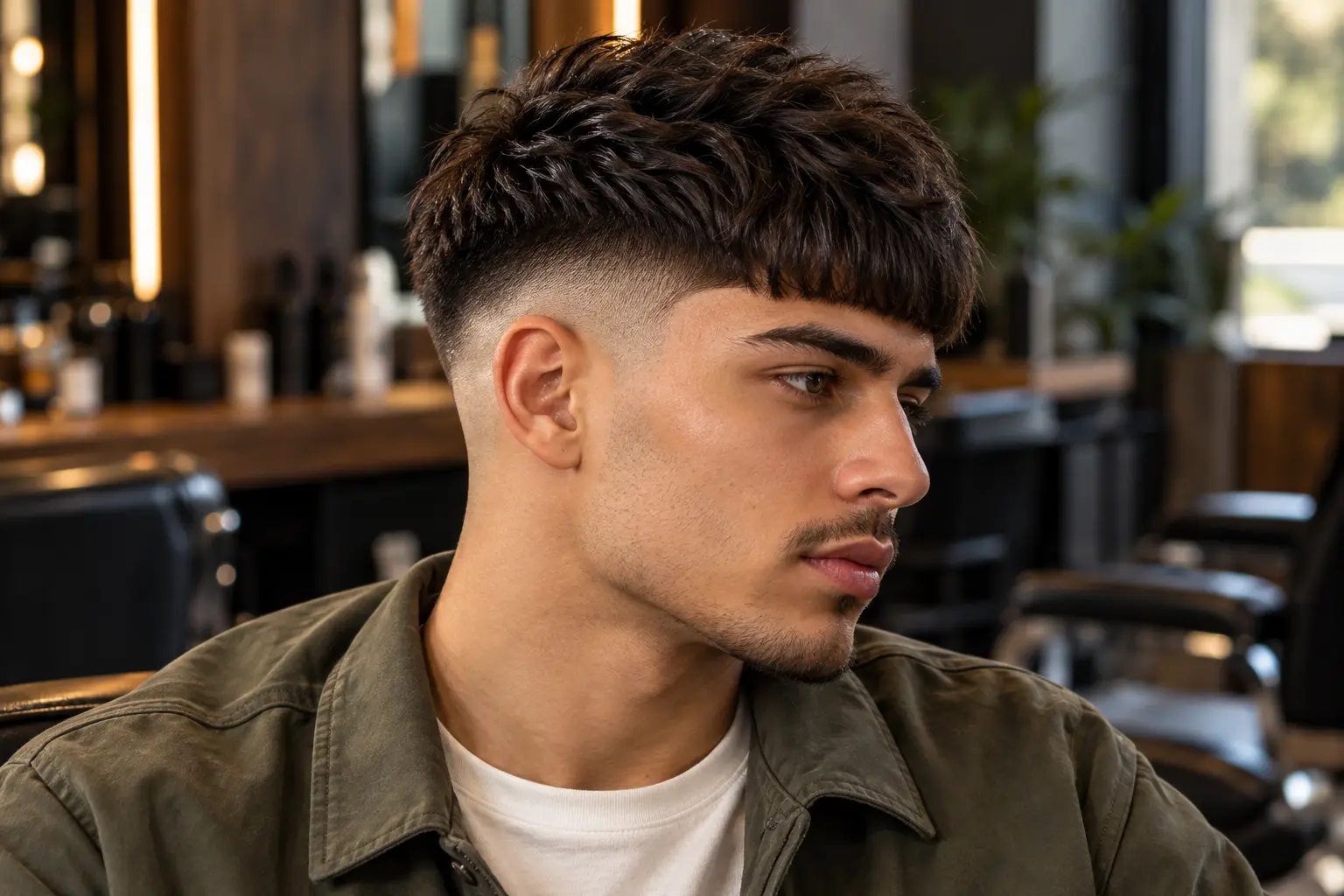
A High Taper Edgar Haircut changes the balance of the Edgar in a noticeable way. The familiar forward fringe and structured top remain, but the transition begins higher on the sides, removing more visual weight and making the difference between the top and sides easier to see.
That can make the haircut look sharper and more defined—but higher does not automatically mean better.
The real question is whether you actually want less side weight and stronger contrast.
You may also see similar cuts described as a High Taper Fade Edgar Haircut, High Taper Fade Edgar or High Fade Edgar. These terms are sometimes used loosely, so the name alone does not tell you exactly how the sides will be finished.
What matters more is where the transition begins, how close it becomes and how much side weight remains above it.
That is where we’ll start.
Look at the Side Before You Choose the Haircut
When people choose an Edgar, attention naturally goes to the fringe.
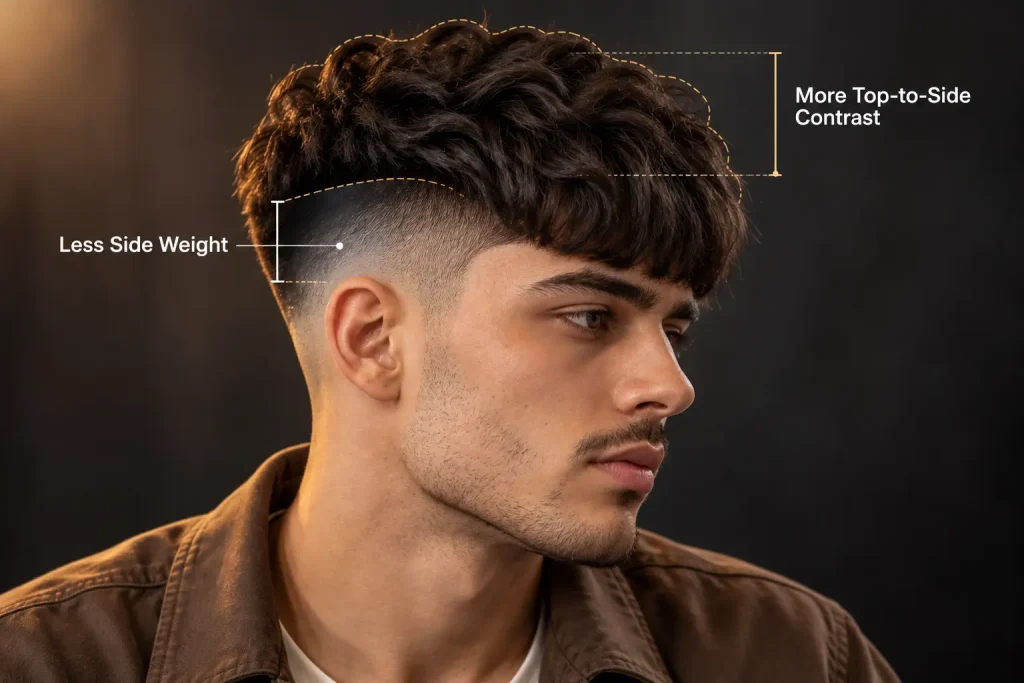
With a high taper, look at the side profile first.
Imagine a line moving upward from the sideburn toward the temple. As the transition moves higher, a larger portion of the side becomes part of the shorter blended area.
That produces three important changes.
Less side weight.
More of the darker, fuller side panel is removed.
More visible contrast.
The longer top stands out more clearly against the shorter area beneath it.
A stronger upper silhouette.
With less visual mass on the sides, your eye is naturally drawn toward the fringe, texture and shape on top.
This is what makes a High Taper Edgar different from simply getting a standard Edgar haircut with neatly cleaned sides.
The height of the transition becomes part of the haircut’s personality.
How High Is “High”?
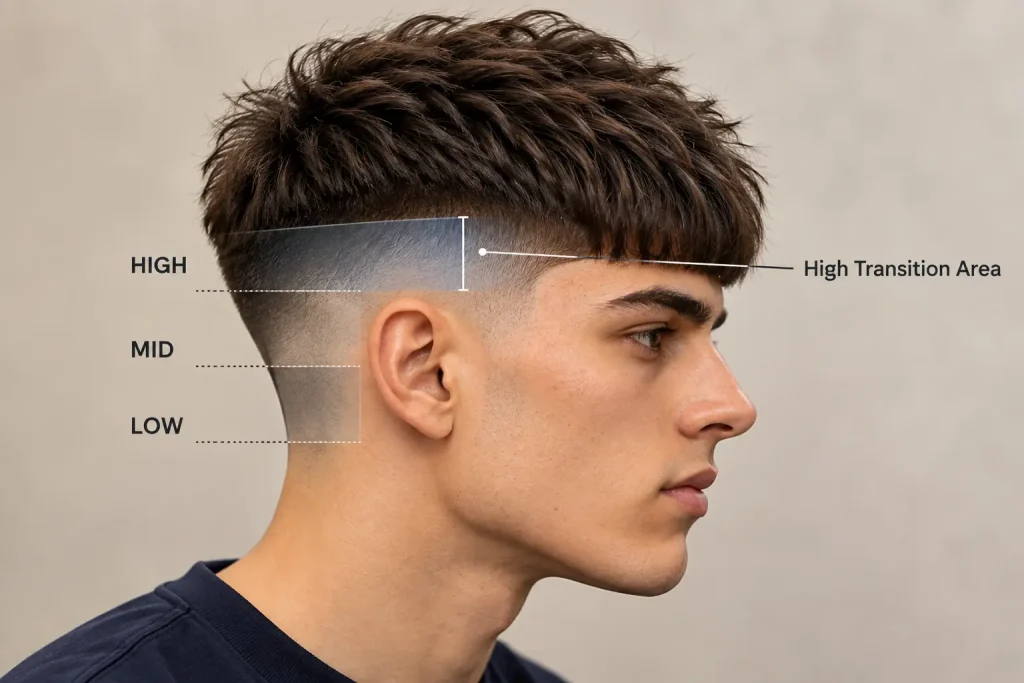
There is no universal line on every person’s head where a high taper must begin.
Head shape, temple area, hairline, density and barber technique all affect the exact placement.
What matters is the relationship between the transition and the remaining hair above it.
A low taper concentrates most of its shortening near the lower perimeter.
A mid taper allows that transition to become more visible through the middle of the side.
A high taper carries the transition farther upward, leaving less uninterrupted side weight before the longer top begins.
That doesn’t mean the entire side needs to be shaved extremely short.
And it doesn’t mean every High Taper Fade Edgar Haircut needs exposed skin.
Those are separate decisions.
A useful reference photo should therefore show two things clearly:
- How high the transition sits
- How close the shortest area becomes
If you can see both, you’re much closer to communicating the haircut accurately.
High Taper Edgar vs High Taper Fade Edgar: What’s the Difference?
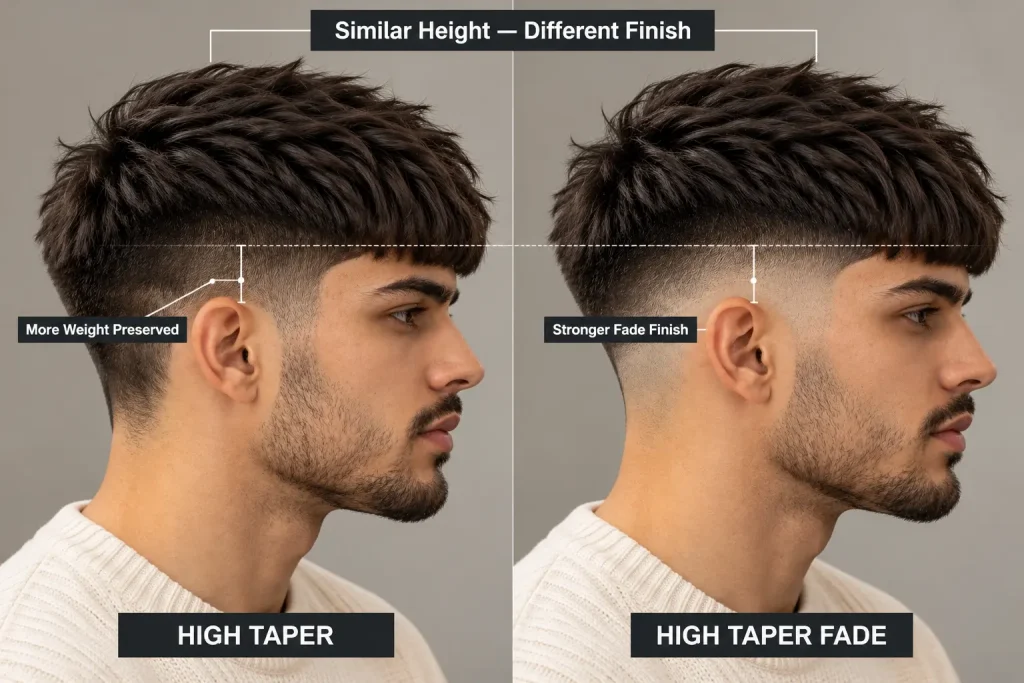
This is where reference photos—and haircut names—can become confusing.
Search for a High Taper Edgar and you may find a haircut another barber would describe as a High Taper Fade Edgar. Search for a High Fade Edgar and you may see something with considerably more of the sides faded away.
Instead of trying to force every haircut into one universal definition, separate height from finish.
Height asks: Where does the transition sit?
Finish asks: How closely and extensively is that area blended?
A High Taper Edgar can still retain some darkness and weight through the side.
A High Taper Fade Edgar Haircut generally describes the same high-placement idea combined with a more visibly faded transition.
A stronger High Fade Edgar can remove even more visual weight through the sides and create greater separation from the top.
But barber terminology varies. One shop’s “high taper fade” may look very similar to another barber’s “high taper.”
That is why the photograph in front of you matters more than arguing over the label.
If you like a particular reference, don’t just tell your barber:
“I want a high taper fade.”
Point to the transition.
Show where you want it to begin, how much darkness you want left above it and how close you want the shortest area.
That prevents two people using the same haircut name while imagining very different results.
What You Gain—and Give Up—by Moving the Transition Higher
A higher transition isn’t simply a more fashionable version of a lower one.
You are making a trade.
You Gain More Definition
The shorter side area becomes easier to see, particularly from a three-quarter or side view.
This can make the barbering itself a stronger visual feature of the haircut.
You Gain More Top-to-Side Contrast
Because there is less uninterrupted side weight, texture, curls or volume on top can become more prominent.
A closer High Taper Fade Edgar can push this contrast further because the shortest portion of the side becomes even more visually distinct.
You Give Up Some Fullness Through the Sides
If you like the darker, heavier side panel of a Low Taper Edgar, moving high changes that characteristic.
This matters particularly with thick or dark hair, where removing side density can noticeably alter the overall silhouette.
You Make Placement More Important
A small difference in transition height can noticeably affect the haircut when a larger portion of the side is involved.
This is why choosing High should be intentional.
Don’t move the transition upward simply because you want the haircut to look “cleaner.”
You can have a very clean Low or Mid Taper Edgar too.
Choose High because you actually want the additional side exposure and contrast.
Same Edgar, Three Very Different Side Profiles
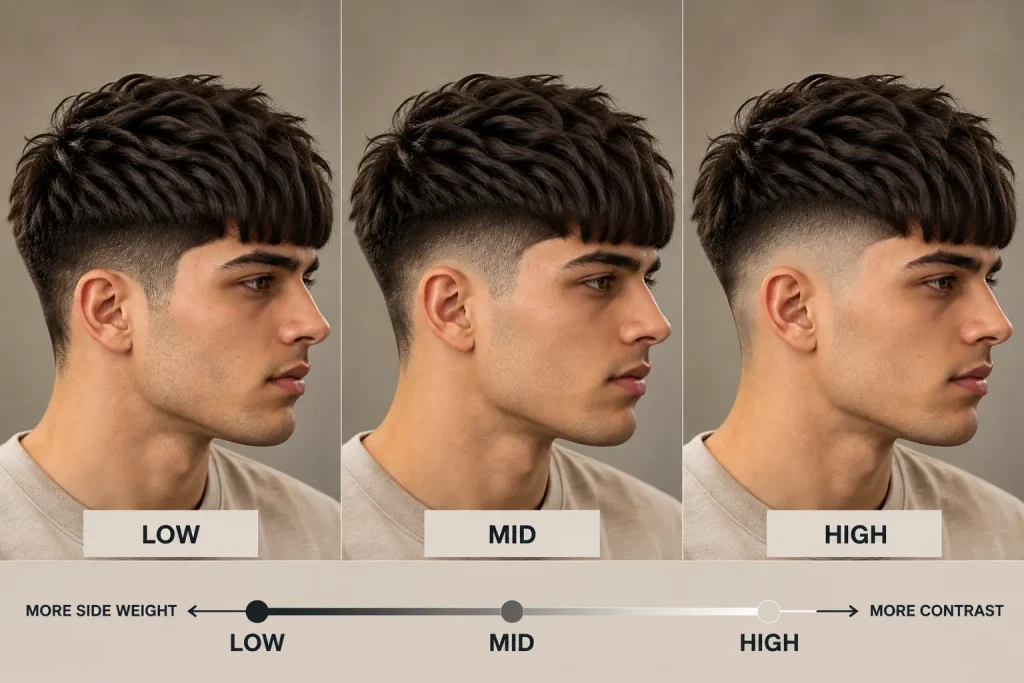
If you’re deciding between Low, Mid and High, ignore the top for a moment.
Imagine the same person, with the same fringe, same top length and same hair texture.
Only move the side transition.
Low: Keep More Side Weight
The transition stays close to the lower perimeter.
More dark hair remains through the side, producing a softer connection with the top.
If this is what you’re after, see our Low Taper Edgar Haircut guide rather than trying to make High behave like Low.
Mid: Show the Transition Without Taking It Too Far
Move upward and the blend becomes more visible.
You sacrifice some side weight but retain enough to create a fairly balanced connection between top and sides.
Our Mid Taper Edgar Haircut guide explores that middle-ground decision in detail.
High: Let the Contrast Show
Move higher again and the relationship changes.
The side becomes visually lighter and the upper section becomes more dominant.
That’s where High earns its place in the Edgar family—not because it is automatically sharper or better, but because contrast becomes part of the design.
A simple way to decide:
More side weight ← LOW — MID — HIGH → More contrast
If your instinct keeps pulling toward the left, High probably isn’t the version you’re looking for.
Don’t Choose the Top Until You Decide What Should Stand Out
Once you’ve decided that you actually want a high transition, the next question isn’t:
“Which High Taper Edgar is best?”
Ask:
What do I want people to notice above that transition?
That produces much more useful choices.
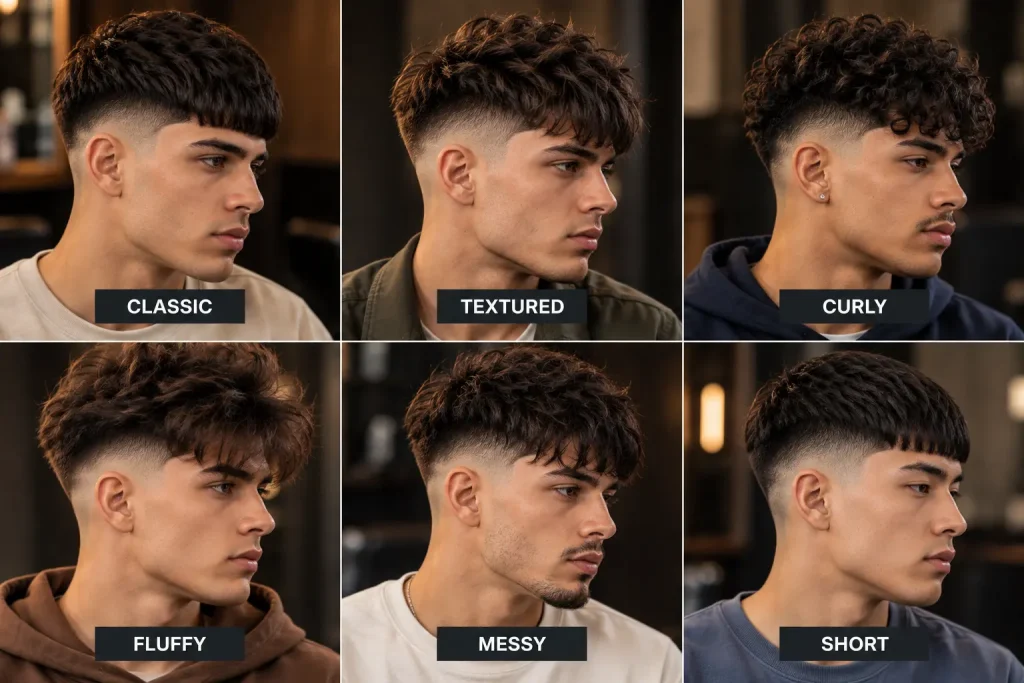
If You Want the Fringe to Lead: Classic High Taper Edgar
Keep the top relatively controlled and let the recognizable forward fringe establish the Edgar shape.
Because the sides already provide noticeable contrast, the top doesn’t need extreme texture or height to look deliberate.
This is one of the clearest ways to keep the haircut recognizably Edgar while using a higher transition.
If You Want Separation: Textured High Taper Edgar
Breaking the top into visible sections makes the difference between the shorter sides and longer upper hair more apparent.
Texture works particularly well when you want movement without adding substantial height.
The important part is controlled weight removal. Texture should create separation—not leave the top looking thin or randomly chopped.
If Your Curls Should Be the Feature: Curly High Taper Edgar
Natural curls can create substantial volume above a high transition.
That means contrast can become strong quickly: fuller curls above, much shorter hair below.
Keep enough length for the curl pattern to form properly and decide how much of that pattern you want continuing into the fringe.
For curl-specific cutting, styling and maintenance, our Curly Edgar Haircut guide goes much deeper.
If You Want Height as Well as Contrast: Fluffy High Taper Edgar
This is a stronger visual combination.
A high transition reduces side weight while the fluffy top expands upward, increasing the difference between the two areas in both directions.
That can work well when intentional, but there is no need to exaggerate the volume.
A genuine Fluffy Edgar should still move forward toward a recognizable fringe rather than turning into a quiff or pompadour.
Our Fluffy Edgar Haircut guide covers the root lift and styling side of that decision.
If You Prefer Imperfection: Messy High Taper Edgar
The clean side structure can support a deliberately less controlled top.
But “messy” shouldn’t mean the Edgar shape disappears.
Keep enough forward direction and fringe definition that the haircut still reads as an Edgar rather than a generic messy crop.
If You Want Less Daily Work: Short High Taper Edgar
A shorter top reduces styling possibilities but also reduces the amount of hair you need to manage.
With less texture and movement above, however, the transition and fringe become more visually important.
The cut has fewer places to hide poor execution.
Your Hair Can Make the Same High Taper Look Completely Different
This is one reason copying a reference photo exactly can fail.
Two people can receive a transition at approximately the same height and walk out with haircuts that feel very different.
Straight hair tends to expose the geometry clearly. The fringe, top outline and side transition can all look more defined.
Wavy hair introduces movement above the shorter sides, which can soften an otherwise strong transition.
Curly hair often creates considerably more upper volume. That can make the contrast look stronger without changing the taper height at all.
Thick hair can produce a dramatic density change between the full top and shorter side. Good blending above the transition becomes especially important.
Fine or lower-density hair needs more caution. Removing too much visual weight from the sides while heavily texturizing the top can leave the haircut looking less substantial than intended.
This becomes particularly important when choosing a High Taper Fade Edgar, because a closer side finish can increase the apparent density difference between the sides and top.
So when you’re collecting reference photos, don’t only look for the haircut name.
Look for hair that behaves somewhat like yours.
That one choice can make your reference much more useful to your barber.
A High Taper Changes Proportion, Not Your Face
You will often see hairstyle advice claiming that a particular haircut is “for” one face shape and not another.
That’s too simplistic.
A high transition changes visual proportions.
By removing more side weight, it can make the sides appear narrower and direct more attention toward the upper part of the haircut.
Then the top changes that effect again.
A tall fluffy top can add apparent vertical height.
A flatter top keeps the silhouette more compact.
A wide, blunt fringe emphasizes the forehead differently from a softer or more textured fringe.
So instead of asking:
“Is my face shape allowed to have a High Taper Edgar?”
ask:
“Do I want less width at the sides and more attention on the top?”
Then adjust the top and fringe around your actual proportions.
That gives your barber something useful to work with instead of forcing your face into a category.
Before the Clippers Start, Make These Four Decisions
This is the part worth sorting out before you’re sitting in the chair.
1. Where Should the Transition Start?
Show the side view.
Point to the height.
Don’t rely only on saying “high.”
2. How Close Should the Bottom Become?
Do you want visible darkness?
A closer fade?
Skin exposure?
These are not automatically answered by choosing a high transition.
If you’re asking for a High Taper Fade Edgar Haircut, this is especially important. “Fade” still doesn’t tell the barber exactly how close you want the shortest section.
3. How Much Weight Should Remain Above It?
This controls whether the top still feels connected to the sides or appears dramatically separated.
If you like some darker structure beneath the top, say so before the barber removes it.
4. What Is Happening on Top?
Choose the priority:
compact / textured / curly / fluffy / messy / short
Then decide how you want the fringe finished.
Those four decisions communicate far more than repeating the haircut name several times.
Try This Instead of Saying “Just Give Me a High Taper Edgar”
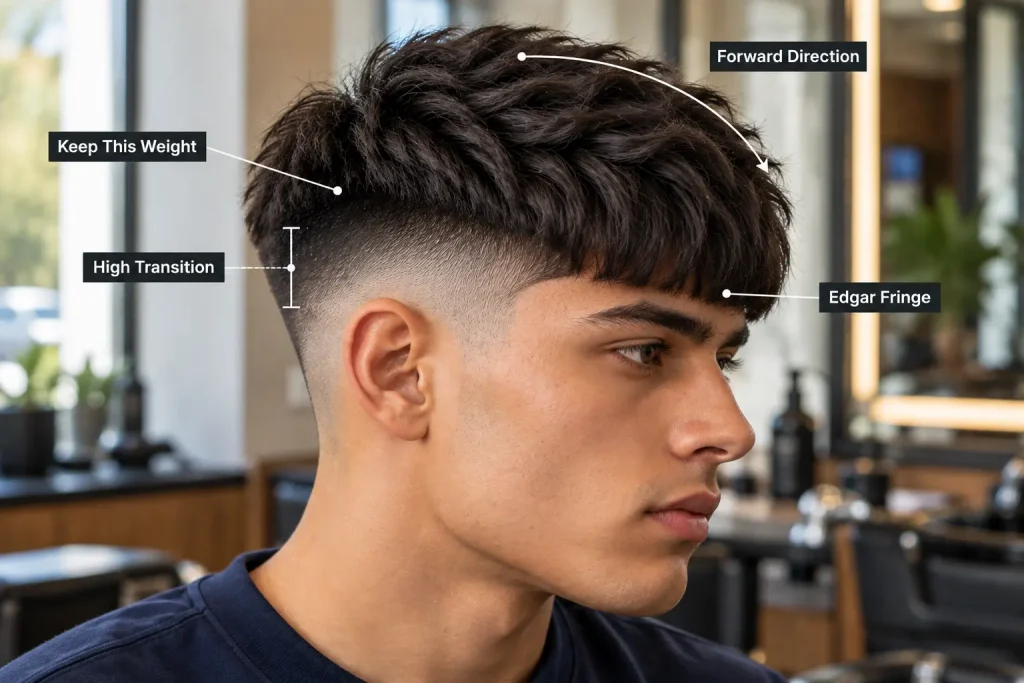
Show your barber a clear side reference and say:
“I want the Edgar shape on top with the transition sitting high on the sides. Keep enough weight above the transition for this kind of connection, and match the closeness at the bottom to this photo. Keep the hair moving forward into the fringe.”
Then explain one thing about the top:
“Keep my curls defined.”
or
“Give the top more separated texture.”
or
“I want some lift, but not a quiff.”
If your reference is specifically a High Taper Fade Edgar, point out the faded area as well. Don’t assume the word “fade” alone will reproduce the picture.
That’s enough.
A useful picture plus a few specific instructions is better than trying to speak like a barber.
Five Signs the Cut Is Drifting Away From What You Asked For
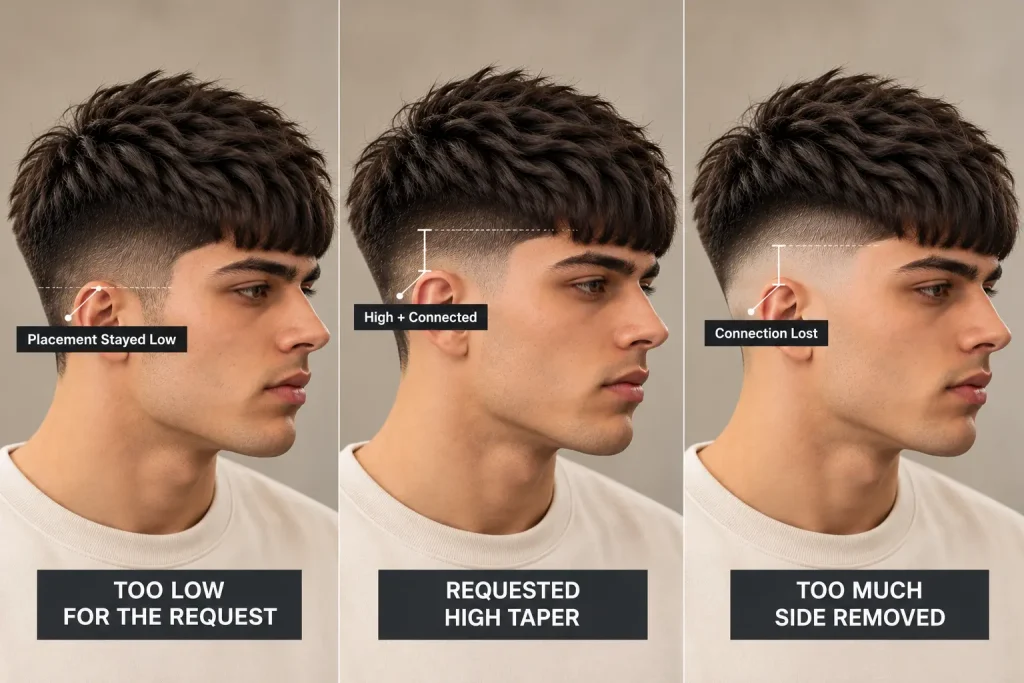
This is where knowing the haircut helps before the cut is finished.
The Transition Is Sitting Closer to the Ear Than Expected
You may actually be getting something closer to a Mid Taper Edgar.
If High is important to you, compare the placement with your side reference before the haircut is complete.
Almost All the Side Weight Has Disappeared
A high transition does remove more weight, but that doesn’t mean every High Taper Edgar needs the entire side aggressively faded.
If your reference retains darkness above the transition, yours should too.
The Top Has Become Disconnected
Strong contrast and disconnection are not the same thing.
There should still be a deliberate relationship between the longer upper hair and the shorter side unless a disconnected look is specifically what you requested.
The Fringe Has Disappeared Into a Generic Crop
The side treatment shouldn’t erase the haircut’s identity.
If you wanted an Edgar, the forward top and recognizable fringe still matter.
“High” Has Been Interpreted as “Skin”
Transition height and shortest length are separate choices.
Even a High Taper Fade Edgar Haircut does not automatically have to end in bare skin.
If you don’t want exposed skin, say that explicitly.
None of these automatically means the barber has performed a bad haircut. They mean the result may be moving away from the High Taper Edgar you intended to request.
Styling Changes With the Top, Not With the Taper
The high transition itself doesn’t require a complicated styling routine.
Most of your daily work happens above it.
For a compact or short top, direct the hair forward and control the fringe without loading it with product.
For a textured top, work a small amount of lightweight product through the hair and separate sections rather than coating the surface.
For a curly top, preserve curl definition and avoid manipulating the hair until it becomes unnecessarily frizzy.
For a fluffy top, create lift at the roots first and then guide the hair forward. Product should support the shape rather than manufacture all the volume by itself.
The useful rule is:
Style for the top you chose. Let the high transition do its own visual work.
You don’t need to exaggerate both.
Watch the Contrast as the Hair Grows
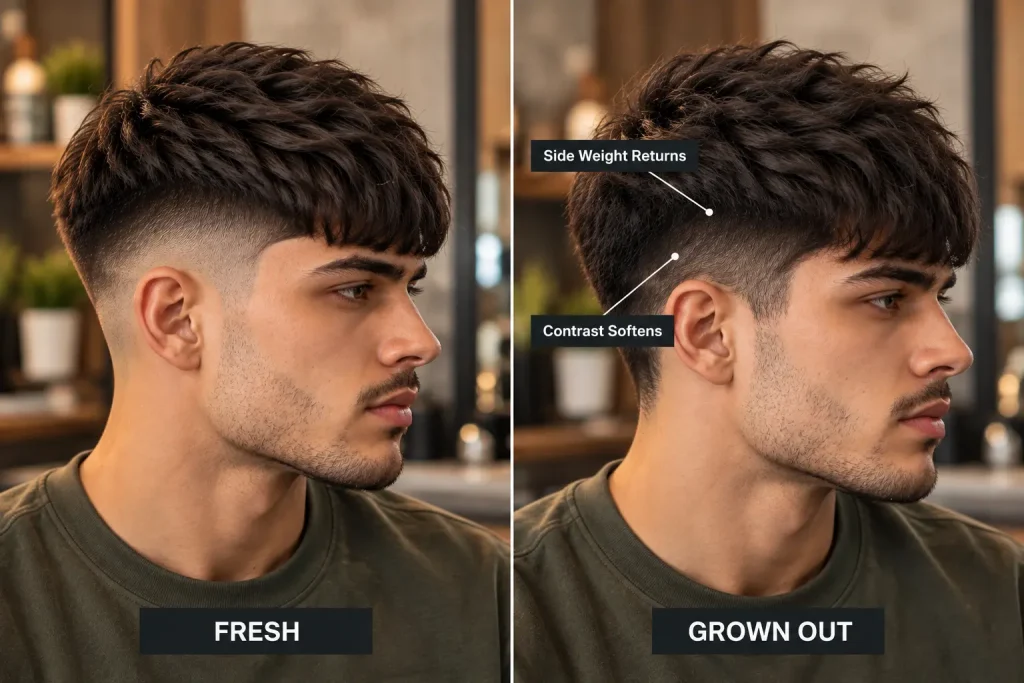
A High Taper Edgar does not suddenly stop working on a particular day.
It changes gradually.
The shortest areas begin filling in.
The sharp difference between short and long becomes softer.
More visual weight returns through the sides.
The transition becomes harder to identify.
Meanwhile, the fringe and top continue growing too, so the overall proportion starts shifting from both directions.
A close High Taper Fade Edgar Haircut may show that change more obviously because the fresh haircut started with greater contrast. A softer high taper can look less dramatic as it grows.
Rather than following a universal number of days between cuts, use the haircut itself as your indicator.
If you chose High because you liked the visible contrast, the loss of that contrast is the useful signal.
You may only need the sides and edges refreshed, or you may want the top reshaped as well. That depends on which part has stopped behaving the way you want.
Before You Choose High, Answer These Three Questions
Forget the haircut name for a moment.
Do You Actually Want Less Hair Showing Through the Sides?
If the answer is no, look at a Low Taper Edgar instead.
Do You Want the Transition to Be Clearly Noticeable?
If you want some definition but not such strong side exposure, Mid Taper Edgar may be closer to what you’re imagining.
Do You Want the Top to Become More Visually Dominant?
If yes, High starts making sense.
Once those answers line up, choosing the top treatment becomes much easier.
You aren’t choosing High because it sits at one end of a haircut chart.
You’re choosing it because the extra contrast is part of the look you want.
High Taper Edgar FAQs
Is a High Taper Edgar the Same as a High Taper Fade Edgar?
Not necessarily.
Both can describe an Edgar with the transition positioned relatively high on the sides, but adding “fade” commonly suggests a more visibly faded or closer finish.
Because terminology varies between barbers, show the transition height and side finish you actually want rather than relying only on either name.
What Is a High Taper Fade Edgar Haircut?
It generally combines the forward fringe and top structure of an Edgar with a high-positioned transition that is visibly faded through the sides.
The exact height, shortest length and amount of weight preserved above the fade can vary, so reference photos remain important.
Does a High Taper Edgar Have to Show Skin?
No.
A high transition describes placement, not an automatic requirement to take the shortest section down to bare skin.
Is a High Taper Edgar More Dramatic Than a Mid Taper Edgar?
Moving the transition higher generally removes more side weight and increases the visible difference between the top and sides.
How dramatic the finished haircut appears also depends on hair density, top volume and how closely the sides are faded.
Can Curly Hair Work With a High Taper Edgar?
Yes.
Curly hair can create substantial volume above the shorter sides, so the contrast may be particularly noticeable. Keeping enough upper length for the curl pattern to form is important.
Can I Get a High Taper Edgar Without a Perfectly Straight Fringe?
Yes.
The fringe can be softer or more textured while maintaining the forward direction that keeps the haircut recognizably Edgar.
What Should I Show My Barber?
A side photo is particularly important because it communicates transition height, fade finish and retained side weight.
Add a front reference if you also want to show the exact fringe and top shape.
Should I Choose a High Taper or High Fade Edgar?
Choose based on the result rather than the label.
Look at how much side weight you want preserved, how close you want the shortest area and how strong you want the top-to-side contrast to appear.
Show those details to your barber instead of relying solely on either name.