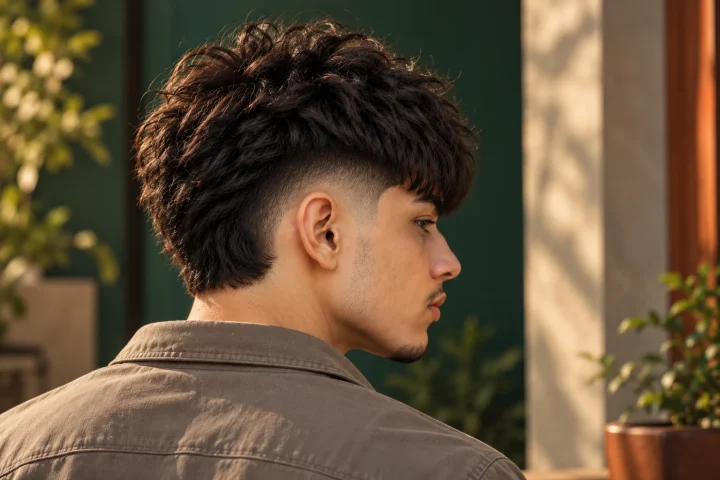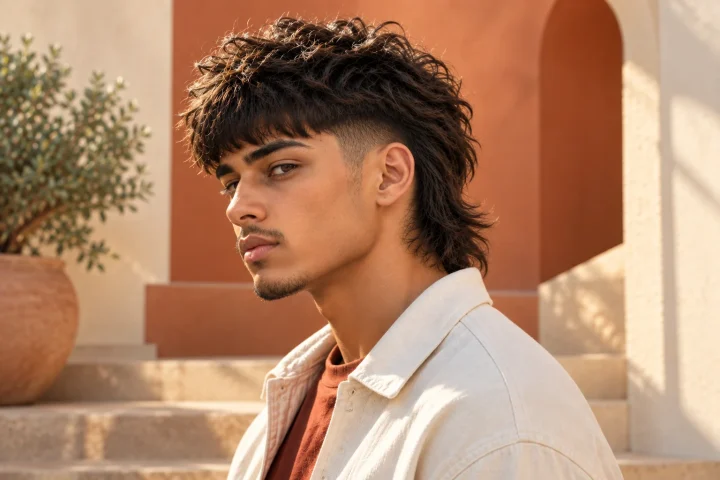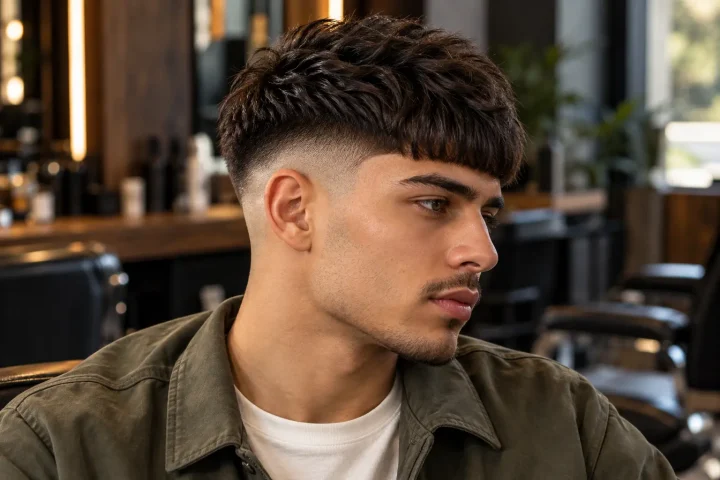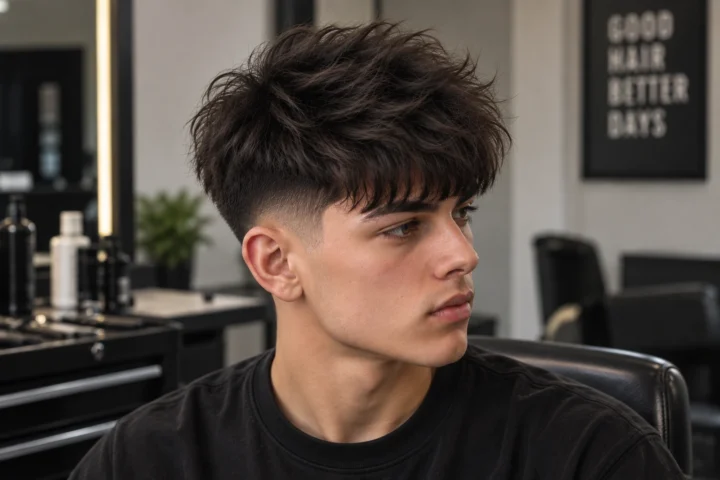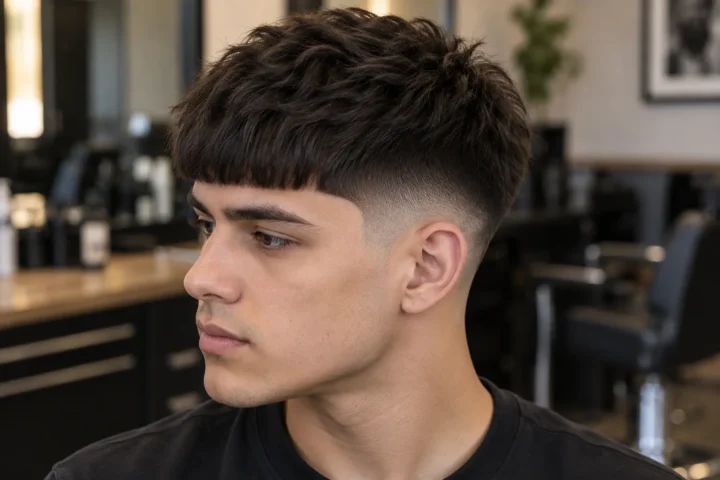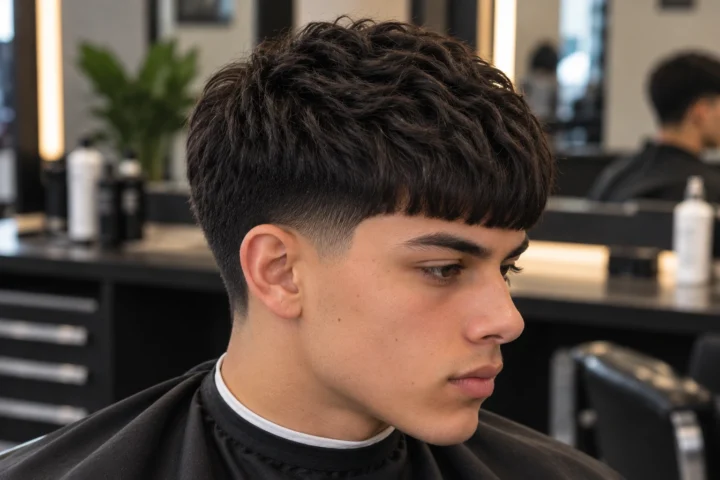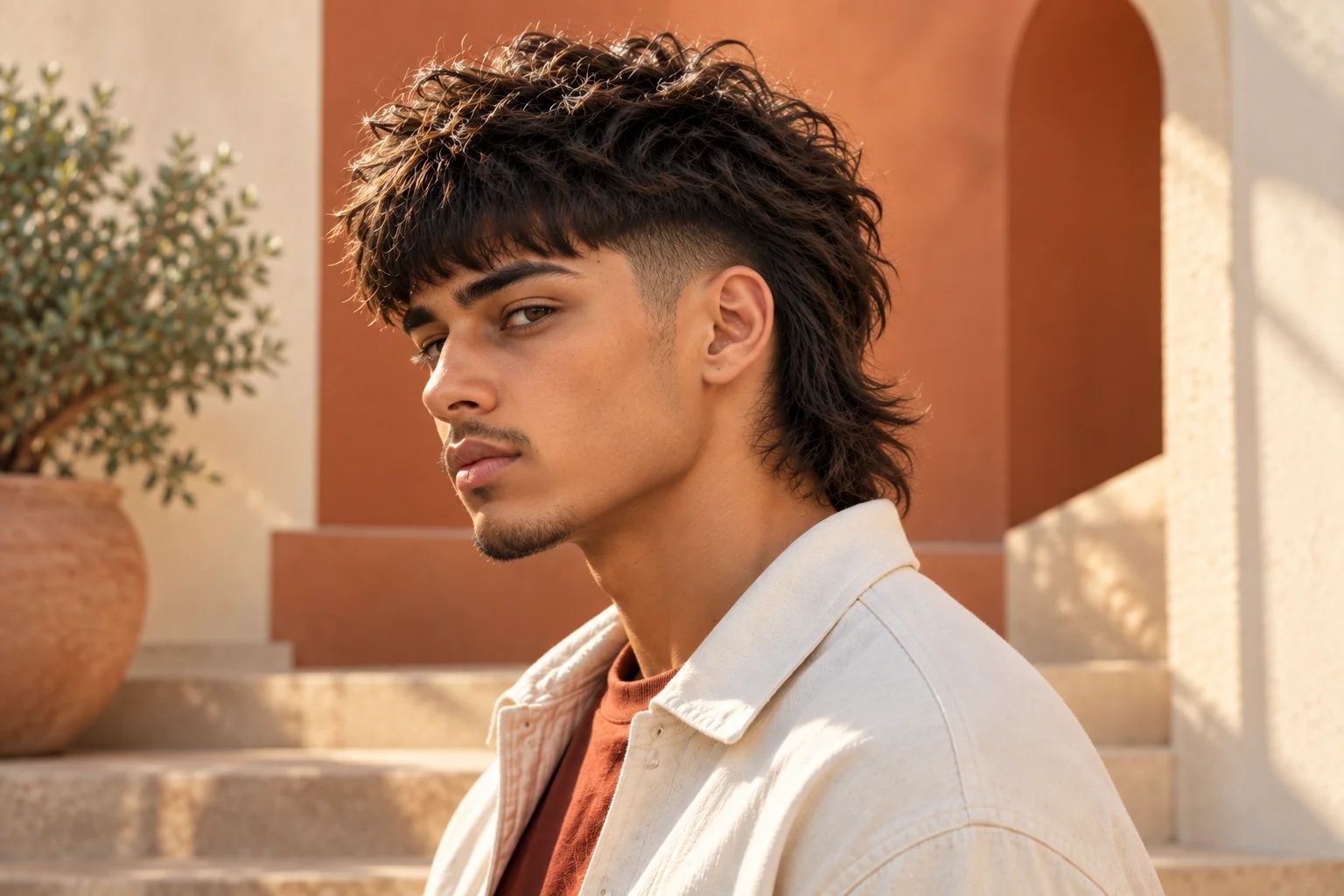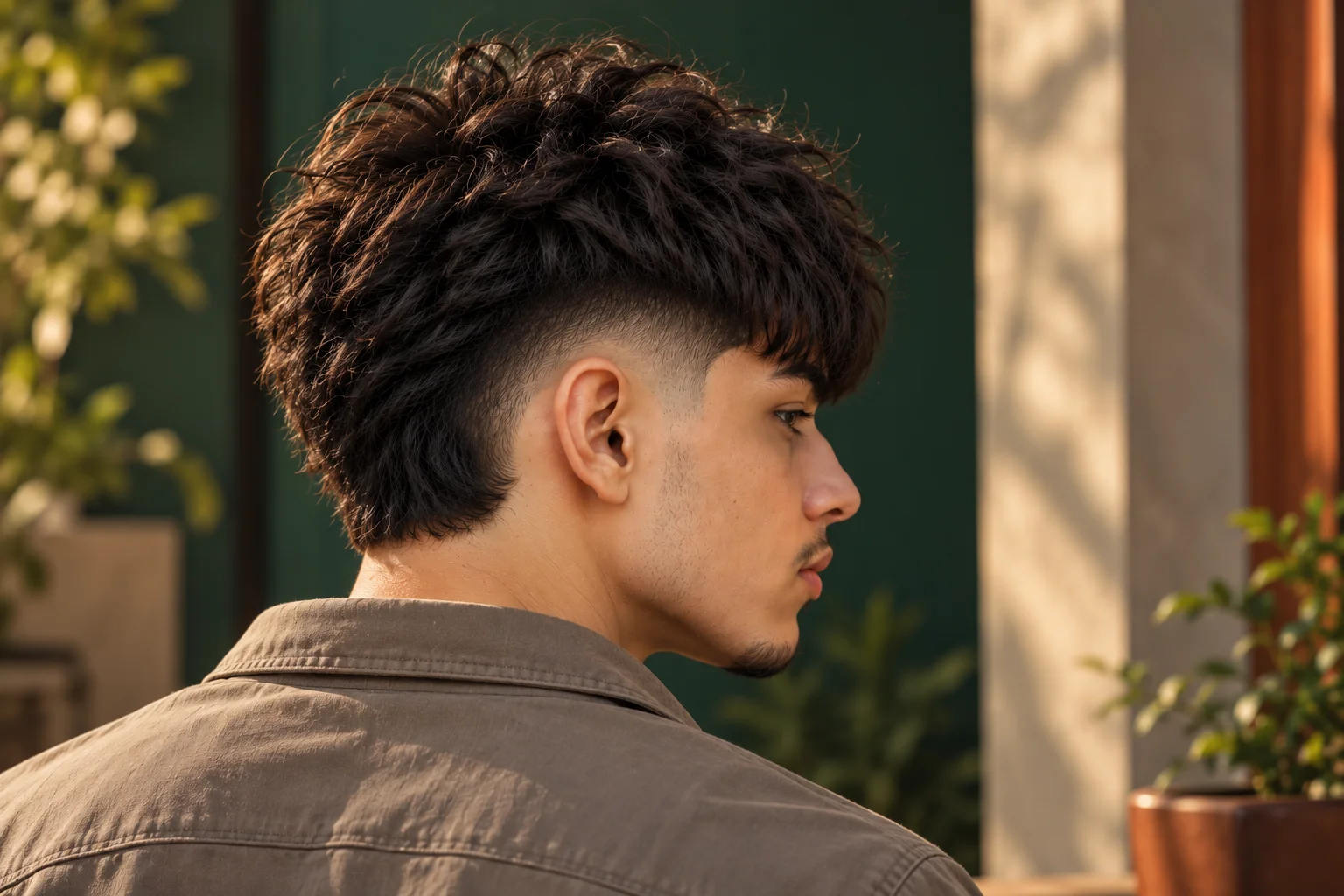

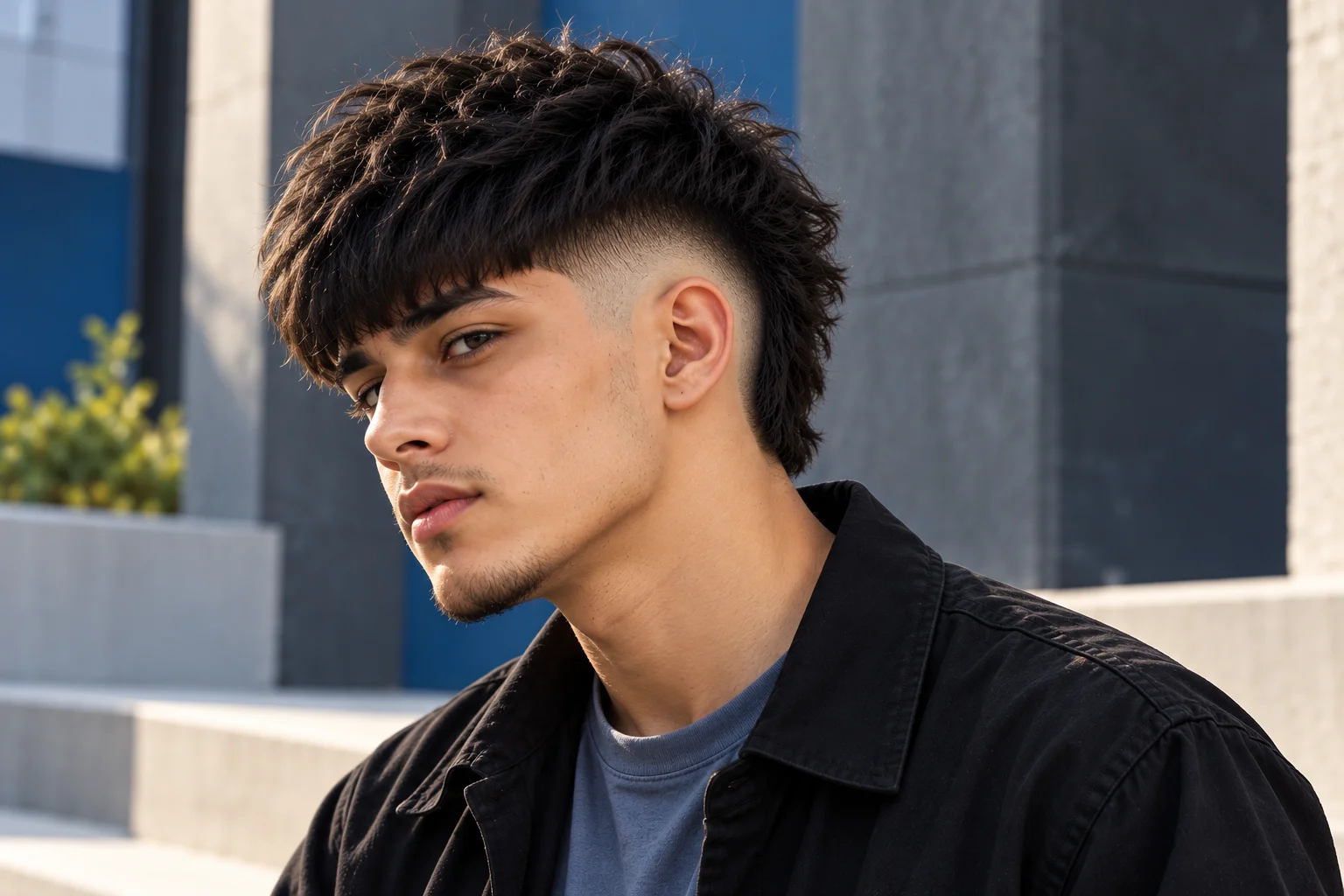
Two haircuts can both be called a Burst Fade Edgar and look surprisingly different. One may have a small, low curve around the ear with plenty of weight left behind it, while another exposes much more of the side. Add a fluffy top, curls, heavier texture or extra length at the back, and the result changes again.
That is why asking your barber for a Burst Fade Edgar haircut is only the beginning. The recognizable Edgar front and curved burst around the ear establish the basic idea, but the burst placement, how close the fade goes, fringe shape, top texture and amount of hair kept toward the back determine the haircut you actually leave with.
This guide will help you make those decisions before the clippers start. If you are still deciding between different Edgar variations, our Edgar Haircut guide explains the wider haircut family and where the burst fade fits within it.
What Actually Makes It a Burst Fade Edgar?
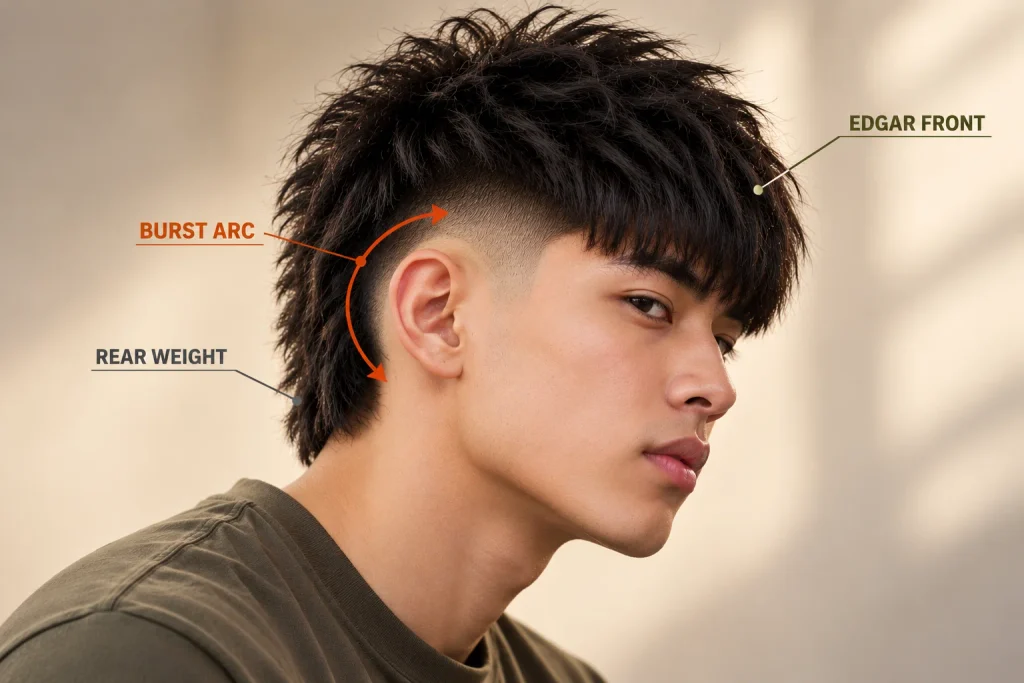
A Burst Fade Edgar combines two recognizable elements. The Edgar provides the front and upper identity: hair directed forward, usually with a noticeable fringe and enough structure through the top to keep the familiar Edgar shape.
The burst fade changes the side. Instead of treating the side as one broad, level transition, the shorter area follows a rounded path around the ear. That curved, ear-centered shape is what gives an Edgar haircut with a burst fade its distinctive side profile.
Think of the haircut as three interacting areas:
EDGAR FRONT → BURST AROUND THE EAR → WEIGHT TOWARD THE REAR
The first establishes the Edgar. The second creates the burst. The third has a major influence on whether the finished haircut looks compact, strongly contrasted or starts moving toward an Edgar Mullet.
The mistake is choosing only the fade. You need to decide how all three areas should work together.
The Ear Is the Center of This Haircut
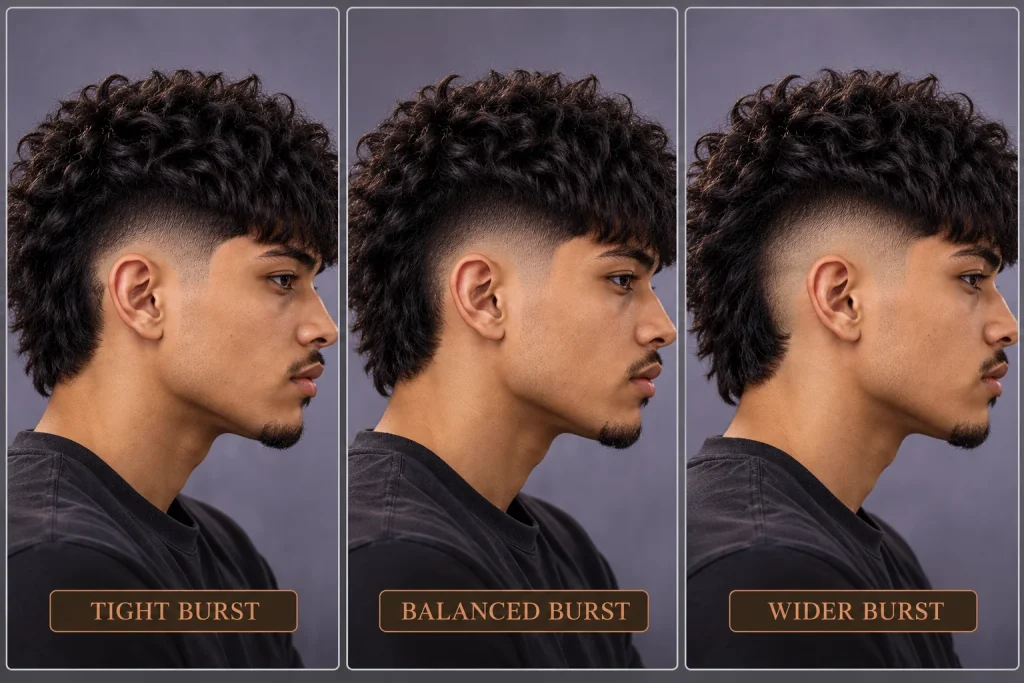
If you want to understand a Burst Fade Edgar quickly, look at the ear. That is where the main visual action happens, but knowing this still does not tell your barber exactly how you want yours built.
Four details make the biggest difference.
1. Where the Burst Sits
A Low Burst Fade Edgar keeps the curved transition relatively close to the ear, allowing more visual weight to remain above it. Move that transition higher and more of the side becomes exposed, increasing the contrast between the top and the faded area.
So there are really two separate decisions: what shape should the fade follow, and how high should that shape reach? The burst describes the curved pattern around the ear; low or high describes its placement. They are not the same decision.
2. How Close Should It Go?
A burst does not automatically mean that the shortest section must be taken completely to skin. The area around the ear can be finished very close or kept slightly softer, which means two Burst Fade Edgars at approximately the same height can still create very different levels of contrast.
If you do not want much visible scalp, show your barber that in your reference rather than assuming the word burst communicates it.
3. How Wide Should the Burst Feel?
Look at how far the short area spreads around the ear. A tighter burst keeps the dramatic change relatively localized, while a broader treatment removes more surrounding weight and makes the side more visually dominant.
This is one reason copying only the fringe from a reference can go wrong. The side geometry may be doing far more work than you realize.
4. What Happens Behind the Ear?
This is the detail people often miss. How much hair remains behind the burst affects the entire silhouette.
Keep more weight and the haircut can feel fuller and more connected. Remove more and the contrast becomes stronger. Preserve considerably more length through the crown and nape, and the haircut can begin moving toward a Burst Fade Edgar Mullet.
We will come back to the back because it deserves its own decision.
Before You Choose a Photo, Make These 4 Decisions
You do not need to know barber terminology perfectly. You do need to know what you want to see in the mirror.
How Much Scalp Do You Want to See?
Start here. If you like strong contrast, you may prefer a closer finish around the ear. If you want the haircut to feel softer, choose a reference where the shortest section is not taken as close and more surrounding weight remains.
Do not choose based only on words such as low, high or skin. Choose based on what you can actually see.
How Defined Should the Fringe Be?
The fade gets attention, but the front is what keeps the haircut recognizably Edgar. You can choose a sharper, more solid-looking fringe or a broken, textured front.
Neither changes the basic burst concept, but it dramatically changes how sharp or relaxed the haircut looks from the front.
How Much Hair Should Stay Behind the Ear?
This controls the relationship between the side and back. Look closely at your reference: does the hair immediately behind the burst remain substantial, move into a compact rear, or continue into noticeable length?
Do not assume your barber can determine the answer from a front-facing photo.
What Should the Top Do?
A compact top makes the burst geometry easier to notice. Texture creates movement, fluffy hair creates more volume above the fade, and curls change the silhouette again.
Do not choose the fade first and treat the top as an afterthought. The contrast only makes sense when you know what the burst is contrasting with.
Burst Fade Edgar vs Taper Edgar vs Drop Fade
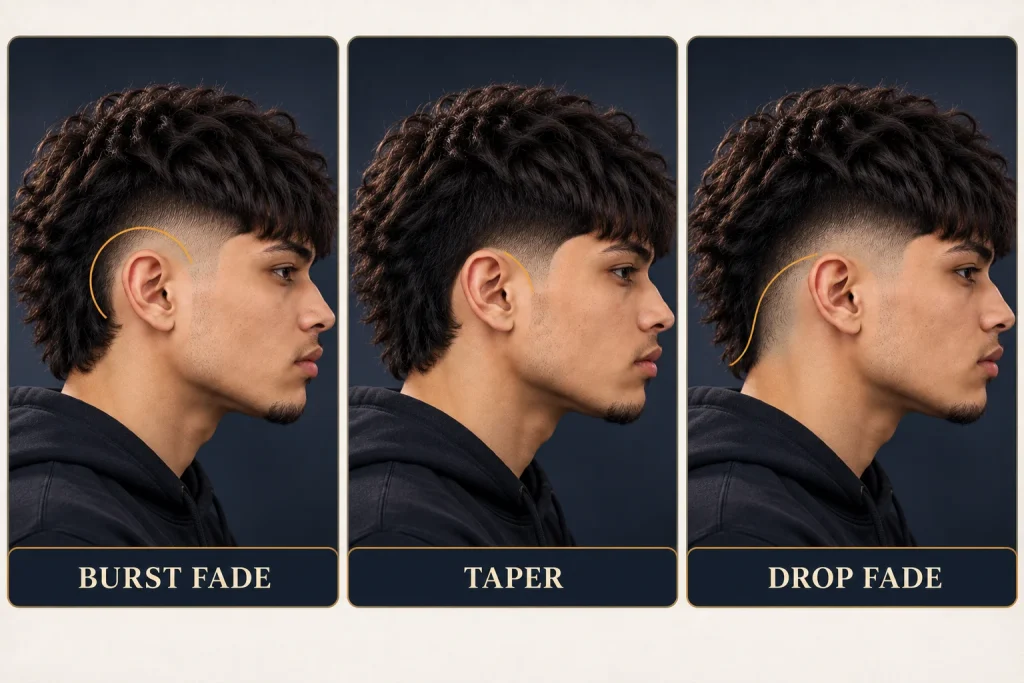
These names are easy to mix up because all three involve changing hair length through the sides. The easiest way to separate them is to stop asking only “How short is it?” and instead ask “Where does the transition travel?”
| Cut | What to Look For | Around the Ear | Overall Effect |
|---|---|---|---|
| Burst Fade Edgar | Rounded transition centered around the ear | Strong visual emphasis | Localized, curved contrast |
| Taper Edgar | More localized shortening around the edges | Usually subtler | More surrounding weight preserved |
| Drop Fade Edgar | Fade line descends toward the rear | Transition continues downward behind the ear | More continuous rear flow |
If you want a cleaner Edgar without making the ear the visual focus, our Low Taper Edgar Haircut guide explains the lower, more restrained approach in detail.
The important point is simple: burst, taper and drop are not interchangeable names for roughly the same haircut. The path and placement of the transition change what you see from the side and back.
Barber terminology can vary slightly between shops, so if you want to understand the technical transition patterns before your appointment, this barber guide to fade types provides a useful visual reference.
6 Burst Fade Edgar Styles That Actually Change the Look
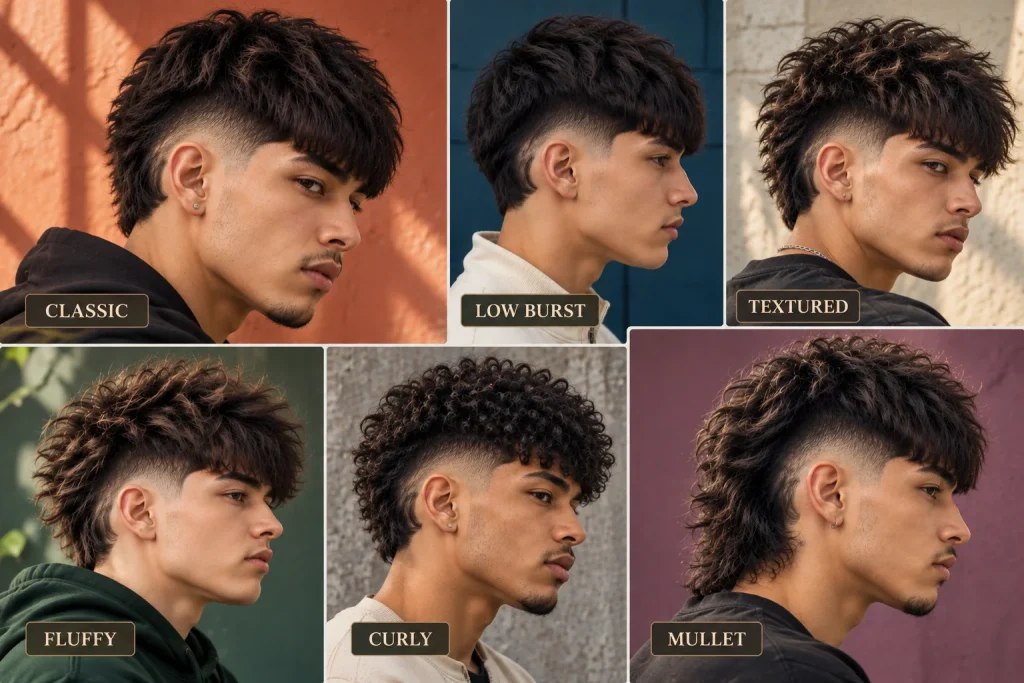
You can find dozens of names for this haircut online, but you do not need dozens of nearly identical variations. These six versions represent changes that actually affect the silhouette or what your barber needs to do.
Classic Burst Fade Edgar
Start here if you want to understand the haircut without additional modifiers. The classic version keeps a recognizable forward Edgar front, controlled top and obvious curved fade around the ear.
The rear retains enough weight to keep the burst localized rather than making the entire side and back feel heavily faded. It is a useful reference when you want the burst itself to be the distinguishing feature.
Low Burst Fade Edgar
A Low Burst Fade Edgar keeps the curved transition relatively close to the ear. Because the short area does not climb as aggressively into the upper side, more surrounding weight can remain.
That makes it a useful direction if you like the burst shape but do not want the side to dominate the whole haircut. Do not confuse it with a low taper, though: the low describes placement, while the burst still needs its recognizable rounded treatment around the ear.
If you are deciding between these two softer-looking directions, compare the shape with our Low Taper Edgar Haircut guide rather than relying on the names alone.
Textured Burst Fade Edgar
A Textured Burst Fade Edgar changes the upper half more than the fade itself. Instead of making the top look uniformly solid, separation and movement through the hair break up the shape.
That can make the transition from the defined Edgar front into the top feel less rigid while the burst keeps the side clean and sculpted. Texture should still look intentional; removing too much weight can leave the top looking thin while the side remains visually strong.
Fluffy Burst Fade Edgar
A Fluffy Burst Fade Edgar creates more lift and visual softness above the curved fade. The fuller top can make the short area around the ear appear even tighter by comparison, even when the burst itself has not been taken especially high.
If you like a fluffy reference, do not show your barber only the side. The top volume is part of why that particular burst looks the way it does. Our Fluffy Edgar Haircut guide goes deeper into creating and controlling that airy upper shape without repeating all of that guidance here.
Curly Burst Fade Edgar
A Curly Burst Fade Edgar lets natural curl volume provide much of the upper silhouette. The rounded fade creates a cleaner area around the ear while the curls retain movement and volume above it.
Curly hair changes the proportions, however. The same length can sit much shorter when curled, while dense curls may create considerably more volume above and behind the faded area. A straight-haired reference may therefore be a poor blueprint if your curls behave very differently.
For curl-specific fringe, shape and styling decisions, our Curly Edgar Haircut guide goes deeper into working with natural curl patterns.
Burst Fade Edgar Mullet
A Burst Fade Edgar Mullet changes the rear rather than simply changing the fade. The Edgar front remains recognizable and the burst still curves around the ear, but deliberate length is preserved through the crown and toward the nape.
The localized shortness around the ear can create strong contrast against that longer rear, but do not assume every Burst Fade Edgar needs a mullet. If the longer back is the feature you actually care about, our Edgar Mullet Haircut guide explains rear length, side connection and the front-to-back relationship in much greater detail.
The Back Can Change the Whole Haircut
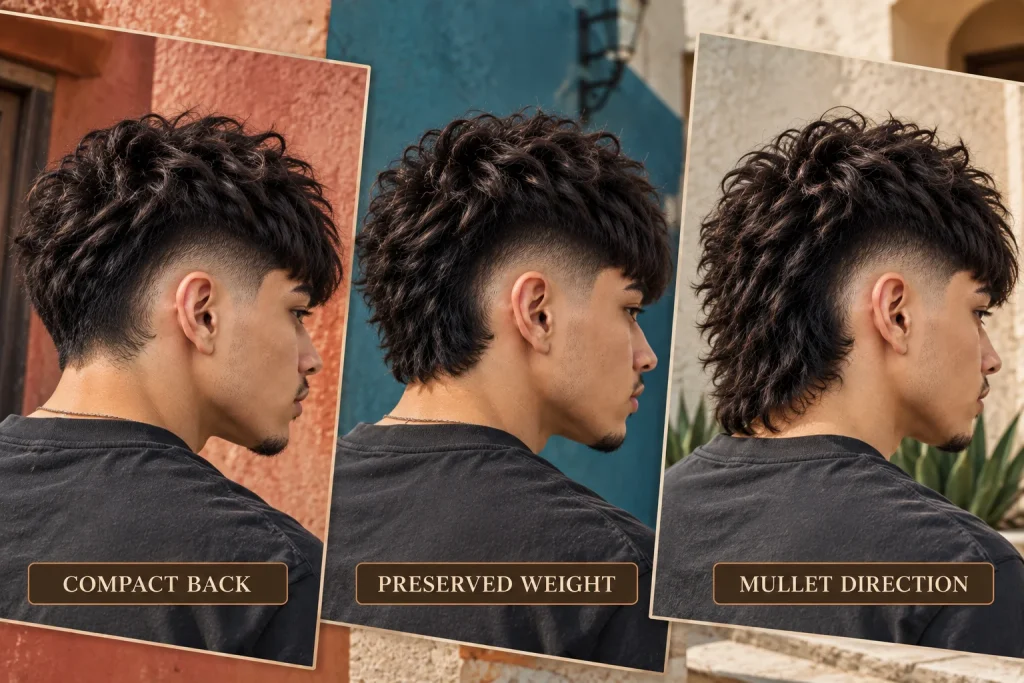
Search for Burst Fade Edgar inspiration and the dramatic side view naturally gets most of the attention. Before choosing one, however, ask a question that side-profile photos often leave unanswered:
What happens behind the burst?
Compact Back
With a compact back, the rear stays relatively controlled. You still see the curved burst around the ear, but there is not enough deliberate nape length for the back to become a separate feature.
This keeps most of the attention on the Edgar front and burst.
Preserved Weight
More hair remains behind the faded area and through the rear. This creates a fuller silhouette and can make the burst look more isolated—almost like a curved section carved into a heavier haircut.
This is where the connection immediately behind the ear becomes particularly important. Too little thought here can make the side and rear look accidental rather than intentionally connected or contrasted.
Mullet Direction
Keep more deliberate length through the crown and nape and the back becomes part of the haircut’s identity. Now the side is doing two jobs: showing the burst and creating contrast with the longer rear.
That is why a side photo alone is not always enough. When the back matters, bring a back reference too.
Your Hair Texture Changes the Result
The burst may follow a similar general path, but the hair surrounding it will not behave the same way for everyone. The goal is not to force every texture into an identical silhouette; it is to make the burst, Edgar front and natural hair behavior work together.
Straight Hair
Straight hair tends to reveal the geometry clearly. The fringe can look especially defined, and the boundary between the fuller top and short burst is easy to see.
That clarity has a downside too: an awkward weight line or poorly controlled transition may be more noticeable.
Wavy Hair
Waves can soften the upper silhouette without hiding the burst. Natural movement through the top and crown can make the transition toward the back feel less rigid.
There is usually little reason to flatten that movement simply to imitate a straight-haired reference.
Curly Hair
Curls can create considerably more volume above the faded arc, making the contrast around the ear especially noticeable. The haircut needs to account for how the curls actually sit when dry rather than judging their length only when stretched.
If your chosen reference has a very different curl pattern from yours, focus on the shape and proportions you like rather than expecting an identical result.
Thick or Dense Hair
Dense hair gives the barber more weight to manage above and behind the burst. That can produce a strong silhouette, but excessive bulk in the wrong area can make the short section around the ear look disconnected rather than deliberately contrasted.
Removing weight should therefore support the intended shape, not simply make thick hair thinner.
What to Show Your Barber — Not Just What to Say
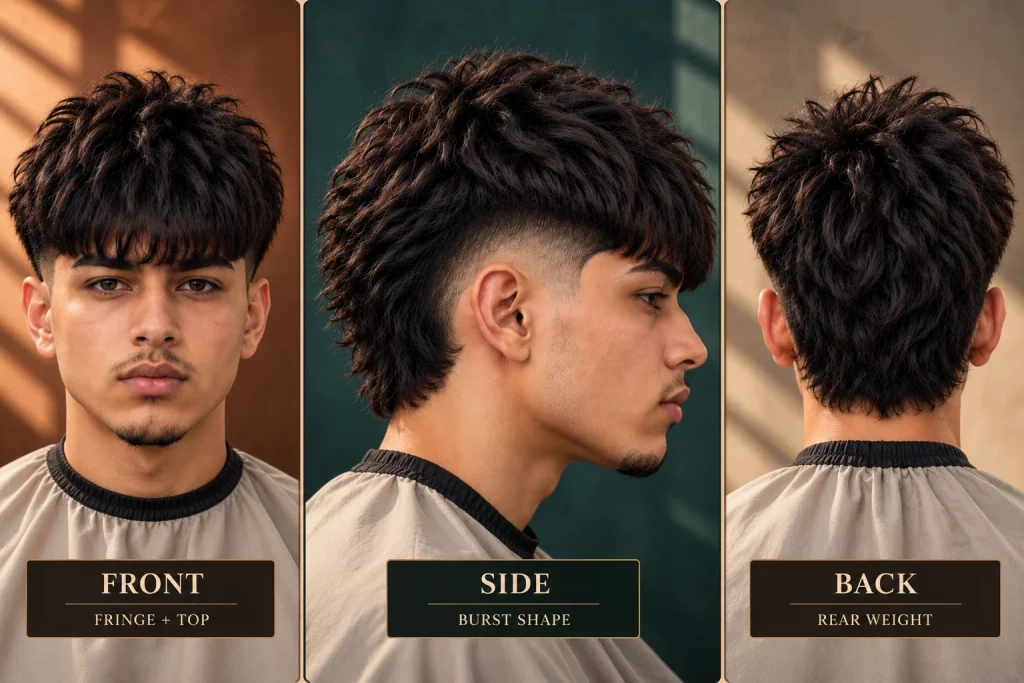
You can walk into the barbershop and say, “I want a Burst Fade Edgar.” Your barber will understand the general direction, but several important decisions are still missing.
A much better reference system uses three views.
Front Photo — Show the Edgar
Use the front view to communicate the fringe shape, top direction, texture and overall front silhouette. If the fringe in your reference is sharp but yours is cut soft and broken, the haircut will look different even if the burst is perfect.
Side Photo — Show the Burst
This is the most important view for communicating the fade itself. Look for where the burst begins, how high it reaches, how close it gets, how broad the curved area is and how much weight remains above and behind it.
Do not simply show a photo and assume the barber knows which detail attracted you. Point to the burst you want.
Back Photo — Show What Happens After the Burst
The back view communicates whether you want a compact rear, preserved weight, additional nape length or a mullet-style direction.
Without this view, your barber may understand the front and side perfectly while still having to guess what you want toward the rear.
A simple way to explain the complete haircut is:
“Keep this Edgar shape in front. I want the burst to curve around the ear at about this height and this close, but keep this amount of weight behind it. Make the back match this reference.”
You do not need to memorize clipper guard numbers. Show the shape you want.
What a Burst Fade Edgar Looks Like as It Grows Out
Different parts of the haircut will not lose their shape at exactly the same time. The close area around the ear may stop looking freshly defined while the longer top still feels completely manageable.
As growth continues, the surrounding side weight fills in, the fringe extends farther forward and the clean curved outline of the burst becomes less obvious. If you are preserving the rear, the difference between the faded area and the back may also become increasingly noticeable.
How soon you need another appointment depends on your hair growth and how crisp you want the burst to remain. Instead of automatically recutting everything, tell your barber which parts you are trying to preserve.
For example, you may only need the burst refreshed, fringe lightly reshaped and rear length preserved. That distinction becomes particularly important if you are intentionally growing toward an Edgar Mullet.
Is the Burst Fade Edgar Right for the Look You Want?
Forget rigid rules about whether the haircut is “for” a particular face shape for a moment. A more useful question is whether you actually like the visual features that make this haircut different.
A Burst Fade Edgar is worth considering if you want:
- a recognizable forward Edgar front;
- visible curved detail around the ear;
- stronger side contrast than a subtle taper;
- control over how much weight remains toward the rear; and
- flexibility to combine the shape with compact, textured, curly, fluffy or longer-backed hair.
You may prefer another Edgar variation if you want very subtle side cleanup, minimal visible scalp, no pronounced curved feature around the ear or a softer-looking transition as the haircut grows.
If that second description sounds closer to what you want, compare the look with a Low Taper Edgar before committing. Neither haircut is automatically better; they create different silhouettes.
Burst Fade Edgar FAQ
What is a Burst Fade Edgar haircut?
A Burst Fade Edgar combines the forward-directed top and recognizable fringe of an Edgar with a rounded fade centered around the ear. The burst changes the side profile while the fringe and top retain the Edgar identity.
What’s the difference between a Burst Fade Edgar and a Taper Edgar?
A Burst Fade Edgar creates a more pronounced curved transition around the ear. A taper generally keeps the shortening more localized around areas such as the sideburns and neckline, producing a subtler side treatment with more surrounding weight.
Can you get a Low Burst Fade Edgar?
Yes. A Low Burst Fade Edgar keeps the rounded burst relatively close to the ear instead of taking the transition much higher into the side. This allows more visual weight to remain above the faded area and can create a less aggressive version of the look.
Does a Burst Fade Edgar work with curly hair?
Yes. A Curly Burst Fade Edgar can use natural curl volume above the ear to create strong contrast with the curved fade. The cut should account for your actual curl pattern, density and how the hair sits when dry rather than copying a straight-haired reference literally.
Can a Burst Fade Edgar have a mullet in the back?
Yes. The burst describes the fade pattern around the ear, while the rear can retain additional crown and nape length. When that longer back becomes a deliberate part of the silhouette, the haircut moves toward a Burst Fade Edgar Mullet.
How do I ask my barber for a Burst Fade Edgar?
Show a front reference for the Edgar fringe and top, a side reference for the height, closeness and shape of the burst, and a rear reference showing how much weight or length you want to keep. Point out the specific features you like instead of relying only on the haircut name.
Get the Shape Right Before the Clippers Start
A Burst Fade Edgar haircut is not defined by how many extra words you can attach to its name. What matters is how its main elements work together.
Start with four decisions: where the burst should sit, how close it should go, how you want the Edgar fringe and top to look, and how much hair should remain behind the ear and through the back.
Once those are clear, terms such as Low Burst Fade Edgar, Curly Burst Fade Edgar, Fluffy Burst Fade Edgar or Burst Fade Edgar Mullet become useful descriptions rather than confusing labels.
Before your appointment, save one front, one side and one back reference that agree with each other. The name tells your barber the general haircut; those three views show the haircut you actually want.