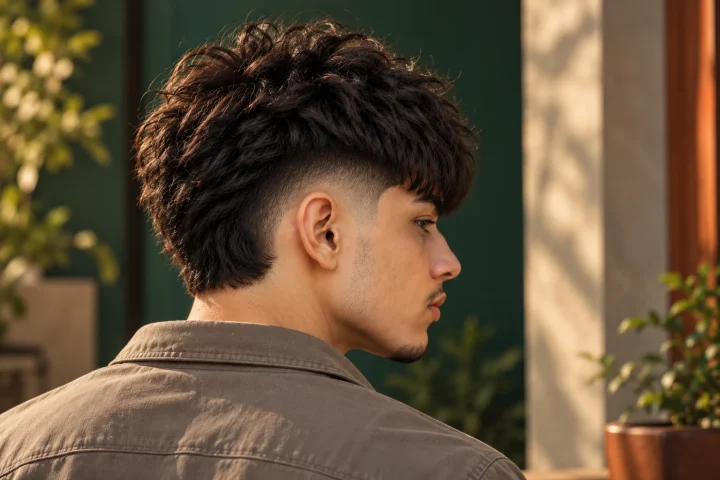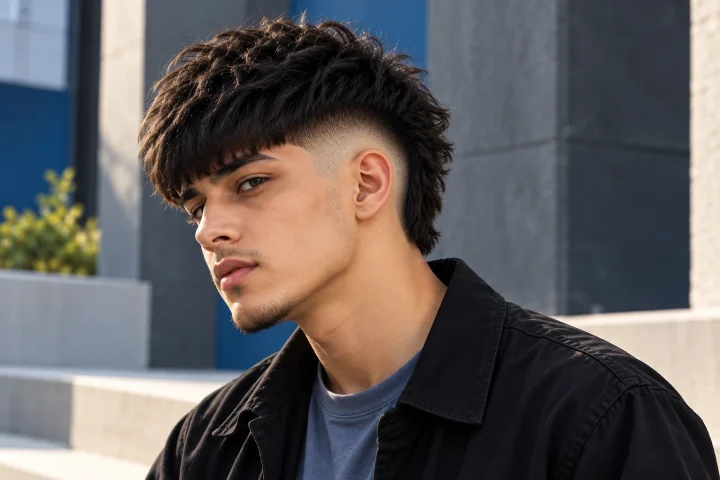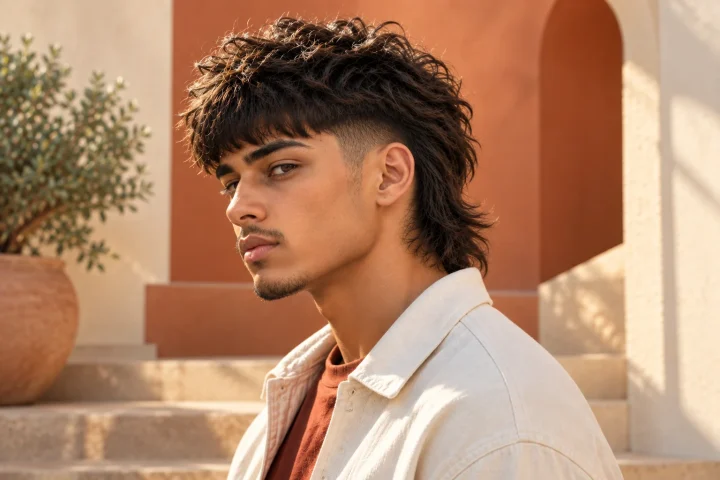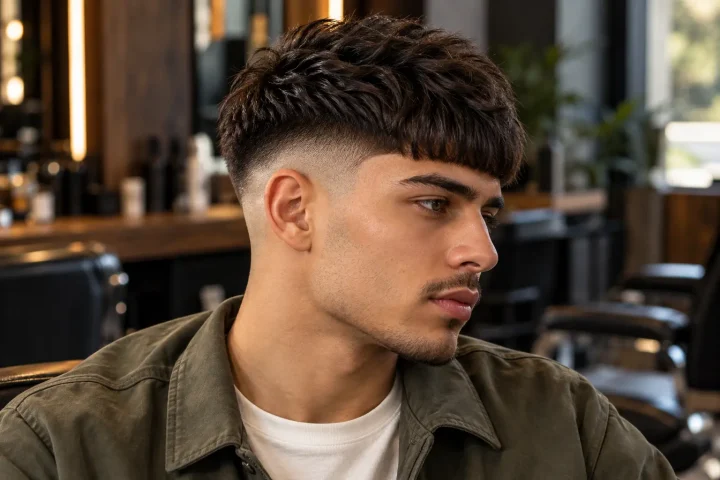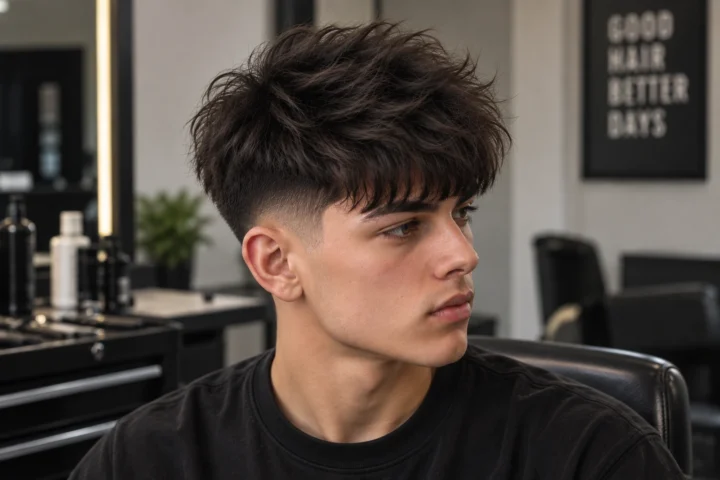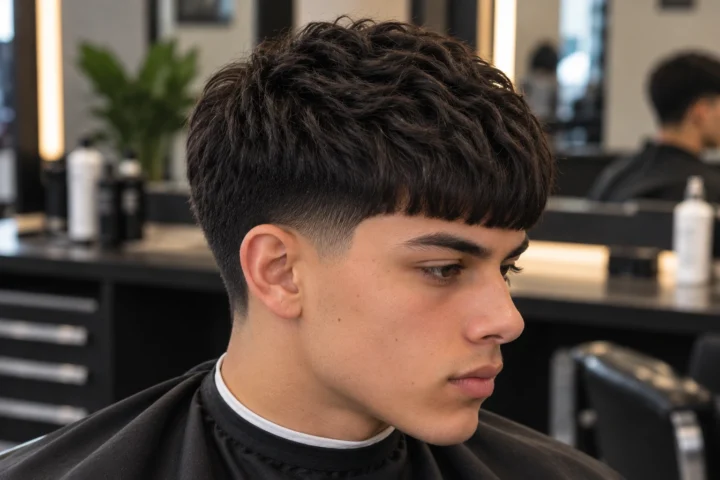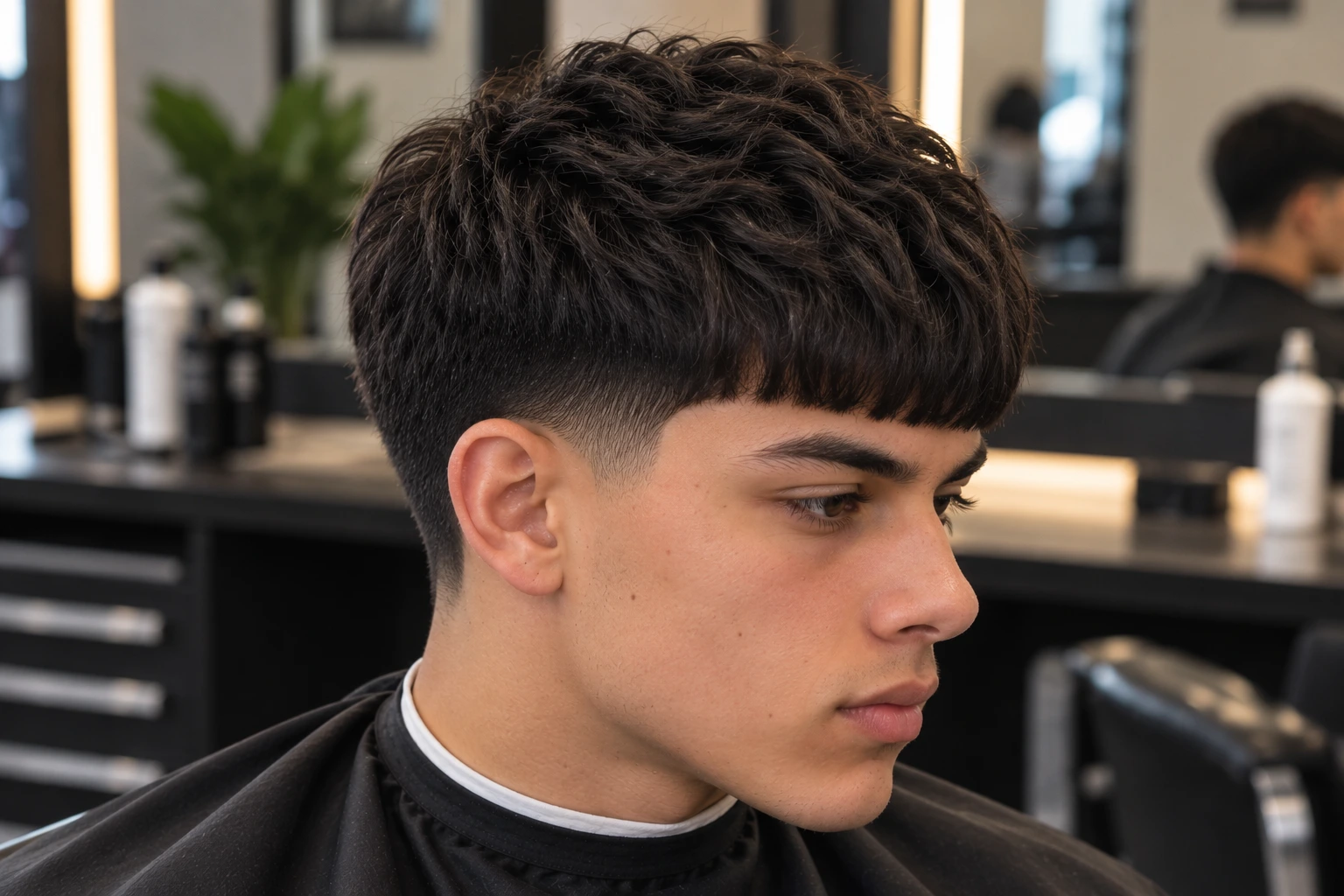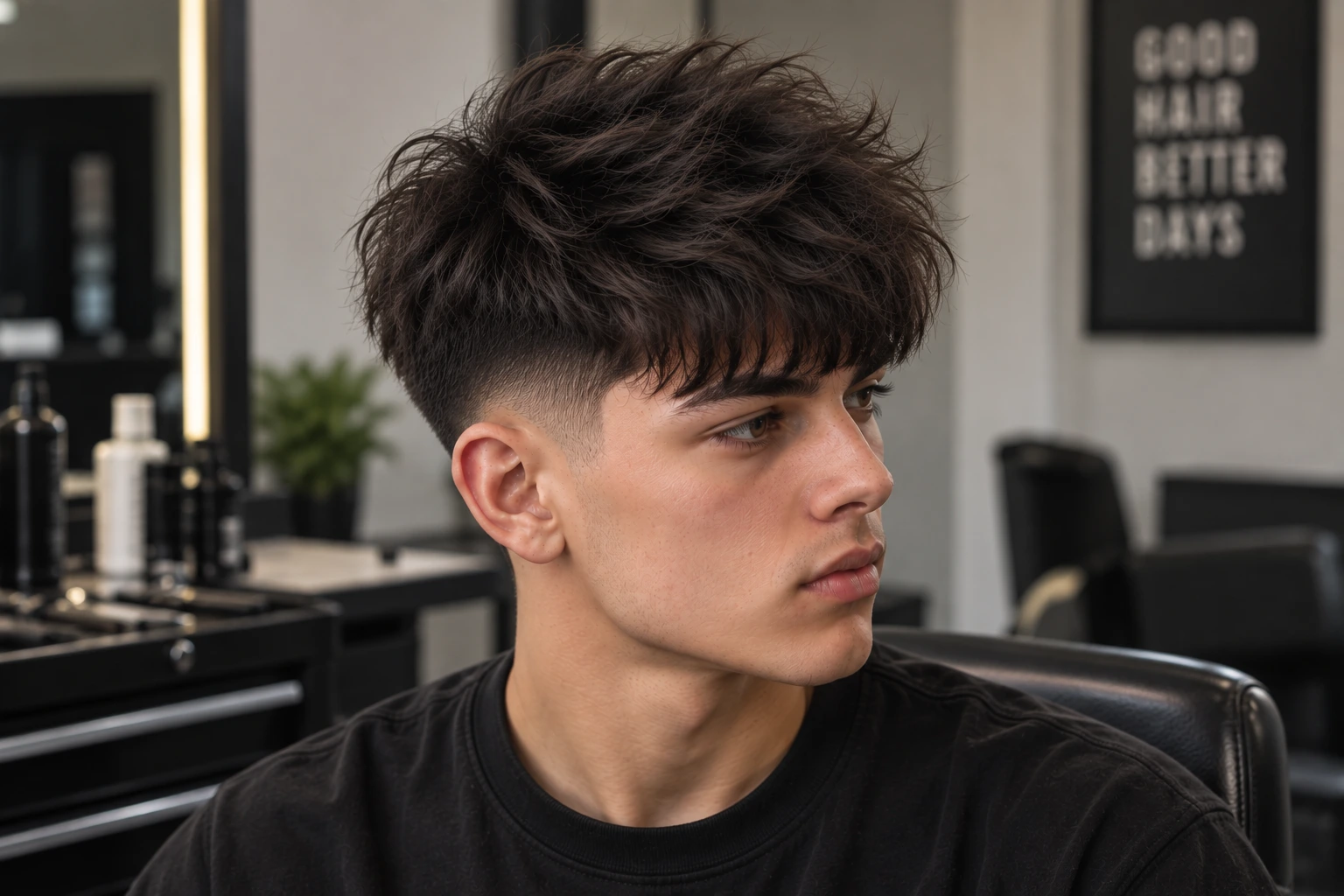

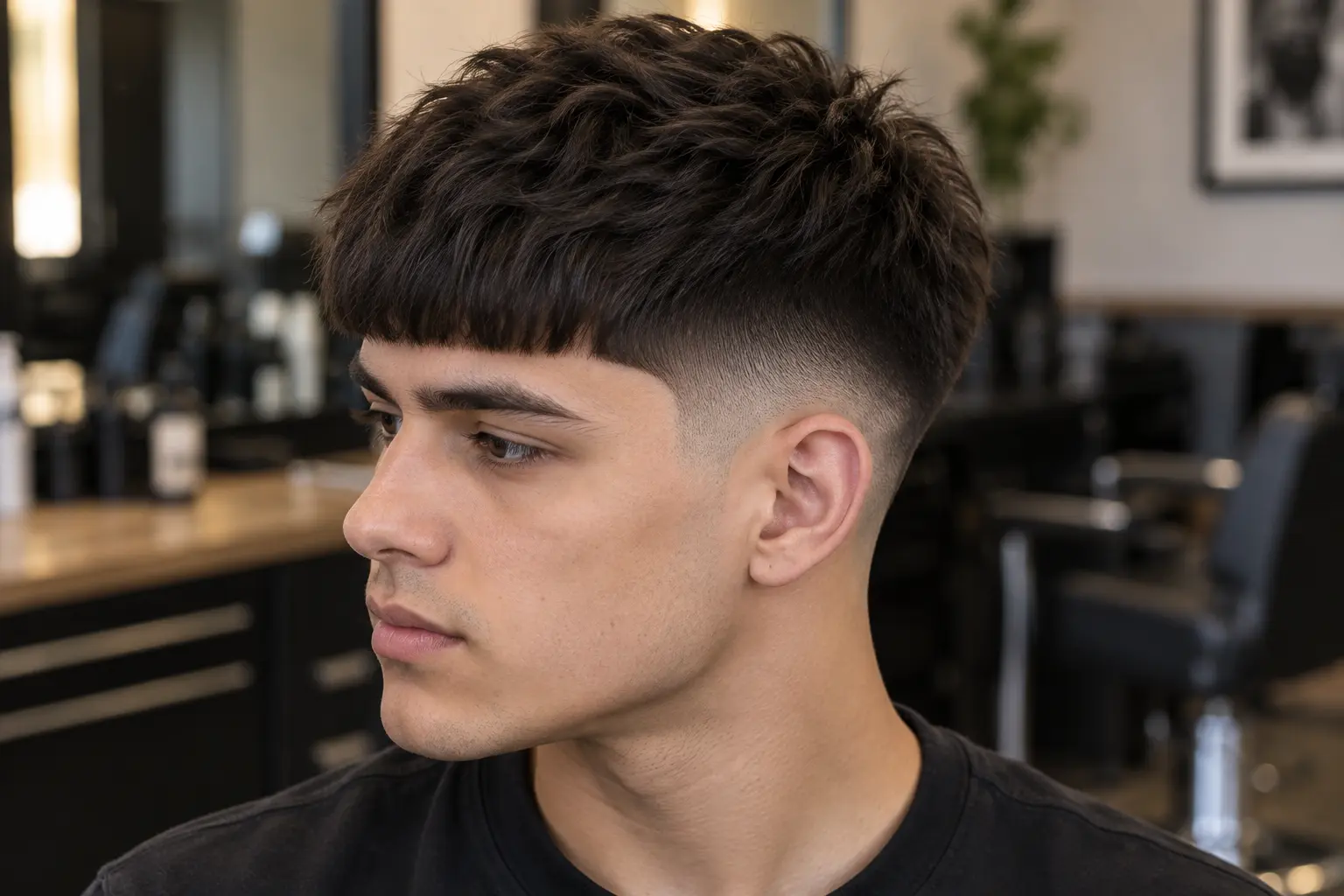
A low taper can feel too subtle. A high taper can create more contrast than you want. The Mid Taper Edgar Haircut sits between those two approaches, giving the sides noticeable definition without making them the most aggressive part of the haircut.
You may also hear this style called a Mid Taper Fade Edgar or Mid Taper Fade Edgar Haircut. Barber terminology is not always used consistently, so the name alone does not tell you exactly how the sides will be finished.
What matters most is where the transition sits, how short it becomes, and how much weight remains above it.
Move that transition lower or higher and the balance of the entire haircut changes.
So before choosing a Mid Taper Edgar, there is one question worth answering: is the middle transition actually the right height for the look you want?
This guide will help you see the difference, choose the right top style and explain the result clearly to your barber. Also, if you want to understand the Edgar haircut as a whole before comparing taper heights, see our Edgar Haircut guide.
First, What Does “Mid” Actually Mean?
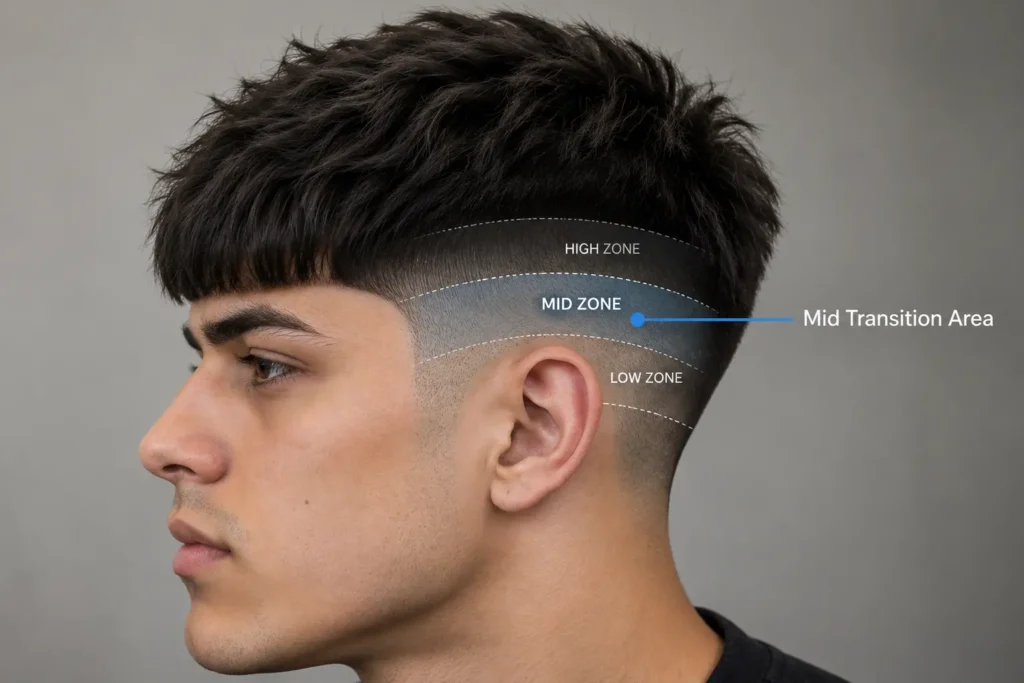
In a Mid Taper Edgar, “mid” describes the general height of the transition on the sides of the head.
It does not describe the length of the hair on top, the length of the fringe or how short the very bottom of the haircut must be.
Think of the side of the head as having three broad transition zones:
- Low: the shortening stays closer to the sideburn, ear and lower edge of the haircut.
- Mid: the visible transition sits farther up the side.
- High: the transition begins higher and removes more visual weight from the sides.
The exact boundaries are not universal. Different barbers may use slightly different terminology and placement, which is one reason a good reference photo is more useful than relying on the word “mid” alone.
The important visual idea is simple: a Mid Taper Edgar makes the transition more noticeable than a low taper while still leaving more connection between the top and sides than a higher, more aggressive treatment.
The Edgar identity still comes primarily from the top: forward-directed hair, a recognizable fringe and the overall shape around the forehead. The mid transition changes how that top connects visually with the sides.
Mid Taper, Mid Fade or Mid Taper Fade: Are They the Same?
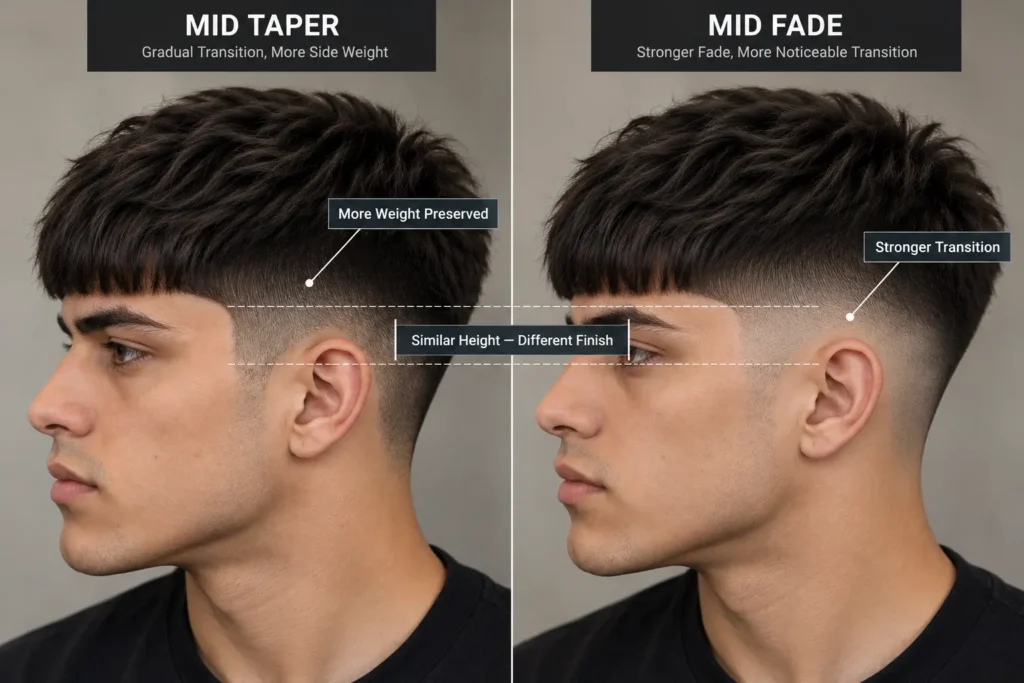
This is where haircut terminology can become confusing.
Search for a Mid Taper Edgar online and you will also encounter names such as Mid Fade Edgar, Mid Taper Fade Edgar and Edgar with a Mid Fade. These labels may describe similar-looking haircuts, but they should not be treated as perfectly interchangeable technical definitions.
A more useful way to understand them is to separate two decisions:
Where should the transition happen?
and
How should that transition be finished?
“Mid” mainly communicates the first decision. It tells your barber approximately where you want the visible transition positioned.
Words such as taper, fade, skin fade or bald fade can influence how the second decision is interpreted.
| Term | What You Should Understand |
|---|---|
| Mid Taper | Focuses on a gradual transition positioned around the middle area of the sides |
| Mid Fade | Usually creates a more obvious faded transition through the middle area |
| Mid Taper Fade | Common wording for a blended middle-height transition |
| What Matters Most | Show your barber the height, amount of side weight and shortest finish you actually want |
This distinction is particularly useful if you are searching for a Mid Taper Fade Edgar Haircut. Two reference photos can carry the same name while showing noticeably different amounts of scalp exposure and side weight.
Do not assume that asking for “mid” automatically means you want the hair taken down to skin.
If you want some darkness left at the bottom, say so. If you prefer a closer fade, show that in your reference photo.
The name starts the conversation. The placement and finish determine the haircut.
See What Happens When the Transition Moves Up
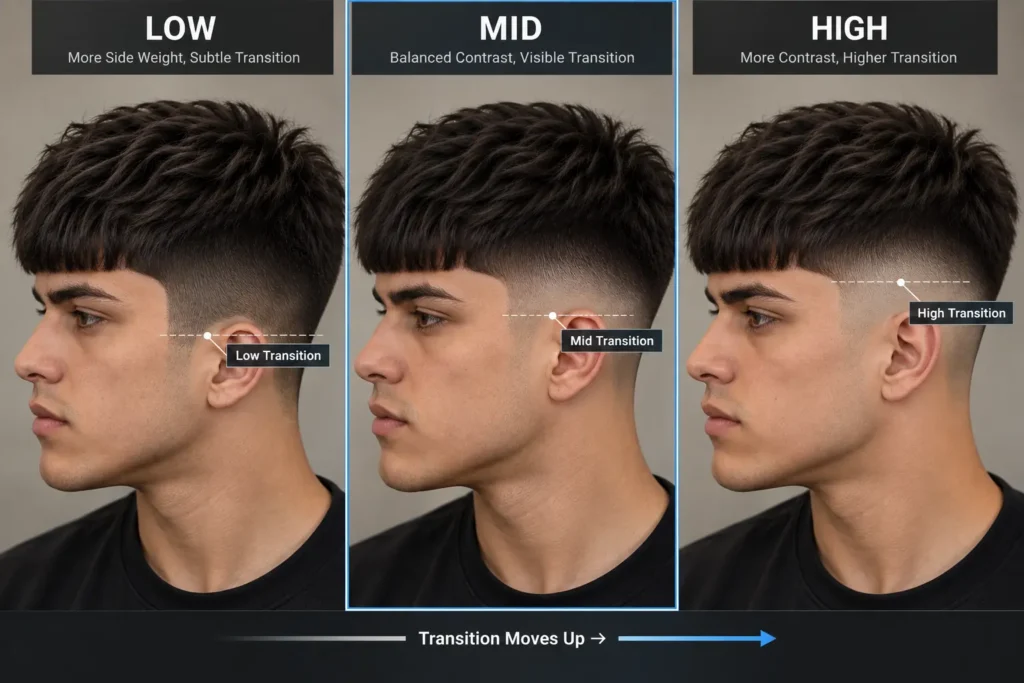
The easiest way to understand a Mid Taper Edgar is not to study it by itself. Compare it with the same Edgar shape using a lower and higher transition.
Keep the top, fringe and hair texture roughly the same and move only the transition height. The difference becomes much easier to see.
Low Transition
A low transition keeps more of the side panel looking full and dark.
Because the shortening happens closer to the lower edges of the haircut, the contrast between the top and sides is less dramatic.
The result can feel softer while still cleaning up the sideburn and lower perimeter.
If that sounds closer to the look you want, our Low Taper Edgar Haircut guide goes deeper into preserving side weight and keeping the transition low.
Mid Transition
Move the transition upward and it becomes easier to see from the side.
There is still enough hair above the transition to connect the top with the sides, but the haircut now has clearer separation and more visible barber work.
That is the main appeal of the Mid Taper Edgar Haircut: the transition is noticeable without automatically becoming the dominant feature of the haircut.
If the lower portion is blended more closely, this same general placement may be described as a Mid Taper Fade Edgar or Mid Fade Edgar depending on the barber and the finish.
High Transition
Move the transition higher again and more of the side is shortened.
The difference between the longer top and shorter sides becomes stronger, and the top can appear more separated from the sides.
For someone who wants a bolder, higher-contrast Edgar, that may be exactly the point. For someone trying to preserve more side structure, it may be too much.
| Feature | Low | Mid | High |
|---|---|---|---|
| Transition visibility | Subtle | Noticeable | Strong |
| Side weight | More preserved | Balanced | Less preserved |
| Top-to-side contrast | Lower | Medium | Higher |
| Overall impression | Softer | Balanced | Bolder |
| Good starting point for | Subtle cleanup | Visible definition without maximum contrast | Stronger separation |
None of the three is automatically better.
The right height depends on how much side weight you want to keep and how much contrast you want people to notice.
Why Choose the Middle?
The Mid Taper Edgar makes the most sense when a low transition feels too quiet but a high transition removes more side weight than you want.
It gives the haircut visible side structure without forcing you into the strongest possible contrast.
That middle position can be especially useful when you want the top of the Edgar to remain the main feature while still making the taper easy to see.
Choose Mid when you want:
- a clearly visible transition;
- more contrast than a low taper;
- more side structure than a higher treatment would usually preserve;
- a clean connection between the Edgar top and shorter sides;
- enough definition for the haircut to look intentional from both the front and side.
If you prefer a closer, more pronounced blend through that same general area, a Mid Taper Fade Edgar may be closer to the reference you have in mind.
But do not choose Mid simply because it sounds like the “safe” option.
If your priority is keeping the sides as full as possible, Low may suit the goal better.
If your priority is stronger separation between the top and sides, moving higher may make more sense.
Mid works best when balance itself is what you want.
Pick the Top You Want; Keep the Mid Transition
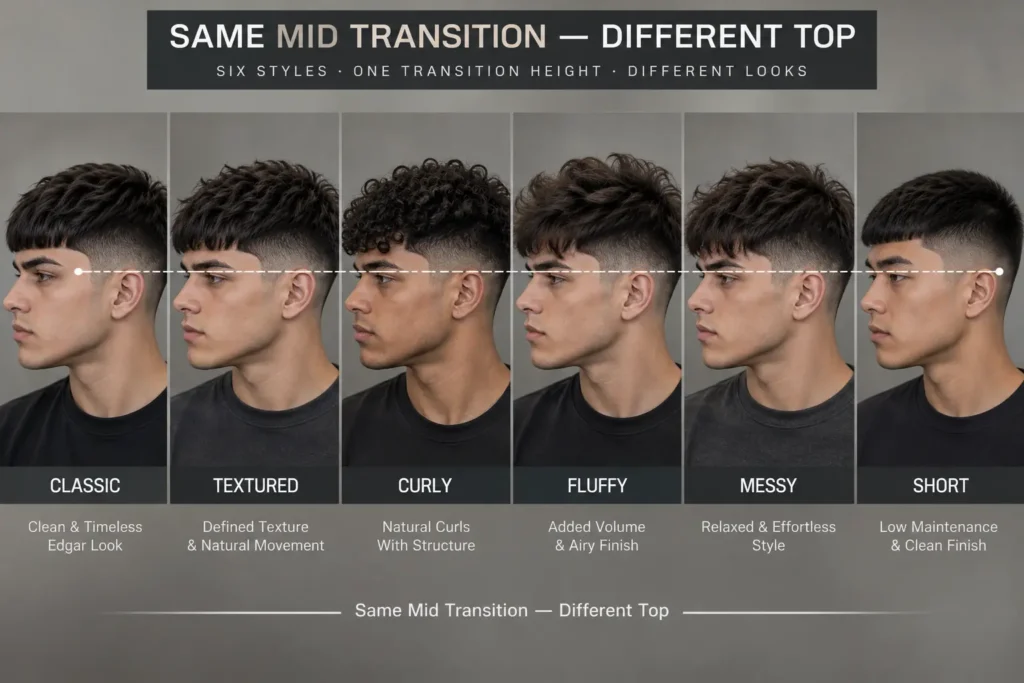
Choosing the transition height does not lock you into one type of Edgar on top.
You can keep the mid placement and change the texture, volume, fringe or overall top length to create a noticeably different result.
Instead of asking which Mid Taper Edgar is universally best, start with the finish you want people to notice.
| If You Want… | Start With… |
|---|---|
| A recognizable traditional Edgar shape | Classic Mid Taper Edgar |
| More visible separation through the top | Textured Mid Taper Edgar |
| Natural curl definition | Curly Mid Taper Edgar |
| More height and airy volume | Fluffy Mid Taper Edgar |
| A relaxed, less controlled finish | Messy Mid Taper Edgar |
| Less top length to manage | Short Mid Taper Edgar |
Classic Mid Taper Edgar
The Classic version keeps the recognizable Edgar structure straightforward: a forward-directed top, defined fringe and a clean transition through the middle of the sides.
It is a useful starting point if you like the Edgar shape itself and do not want texture or extreme volume to become the main feature.
The mid transition adds enough side definition to make the haircut look sharper without taking attention away from the fringe.
Textured Mid Taper Edgar
A Textured Mid Taper Edgar breaks up the top so it looks less solid and compact.
Instead of one heavy surface, individual sections of hair create separation and movement.
The combination works because the mid transition gives the sides structure while the texture prevents the top from looking too rigid.
Ask for texture that suits your actual density rather than requesting maximum thinning. Removing too much weight from the top can make fine hair look weaker instead of more textured.
Curly Mid Taper Edgar
Curly hair changes the relationship between the top and sides because natural volume can make the upper section appear fuller.
A mid transition can create a clean boundary underneath that texture without requiring the curls themselves to be flattened into a straight Edgar shape.
The fringe can remain curly or more controlled depending on the result you want.
If curls are the main reason you are choosing the haircut, use our Curly Edgar Haircut guide for the deeper discussion of curl pattern, length, styling and maintenance.
Fluffy Mid Taper Edgar
Here the sides provide the structure while the top provides the volume.
The Mid Taper Fluffy Edgar works best when the top has enough length and internal movement to lift rather than sitting flat against the head.
Because the transition is already visible, the top does not need exaggerated height to create contrast.
If the fluffy finish is your priority, our Fluffy Edgar Haircut guide explains how to create root lift, forward movement and airy volume without turning the top into uncontrolled puffiness.
Messy Mid Taper Edgar
A messy finish makes the top feel more relaxed while the mid transition keeps the sides deliberate.
The goal is not random hair in every direction. The Edgar should still have a recognizable forward tendency and fringe, even when individual sections are less controlled.
This is a useful option if you dislike a perfectly arranged top but still want the haircut to look structured around the sides.
Short Mid Taper Edgar
You do not need a long, high-volume top to use a mid transition.
A shorter version reduces the amount of daily styling while keeping the visible middle-height transition.
The trade-off is simple: with less length on top, texture and movement become more limited, so the quality of the fringe and side transition becomes more noticeable.
Does Your Hair Change How the Mid Taper Looks?
Yes, but not because one hair type is automatically “right” for a Mid Taper Edgar.
Hair texture and density change how strongly you see the difference between the top and sides.
Straight Hair
Straight hair can make the geometry of an Edgar particularly clear.
The forward direction of the top and the line of the fringe are easy to see, while the mid transition creates a distinct change in length on the sides.
If the hair is very straight and dense, adding some controlled texture on top can prevent the haircut from looking overly solid.
Wavy Hair
Waves introduce natural movement above the structured sides.
That can soften the overall appearance of the haircut while still allowing the mid transition to remain visible underneath.
Rather than fighting every wave, decide whether you want the top controlled or whether some natural movement should remain part of the finished shape.
Curly Hair
Curls usually create more visible volume and shape on top.
That additional fullness can increase the contrast with the shorter sides, so a Mid Taper Fade Edgar on curly hair may appear more dramatic than the same side treatment beneath a flatter top.
This is one reason the reference photo should match your actual hair texture whenever possible.
Fine Hair
With fine or lower-density hair, be careful about removing unnecessary weight.
A very aggressive transition combined with excessive thinning on top can make the haircut look less substantial than intended.
The goal should be useful contrast, not simply removing as much hair as possible.
Thick Hair
Thick hair can make a mid transition especially easy to see because the density above it creates a strong visual change.
Good blending matters here. If too much weight is left directly above the transition, the haircut can develop a visible shelf instead of a smooth connection.
What Will a Mid Taper Do to Your Head Shape?
Transition height can change how the proportions of a haircut appear.
When more hair is preserved on the sides, the head can look visually wider. As more side weight is removed, attention shifts upward toward the top and fringe.
A Mid Taper Edgar sits between those effects.
It can:
- make the side transition more visible;
- reduce some visual width through the middle sides;
- draw more attention toward the fringe and top;
- increase the apparent contrast between top and sides;
- change how much vertical height you notice in the overall silhouette.
That does not mean everyone with a particular face shape should automatically choose the same taper height.
Two people described as having “round” faces can have different hair density, forehead proportions, head shape and preferred top length.
Instead of choosing Mid because a face-shape chart tells you to, ask a more useful question:
Do I want to preserve more visual width at the sides, or remove some of it?
If you want fuller-looking sides, move lower.
If you want stronger side reduction, consider moving higher.
If neither extreme sounds right, Mid is the logical place to start.
Show Your Barber the Height, Not Just the Haircut Name
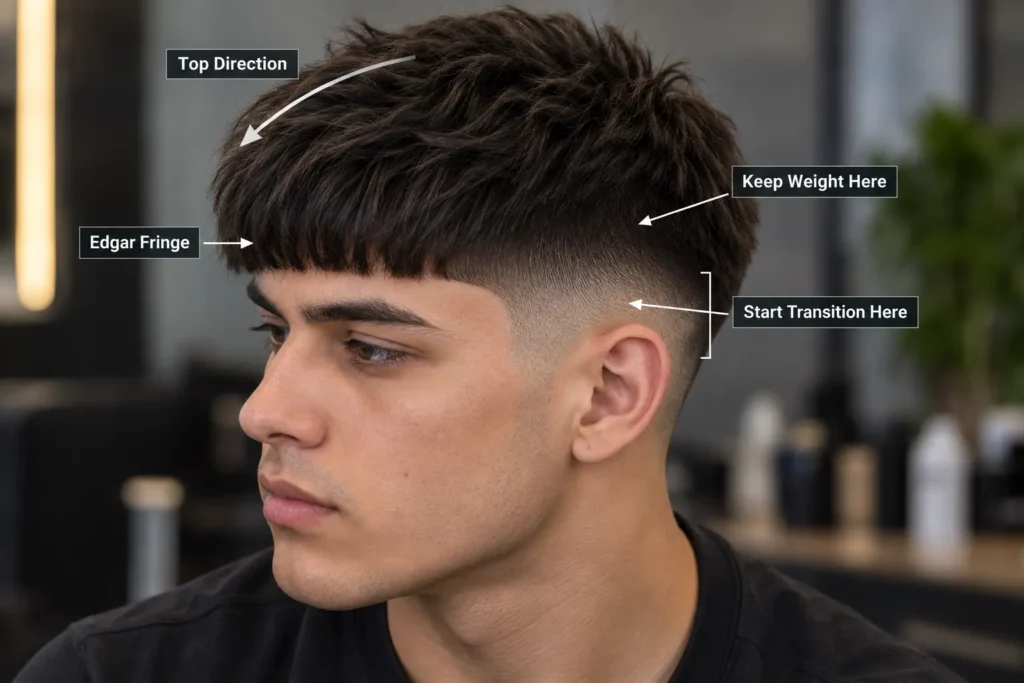
Walking into a barbershop and saying, “Give me a Mid Taper Edgar,” communicates the general direction.
Saying “Mid Taper Fade Edgar” may communicate that you expect a more visible fade, but it still does not settle every detail.
Your barber needs to understand:
- where you want the visible transition to begin;
- how short you want the bottom;
- how much weight should remain above the transition;
- whether the top should be compact, textured, curly or fluffy;
- how much top length you want to keep;
- whether the fringe should be sharp, textured or softer;
- how you want the sideburn and neckline finished.
This is why the side-view reference photo matters so much for a Mid Taper Edgar Haircut.
A front photo can show the fringe beautifully while hiding the exact transition height you are trying to communicate.
Bring at least one clear side view.
If possible, choose a reference with hair texture and density reasonably similar to your own. A transition that looks subtle beneath fine straight hair can appear very different beneath a thick curly top.
When showing the photo, point to the transition and explain what you like about it.
For example:
“I want the transition around this height, but I want to keep this amount of weight above it.”
That is much more precise than relying on the haircut name alone.
The 30-Second Barber Brief
You do not need to deliver a technical lecture from the barber chair.
Once you have a suitable reference photo, keep the request simple:
“I want an Edgar with the transition around the middle of the sides. Keep enough weight above it so the top doesn’t look disconnected. Keep the fringe forward and defined, and don’t take the bottom to skin unless it matches this reference.”
Then show your barber the front and side views you saved.
If you specifically want the closer appearance commonly shown in Mid Taper Fade Edgar Haircut references, say that while pointing to the side of the photo. Do not assume the word “fade” alone communicates the exact shortest length you want.
If you want something different on top, add that one detail:
“Keep the top textured.”
or
“I want more fluffy volume on top.”
or
“Keep my natural curls visible.”
The clearer the visual reference, the less you need to depend on terminology.
When a Mid Taper Goes Wrong, It’s Usually One of These Three Things
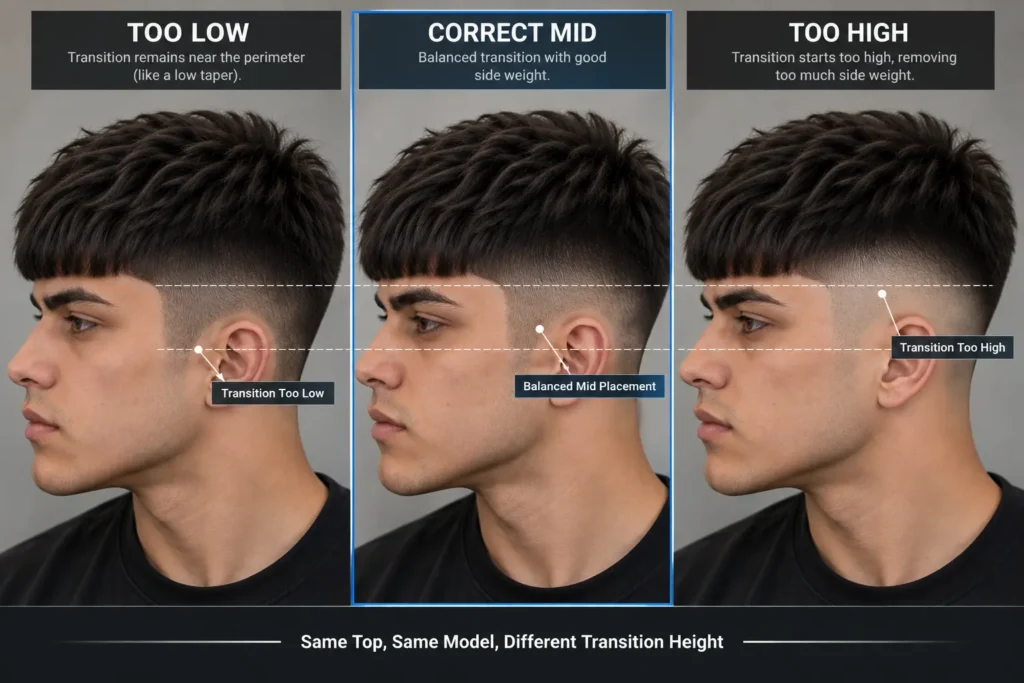
A Mid Taper Edgar can be technically clean and still miss the look you wanted.
Most problems come back to placement and weight.
1. The Transition Is Too Low
If most of the shortening stays close to the sideburn and lower edge of the haircut, the result may read more like a Low Taper Edgar.
That is not a bad haircut. It is simply a different balance.
You will keep more darkness and fullness through the sides, while the transition itself becomes less noticeable.
If you specifically chose Mid because you wanted visible side definition, this can leave the finished cut feeling too subtle.
2. The Transition Is Too High
The opposite problem happens when the transition climbs farther up the side than intended.
More side weight disappears, the contrast becomes stronger and the top begins to look increasingly separated from the sides.
Again, that can be an excellent look if stronger contrast is the goal.
But if you asked for Mid because you wanted the middle ground, moving too high changes the character of the haircut.
3. Too Much Weight Is Removed Above the Transition
Correct height alone does not guarantee a balanced result.
If too much hair is removed above the transition, the top can look disconnected even though the transition technically began in the middle zone.
This becomes particularly important with a closer Mid Taper Fade Edgar, where stronger fading can make the difference between the shorter sides and longer top more obvious.
The haircut needs enough remaining structure to connect the Edgar top with the shorter area underneath.
This is why transition height and preserved weight should be discussed together.
A useful reference photo should show both.
What Will Your Mid Taper Look Like After a Few Weeks?
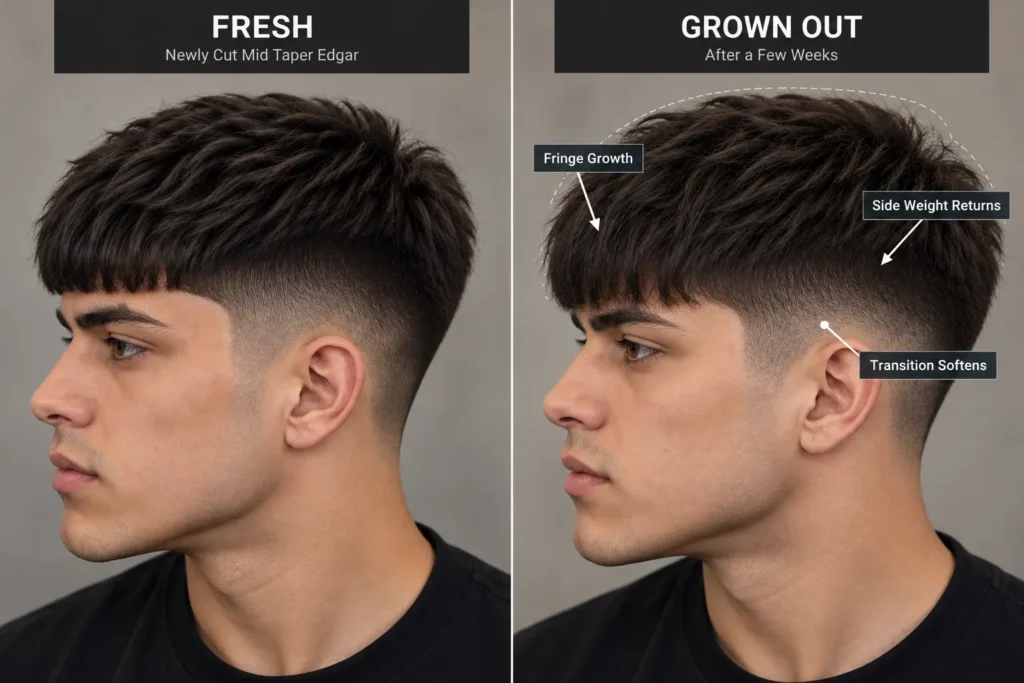
A fresh Mid Taper Edgar makes the transition easy to see because the difference between shorter and longer areas is crisp.
As the hair grows, that difference gradually softens.
The first changes you may notice are:
The transition becomes less defined.
Shorter hairs begin filling the visual gap between the bottom and fuller area above.
Side weight returns.
The sides start looking darker and fuller, reducing the contrast that originally made the mid placement obvious.
The outline loses some sharpness.
Sideburn and neckline growth can make the haircut feel less finished even when the top still looks good.
The fringe gets longer.
Because the fringe is such an important part of the Edgar shape, extra length at the front can change the haircut even before the sides feel completely grown out.
A closer Mid Taper Fade Edgar may show the loss of contrast particularly clearly as the shortest areas grow back in, while a softer taper can grow out less dramatically.
There is no single maintenance interval that works for everyone.
Someone who wants a very crisp transition will notice growth sooner than someone comfortable with a softer finish. Hair growth rate, shortest length, density and the amount of contrast in the original cut all affect how quickly the change becomes visible.
Instead of cutting your hair according to an arbitrary number of days, look at the features that made you choose Mid in the first place.
When the transition is no longer visible enough for the look you want—or the fringe and side weight have changed the balance—it is time for cleanup.
Mid Taper Edgar FAQs
Is a Mid Taper Edgar the same as a Mid Taper Fade Edgar?
Not always.
Both can describe an Edgar with a transition positioned around the middle region of the sides, but adding “fade” often suggests a more obvious or closer blended finish.
Because barber terminology varies, the safest approach is to show the transition height and finish you want rather than assuming both names guarantee exactly the same result.
Is a Mid Taper Edgar the same as a Mid Fade Edgar?
Not necessarily. “Mid” mainly describes the general height of the transition. A fade may imply a more continuous or closer transition through the sides, while a taper can preserve more weight depending on how it is executed.
Show your barber the actual result you want rather than relying only on the name.
Does a Mid Taper Fade Edgar have to go down to skin?
No. Adding “fade” does not mean you must automatically choose a skin or bald finish.
Tell your barber how close you want the shortest area, and use a reference image that clearly shows it.
Is a Mid Taper more noticeable than a Low Taper Edgar?
Usually, yes. Moving the transition upward makes more of the side change visible and generally creates stronger contrast.
A Low Taper Edgar normally preserves more side weight and keeps the shortening closer to the lower perimeter.
Can you get a Mid Taper Edgar with curly hair?
Yes. The mid transition can work underneath curly hair, but natural curl volume can make the top-to-side contrast appear stronger.
Preserve enough length for your curl pattern and avoid treating the curly top as if it were straight hair.
Can you get a Mid Taper Edgar with a fluffy top?
Yes. A fluffy top and mid transition control different parts of the haircut.
The fluffy finish creates volume and movement above, while the mid taper determines where the shorter side transition sits.
Can a Mid Taper Edgar have a softer fringe?
Yes. The fringe does not have to be an extremely hard, perfectly straight line.
It can be textured or slightly softer while still keeping the forward shape associated with an Edgar.
Should I show my barber a front or side photo?
Ideally, show both.
The front view communicates the fringe and overall top shape, while the side view is much better for showing the transition height, fade finish and how much side weight you want preserved.
Low, Mid or High? Make the Final Call
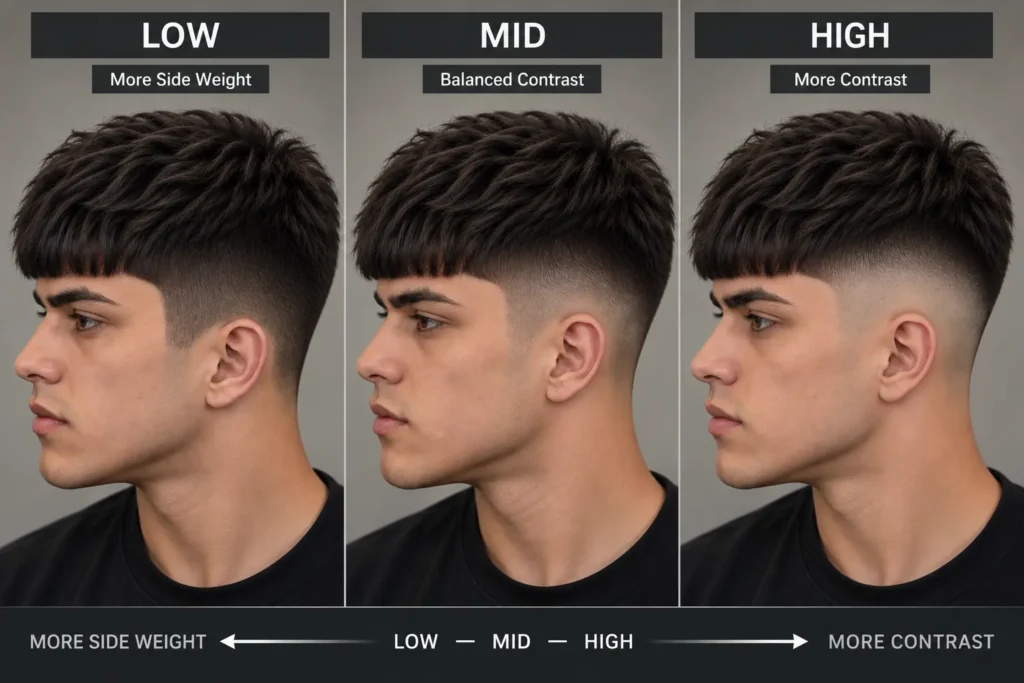
If you are still deciding between transition heights, do not choose according to which name sounds best.
Choose according to what you want the sides to do.
| Choose | If Your Priority Is… |
|---|---|
| Low Taper Edgar | Preserving more side weight and keeping the transition subtle |
| Mid Taper Edgar | Creating a noticeable but balanced transition |
| High Taper Edgar | Increasing contrast and exposing more of the sides |
Want the sides to stay fuller? Start with Low.
Want the transition clearly visible without making it the most aggressive feature? Mid is likely the better starting point.
Want the same general middle placement but a more pronounced faded finish? Use a Mid Taper Fade Edgar reference and show your barber exactly how close you want the sides.
Want stronger separation between the top and sides? Consider High.
If Mid sounds closest to what you want, don’t obsess over the name. Save a front view you like, save a side view that clearly shows the transition height and finish, and use both when you sit in the barber’s chair.